· 27 min read
How do you coordinate coach seats with admission at the destination?
Your coach company has a vehicle available. The attraction has tickets left. You're ready to put the trip on sale, until you discover those tickets are for a different entry time, the group rate excludes the date you chose, or the coach park needs its own reservation.
For a coach trip with attraction admission, confirm the vehicle places, the correct admissions and the arrival arrangements together. Set your sales limits and deadlines from those agreements. A seat becomes saleable when you can deliver everything attached to it.
That sounds obvious when you're looking at one booking. It gets harder when adults and children pay different prices, the host needs admission too, and customers keep changing their plans. The useful question is whether the next booking still fits both suppliers' current commitments. An empty seat alone doesn't answer it.
We'll follow a fictional day trip to a heritage attraction, including a mixed passenger group, a supplier deadline and a late request to add a family. All example quantities, prices and timings are invented. Money examples use USD and aren't supplier quotes, recommended capacities or industry benchmarks. Actual vehicle arrangements, access requirements and applicable rules need checking for your trip.
Start with the visit your customer is buying
Write the offer as a customer would understand it. Does the ticket include return transport and admission to the whole attraction, or just a garden? Is a guided activity included? Can passengers explore independently, and when do they need to return? Those answers decide which resources you have to secure.
For our fictional departure, one ticket includes return coach travel, a host and entry to a house and garden at 10:30. Lunch is the customer's own purchase. The visit has a published return meeting time. Everyone travelling, including young children, has an allocated passenger place under the arrangement confirmed with the coach operator.
Now consider a cheaper garden-only admission. It might be perfectly good for a different trip, but it cannot fulfil a house-and-garden ticket you've already sold. Keep the attraction's exact product name and date on your booking record. A general note saying "entry included" leaves too much room for the wrong purchase.
Ask about extras before mentioning them in your advertising. Audio guides, an introductory talk, group dining and special exhibitions may need separate arrangements. If an optional extra can sell out independently, explain its availability and secure it through the appropriate process. Don't let an attractive description promise something your supplier hasn't accepted.
The attraction also needs to know you're bringing a commercial coach group. Chatsworth's group-visit information says coaches must have a pre-booked visit and describes timed house entry. Its published arrangements distinguish admission products, seasons and dates when group rates aren't available. Those are Chatsworth's conditions, checked in October 2026, rather than rules for every destination. They show why buying ordinary admission and assuming the coach will be welcomed can fail.
Keep the scope of the business clear too. This guide concerns a paid day trip, with transport hired from a suitable operator. If you're organizing visits for schools, our school group bookings guide develops the educational programme, school payment and supervision arrangements. Here, we're matching your customers' trip bookings with commitments to two suppliers.
Ask both suppliers about the same itinerary
Use one proposed itinerary for the coach company and attraction. It should name the departure date, pickup route, expected group, destination arrival, entry time and return arrangements. If one supplier works from an earlier version, their confirmation can be accurate while the whole trip is impossible.
The coach operator needs the actual loading location and destination instructions, including any approach restrictions. The attraction needs your likely passenger breakdown and the time the coach will reach its entrance. A 10:30 admission isn't automatically permission to arrive at the coach gate at 10:30 with everyone still seated.
Explain what remains provisional. You may be asking for an initial allocation while judging demand, rather than confirming the maximum group. Ask whether the supplier offers that arrangement, how long it lasts and what commitment it creates. If no places are held, record that plainly.
You can adapt this enquiry for the destination:
We propose to bring one coach on [date], arriving at [coach entrance] around [time], for [specific admission product] at [entry time].
Please confirm the maximum visitor allocation available to us, including how hosts, children, infants and accompanying carers are counted.
Please confirm the category definitions, any evidence needed and the charge for each category. Tell us whether the group price depends on a minimum number or a particular date.
Do coach access, parking, unloading or collection need separate bookings? Please identify the references and instructions we will need.
Can you hold this allocation while we sell? Please state the expiry, payment dates, final-number deadline, amendment conditions and what confirms the reservation.
Please explain late-arrival arrangements, cancellations and whom our host should contact on the day.
Replace the placeholders before sending it, and include access questions relevant to the intended trip. The enquiry is a starting point for a proper supplier conversation. It doesn't establish permission, a contract or a suitable passenger arrangement by itself.
When the reply arrives, check the details against the itinerary. An enthusiastic "we'd love to welcome you" can precede a booking form, payment or availability check. Ask which step secures the allocation and complete it before describing the visit as confirmed to customers.
Keep the supplier's own reference. Your departure reference connects your records; their reference lets their staff find the booking. You need both when a host calls from the coach entrance with a queue forming behind them.
Work out how many complete places you can sell
Confirm the actual vehicle layout with the coach operator. An advertised vehicle size isn't enough if staff places, luggage or an agreed accessible configuration change what is available for this departure. Let the operator establish the appropriate vehicle and seating arrangements. Don't guess a standard deduction for a wheelchair position or assume every substitute coach has the same layout.
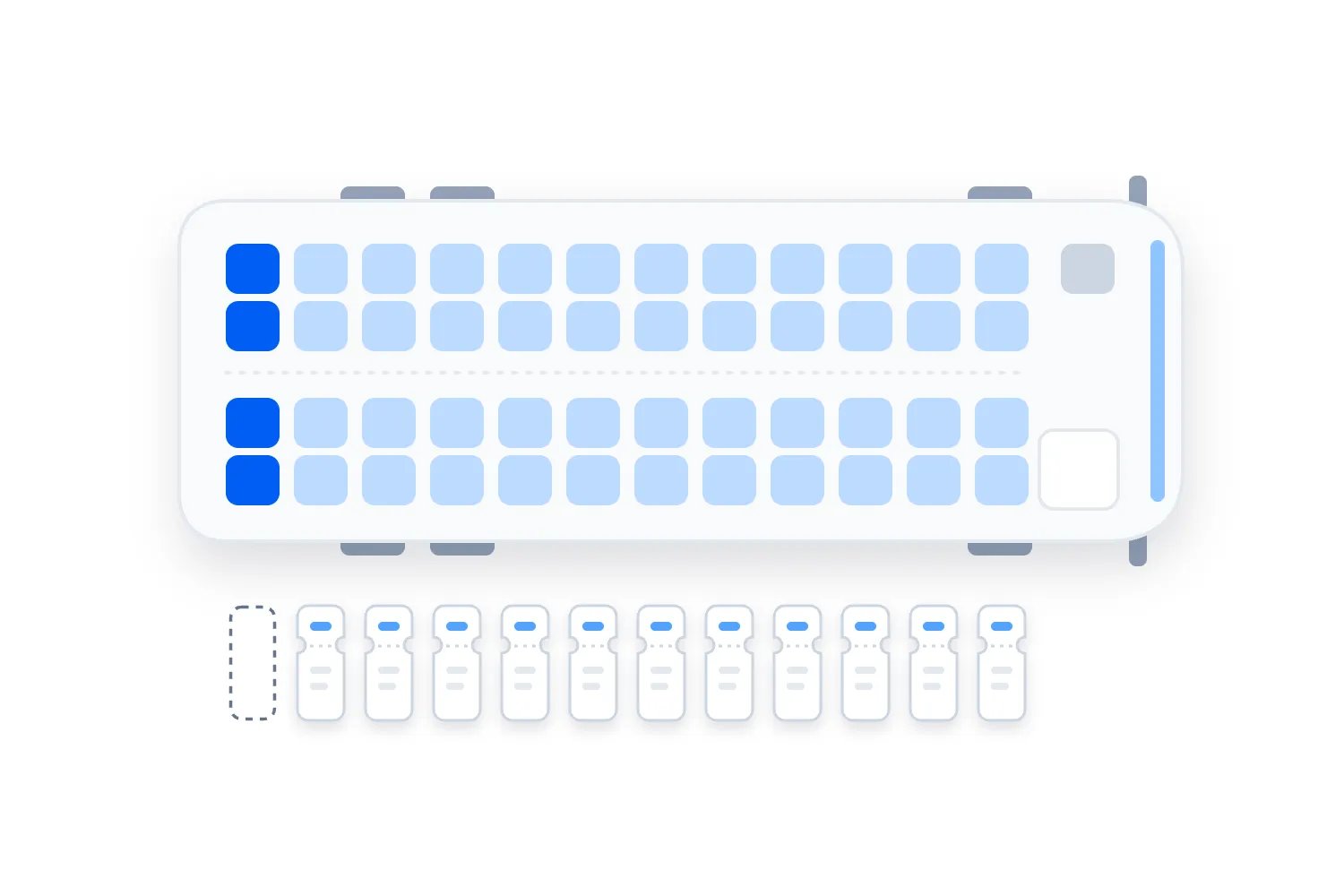
In our fictional example, the confirmed vehicle has 50 passenger places. One is allocated to the host, and the organiser keeps one unsold as an operating spare. There are therefore 48 places potentially available to customers. The driver has a separate driving position and isn't included in those 50 passenger places.
The attraction confirms an allocation of 45 visitors at 10:30. That includes the host, even though the attraction admits the host free under this particular agreement. The destination allocation therefore accommodates 44 customers and the host. The coach could carry more customers, but the combined trip cannot currently be sold to more than 44.
At that limit, 44 customers plus the host occupy 45 passenger places. Five passenger places remain empty, including the operating spare. Four of those empty places reflect the destination limit. They aren't four additional complete trips waiting to be sold.
This calculation assumes all the other requirements are satisfied, including the agreed coach arrival and any essential activity capacity. If the main selling point is a guided visit with fewer places than general admission, the guided visit can become the limit. Find out before setting the public quantity.
Keep complimentary customers in the count. An organiser's guest may produce no ticket revenue while using a coach place and a chargeable attraction admission. Giving that place away changes both availability and the budget. A zero ticket price doesn't make the person disappear from either supplier's requirements.
If a customer needs an access arrangement that affects the vehicle or destination route, work through it with both providers before confirming how the visit will operate. An accessible coach doesn't establish that the attraction's booked entrance is suitable, and an accessible attraction doesn't establish that the vehicle can deliver the customer there. Describe the actual arrangements you can provide and obtain competent advice where needed. The number of places you can sell must reflect the approved plan, with the customer treated fairly throughout the process.
Separate customers who make their own way to the attraction if you offer that option. They may use destination capacity without using your coach. Conversely, a transport-only passenger uses the vehicle without necessarily needing admission. Only sell these variations when your supplier agreements and customer descriptions support them, with quantities that preserve the complete trips already promised.
Match passenger categories before setting ticket types
Your coach company, attraction and ticket page may classify people differently. A child can require a coach place while qualifying for discounted destination admission. An infant admitted free may still need to be declared to the attraction. A host's free admission may require a specific booking category or evidence.
Write down what each customer type consumes. In our example, an adult trip uses one customer coach place and one adult admission. A child trip uses one customer coach place and one child admission. The host uses one passenger place and one visitor place but generates no customer sale. That is the basis for checking quantities and costs.
Use the attraction's actual age definitions. If eligibility depends on age on the visit date, say that where buyers choose tickets. Don't copy the age bands from a previous destination. A family booking for a birthday week can otherwise select a category that won't be valid when they arrive.
Clarify accompanying-carer arrangements privately where needed. Free admission, eligibility evidence, reserved places and the practical access route are separate questions. Check what the attraction requires and what your business must provide under applicable rules. Avoid making a customer repeat unnecessary personal information to every member of staff.
Our fictional 44-customer group contains 30 adults and 14 children. Together with the host, that is 45 people entering. The attraction has confirmed that breakdown within the allocation. Those figures don't suggest a supervision ratio or a recommended mix; they're simply the bookings in this example.
Now a customer wants to replace one child booking with an adult. The overall group stays at 44, but the destination breakdown becomes 31 adults and 13 children. You still need approval under the attraction's amendment conditions, an accurate charge and a corrected customer ticket. An unchanged headcount doesn't prove the change is valid.
Family bundles need the same attention. A bundle covering two adults and two children represents four coach places and four admissions, even if purchased in one order. Test how your chosen selling setup counts the people in that bundle. Staff need passenger quantities, not just a total number of orders or bundles sold.
Where category quotas share an overall limit, confirm the setup really enforces that limit. Separate adult and child quantities can add up to more than you can deliver. If the selling system cannot represent the approved allocation, simplify the offer or use a supported booking process that can. Customer checkout shouldn't create commitments that somebody has to unwind later.
Keep reservations and paid commitments visible
Use clear descriptions for the supplier position. You might have an enquiry awaiting a reply, a temporary allocation with an expiry, or a confirmed booking subject to agreed payment terms. These describe different levels of certainty. A paid deposit also needs context: what exactly does it secure?
Record the confirmed quantity, category breakdown, admission product, date and time against the destination reference. Alongside it, record the coach reference, vehicle arrangements and itinerary version. Give one person responsibility for checking that changes reach both suppliers when necessary.
There may also be a separate arrival commitment. Historic Environment Scotland's groups and travel-trade FAQs explain that selected properties require a coach-space booking and that entry cannot be guaranteed without it, even where admission tickets have been reserved. The same page distinguishes ticket-delivery arrangements with different amendment conditions. Check the terms for your booking method and property; a familiar destination name doesn't guarantee a familiar process.
If you sell through your website, by telephone and through partners, count those sales against the same agreed departure allocation. A partner's reservation still uses places while held under your agreement. Decide when unconfirmed partner allocations return to general sale, and make the release explicit.
Set a handover process for staff absences. The person covering bookings needs to see which quantities are confirmed and which requests remain unanswered. They shouldn't infer availability from a customer count without checking supplier commitments and pending changes.
Don't treat an expected no-show as an available admission or seat. Until a cancellation or release has been confirmed through the right process, that customer can still arrive expecting the trip. Selling against your expectation creates a problem precisely when everyone turns up.
A departure record staff can use
Keep a short current record of the commitments for each departure. You can use the following fields in the booking tools your team already works with. Link the supplier confirmations rather than copying entire agreements into every staff briefing.
Departure reference and date, customer-facing trip name, admission product and current itinerary version.
Responsible booking manager and cover contact, with the person authorized to approve additional spending.
Coach supplier and booking reference, confirmed passenger layout, host places, withheld places and customer limit.
Destination supplier and booking reference, confirmed visitor allocation, host treatment and current adult-and-child breakdown.
Any separate arrival, parking, guide or activity reservation, with its reference and restrictions.
Temporary-allocation expiry, confirmation action, payment dates, final-number deadline and internal review dates.
Customer places sold, partner places still held, pending requests and complete places available for sale.
Current supplier acknowledgement, admission-document location and unresolved issue with a named owner.
For the original fictional departure, the coach customer limit reads 48 and the destination customer limit reads 44. The public combined-trip limit reads 44. At sellout, the breakdown reads 30 adults, 14 children and one host. If someone looks only at the vehicle section, the combined-trip limit still needs to be obvious before they approve another sale.
Keep a separate change history so a current record doesn't erase how you reached the agreement. An entry might say that an additional family was requested, destination approval is pending and no customer confirmation has been sent. After approval, record the new supplier reference or acknowledgement and revise the current quantities. Staff should be able to distinguish the current commitment from a proposal without interpreting a long email thread.
Where your existing system already records ticket sales and customer details reliably, use that information. The departure record's purpose is to connect those sales with supplier commitments and decisions. Re-entering every order into another file creates a second place that can become out of date.
Set your deadlines before the suppliers' deadlines
Read the coach and attraction terms together. Identify when each temporary allocation expires, when money becomes payable and when quantities become harder or impossible to reduce. Then schedule your own decisions early enough to act. Matching your cutoff to the supplier's final minute leaves no time to check discrepancies.
For illustration, our fictional attraction holds the allocation until noon 21 days before departure. It requires payment and the agreed final breakdown by noon seven days before departure. The coach company also needs confirmation of the itinerary. These are invented terms for our example, not standard booking windows.
The organiser sets an internal review 23 days before departure, before the attraction hold expires. They then choose an ordinary customer-change cutoff nine days before departure, allowing time to reconcile the list and obtain supplier acknowledgements before the seven-day deadline. Urgent later requests go through the named booking manager.
That review needs more than a sales total. Check whether proceeding is affordable at the current mix, what additional money must be committed, what cancellation would cost and what customers have been promised. A deadline is useful because it triggers a decision while options remain available.
Supplier payment dates vary. Royal Collection Trust's Buckingham Palace group information requires timed advance booking and describes payment 30 days before a pre-booked visit, or at booking within that period. Chatsworth's published group arrangements describe final numbers and payment on arrival. Neither establishes the terms for another attraction. Build the actual dates into your plan rather than carrying forward last month's calendar.
If a supplier agrees an extension, ask for confirmation of what has changed. An extra week to pay may not extend the allocation, preserve the rate or allow additional visitors. Update only the conditions the supplier has actually accepted, then tell the staff responsible for selling and payment.
Check working days and office hours. An amendment sent late on Friday may not receive a reply before a weekend departure. Have a usable escalation contact for time-sensitive questions, and avoid promising instant approval to customers when the supplier isn't available to provide it.
Deal with a hold that expires before sales close
Suppose the attraction will confirm only the quantity you've sold when its temporary allocation expires. You may decide to commit to more admissions at your own commercial risk, reduce the public sales limit to the confirmed quantity or close sales while requesting a new allocation. Work out which choices the supplier actually offers and what each would cost. Continuing to advertise the original quantity without holding it leaves the customer buying your hope that more tickets will appear.
If you release unused admissions, update the sales limit before those places return to the attraction. A later customer cancellation doesn't restore the places you released earlier. You still need a valid admission for any replacement sale, at a usable time and under the relevant transfer conditions.
For a series of departures, keep each date separate. Ten unused admissions on Saturday don't cover ten excess sales on Sunday unless the attraction explicitly permits that move. The same applies to borrowing places from another entry time. Check the destination's calendar before promoting a new departure, including closures or restrictions described in our blackout-date planning guide.
Price the admission agreement you actually have
The destination's unit price only tells part of the story. Check minimum charges, committed quantities, staff admissions and whether unused tickets can be returned. If you must pay for an allocation regardless of sales, those empty places still cost money.
Here's the admission bill for our fictional 44-customer group. Adult admissions cost an invented $24 each, child admissions $14, and the host's admission is free under the agreed arrangement. Thirty adults cost $720, and 14 children cost $196. The total is $916. These are planning figures only, with no additional admission tax assumed in this simplified example.
Now compare two hypothetical agreements at a smaller turnout of 24 adults and 12 children. Paying only for those admissions would cost $576 plus $168, or $744. If you had instead guaranteed the original 30-adult and 14-child allocation with no reduction permitted, the bill would remain $916. The difference is $172.
That comparison changes only the admission arrangement. It isn't the trip's profit calculation. Include the coach, host, administration, marketing, selling charges and other costs before deciding whether the smaller departure works. Keep deposits credited against the final supplier bill so you don't count the same purchase twice.
Price mixed categories individually. A cheaper child fare may leave less towards the coach bill even though it uses the same passenger place. If your forecast depends on a particular adult-and-child mix, test a different mix before offering broad discounts. The full departure must still pay under a plausible booking pattern.
Keep money collected separate from money available. Supplier payment might fall before ticket receipts reach your account, and some receipts may need to remain available for customer remedies. Ask your accountant about the tax treatment of the actual trip. A profitable forecast won't pay an invoice if the cash isn't there on the due date.
Set up checkout around the confirmed offer
Once suppliers have confirmed the arrangements, make the sales page agree with them. Show the destination product, date, important age definitions, return travel, inclusions and anything customers must buy separately. Explain whether the departure is confirmed or depends on a stated decision process.
Use ticket types people can choose correctly. "Adult return travel and house-and-garden entry" tells the customer more than "standard package A". Keep operational supplier codes in your records, while the public description explains what the ticket delivers.
Loopyah's ticket-selling tools support ticket types and releases with their own prices and quantities, and confirmation emails link to QR tickets. Use those quantities to sell within the allocation you've confirmed. Your team still needs to obtain destination approval and reconcile the supplier booking whenever its requirements change.
Test the shared limit and every category before launch. Try a mixed-family order, the last available place and a booking through another sales route. Check what happens when an abandoned order, a refund or a manual amendment affects availability. Use your platform's supported controls and confirm the result rather than assuming a label enforces a rule.
The QR ticket issued for your departure isn't automatically the attraction's admission credential. Confirm whether the attraction wants its own individual tickets, a group voucher or a host-led check-in. Tell customers which document to present at each stage so they don't queue at the gate with the wrong code.
Collect the details required to deliver the visit, and provide a private route for assistance questions. Under the UK framework, the ICO's data-minimisation guidance says personal information should be adequate, relevant and limited to what is necessary. Establish the applicable privacy arrangements for your business before passing passenger details to suppliers. A category total may be enough where a full named customer list isn't required.
Build the arrival plan backwards from entry
Confirm what the attraction's entry time refers to. Is it arrival at the estate, reporting at the group desk or passing through the house entrance? Ask how long unloading, walking, toilets and admission checks usually require for your particular group. Use the attraction's advice and an appropriate route check to plan those stages.
Our fictional attraction expects the group at its house entrance at 10:30. The agreed plan targets the coach gate at 09:50. Unloading and regrouping take an illustrative 15 minutes, followed by 15 minutes to reach the entrance and complete the group check. That has the group ready at 10:20, with ten minutes before entry.
The coach operator plans the road journey to support the 09:50 target, with suitable allowance for conditions. Our 40-minute interval is an example for this invented visit. It isn't a recommended buffer, and a group with different access requirements could need a different arrangement.
Have the operator approve the whole itinerary, including driver requirements and the return. In Great Britain, DVSA's bus and coach drivers' hours guidance distinguishes driving, other work, breaks and rest. An attraction visit isn't automatically the driver's break if they are still doing other work. Agree staffing and a compliant schedule for the actual operation.
If the attraction offers to split the group into two entry times, work through the customer experience before agreeing. Who accompanies each group? Where does the other group wait? Can everyone still receive the promised visit length and make the return? Extra admissions at a later time may be unusable if the coach cannot stay.
Our timed-entry late-arrivals guide explains how attractions can set admission policies. As the visiting operator, obtain this destination's actual policy and contact route. Don't promise that a group will be squeezed into the next slot merely because that happened on a previous trip.
Approve changes across the whole booking
Make one person responsible for confirming customer changes, with cover when they're absent. Other staff can receive requests, but they should distinguish a request from an approved change. Keep the current customer list and supplier references available to the person making the decision.
Consider a late request to add two adults and two children to our fictional departure. There are four additional customer places on the coach, but the 44-customer attraction allocation is already full. The request cannot be confirmed on the strength of the coach count.
Ask the attraction whether it can increase the allocation to 49 people, including the host, at the same usable entry time. The requested customer breakdown becomes 32 adults and 16 children. If confirmed, there would be 48 customers plus the host on the coach, leaving only the operating spare empty.
The attraction charge would become $768 for adults plus $224 for children, totalling $992 under the invented prices. That's $76 above the original $916. The family must also pay the applicable trip fares, and your team must check every other affected condition before confirming their booking.
If the attraction can only offer the family a later slot, explain the proposed change and assess whether you can deliver it. Don't quietly split a family from the advertised group experience. You may need to decline the request even though the coach has empty seats.
Handle substitutions with equal care. A new passenger might change the category, assistance arrangement or eligibility evidence. Check whether the supplier permits the transfer and whether a new credential is needed. Update the old passenger's status so both people can't arrive holding apparently valid confirmations.
For each approved change, record what was requested, who approved it, the supplier acknowledgement, financial adjustment and customer message. Use a clear current version for staff. If approval is still pending, keep it pending in the record and tell the customer when they can expect an answer.
Treat cancellations as separate customer and supplier decisions
A customer cancellation affects the trip record, the money due to the customer and your supplier purchases. Those won't necessarily change together. Removing a passenger from your list doesn't cancel an attraction ticket or recover a supplier payment.
Check the reason and apply the terms and law governing your sale. A customer choosing not to travel, your business cancelling the departure and the attraction closing can require different responses. Your supplier's refusal to refund you doesn't, by itself, establish what you owe a customer.
For a separate cost example, return to the original booking of 30 adults and 14 children. Suppose two children cancel after you've committed to that allocation, and the attraction won't reduce the bill under the agreement. There are now 42 customers expected instead of 44, but admission cost remains $916. The two unused child admissions represent $28 within that bill. Only reduce the supplier cost if the supplier agrees a reduction. A permitted resale can bring in replacement revenue, but it doesn't reduce that bill.
You might be able to resell the complete places. Check the category, transfer permission, entry validity and current customer obligations first. A waiting customer seeking adult admission cannot necessarily use a child ticket just because there is room on the coach.
Before selling, have the commercial and legal arrangement checked for the location and services involved. In England, Scotland and Wales, Business Companion's package-travel guidance explains the exclusion for arrangements lasting less than 24 hours without overnight accommodation. That exclusion concerns those regulations. It doesn't settle your other consumer, transport or insurance obligations, and adding accommodation changes what needs review.
Make the cancellation process usable. State how customers contact you and who can approve a refund, credit or transfer. Keep the response and accounting outcome together. A considerate phone call followed by an unchanged ticket and unresolved payment can leave the next staff member unable to explain what was agreed.
Give the host a workable admission handover
Before departure, reconcile the passenger record with the destination booking. Check people and categories, the admission product, entry time, payment status, access arrangements and required credentials. Include the host in the destination total wherever the attraction requires it.
Prepare the information the host will actually use. They need the destination reference, coach-gate instructions, reporting location, group quantities, admission documents and monitored contacts. Keep payment records and unnecessary personal details out of the general briefing, while making essential restricted information available to the responsible staff.
Establish who talks to the admission desk and who stays with the group. If the host must leave the coach to collect tickets, the driver shouldn't unexpectedly become responsible for every customer question. Agree suitable staffing for that handover before travel.
At boarding, record the people actually travelling. If someone doesn't arrive, inform the destination where its process requires it, but don't assume that this changes the bill. The attraction may still charge the committed quantity, and the absent customer may have made a separate arrangement that needs clarification.
At the destination, match the documents and actual group to the admission being delivered. If individual attraction tickets are issued, distribute them according to the agreed categories and explain whether customers need to retain them. If entry uses one group voucher, tell people to stay with the host until that process is complete.
Make the return instructions clear before customers disperse. The return meeting point may differ from the arrival entrance, and coach parking may be elsewhere. Keep the agreed contact available during the visit so an admission problem or changed return arrangement can reach someone able to act.
Decide what happens when the visit changes
Agree an escalation process for delay before the journey. The host should tell the attraction about a material change in expected arrival, using the monitored contact and booking reference. The booking manager needs authority to discuss alternatives and associated costs. Ask the driver for current information without pressuring them to recover time unsafely.
Suppose our fictional coach reaches the gate at 10:15 instead of 09:50. If the planned 30 minutes for unloading, walking and checks remain necessary, the group would be ready at 10:45. That is 15 minutes after the 10:30 admission. The original ten-minute margin has been exceeded; it cannot be recovered by describing the gate arrival as on time.
Contact the attraction before arrival where possible. Find out what it can actually offer, whether the whole group can enter and what the change means for the visit. Then check the return schedule with the coach operator. A later slot may shorten the visit or conflict with the agreed operating day.
Separate a temporary delay from an attraction closure or a missing booked service. Customers should receive a clear explanation of what has changed, available options and how the relevant financial decision will be handled. Don't declare an alternative equivalent solely because it costs you the same amount.
For example, garden-only entry would change our house-and-garden offer. Even if the garden has plenty of capacity, the reason some customers bought the trip may no longer be available. The responsible manager needs to address the actual promise and applicable rights rather than instructing the host to call it an upgrade.
Record the facts and the customer's choice where relevant. Keep supplier explanations, additional costs and approved remedies. That gives you something concrete to use when resolving the issue afterwards and helps distinguish a service failure from an ordinary change of preference.
Close the departure against what you delivered
After the visit, compare the sold tickets, actual passengers, attraction admissions and supplier invoices. Explain any difference. A committed but unused admission belongs in the cost record, while an approved supplier credit belongs against the relevant purchase.
Check the host's report before accepting an unexpected charge. Additional visitors, category changes, parking and late departure can create separate items, but each needs to match what was agreed or delivered. Raise discrepancies through the supplier's process within its deadline. Don't let a small unresolved difference repeat across every departure.
Review the time spent managing the booking too. If staff regularly chase category corrections or manually resolve a confusing ticket choice, improve the next offer. If the attraction's deadline repeatedly arrives before useful sales evidence, negotiate a different allocation arrangement or choose a trip you can commit to responsibly.
Before opening the next departure, test one complete customer journey. Try a mixed-family purchase, a category change, the final available place and a late arrival. Follow each through the sales limit, supplier record, customer confirmation and host's instructions. Wherever the answer depends on an unanswered email or a quantity nobody owns, resolve it before collecting the next payment.

Author: By the Loopyah Content Team
The Loopyah Content Team shares expert insights, practical guides, and industry updates to help event organizers create unforgettable experiences and stay ahead in the event planning world.