· 21 min read
Family tickets: how to define admission and avoid confusion
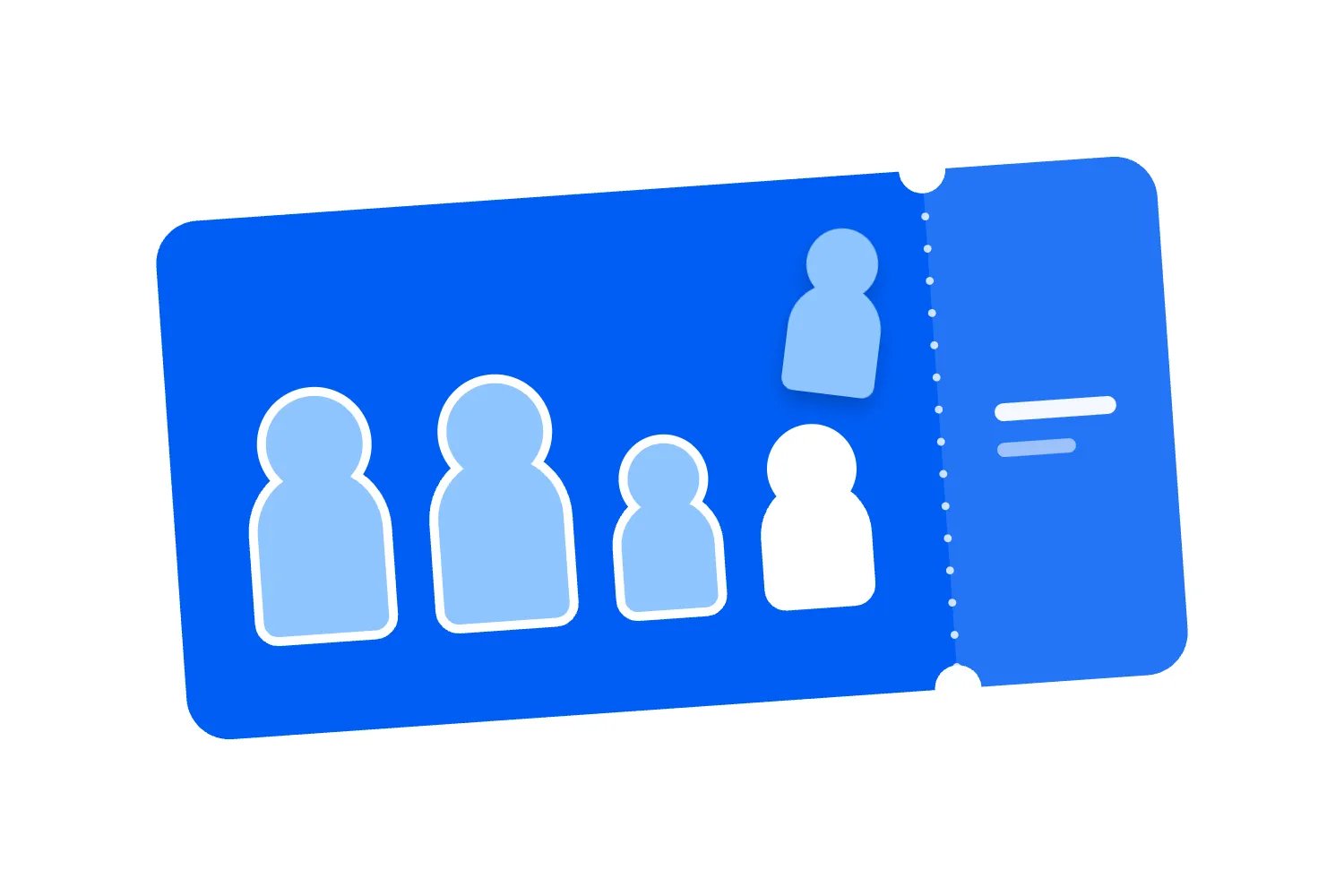
Family tickets should tell buyers exactly who can enter, how many people the booking covers, which ages qualify and how the group arrives. Define those rules before setting the price, then carry the same explanation through your event page, checkout, confirmation email and door briefing.
So you're selling tickets for a show, exhibition or festival that welcomes children. You add a "family ticket" because it sounds simple. Then the questions arrive. Does one adult with three children qualify? Does a baby need a ticket? Can the grandparents bring them? Can someone arrive later?
Those are buying questions. If your page doesn't answer them, people have to contact you before they can spend money. If your staff discover the answers at the entrance, you're asking them to negotiate admission with a queue behind them.
The first thing you want to do is describe the admission you're selling in plain words. This guide covers the people included, age rules, capacity, price, arrival arrangements and the checks that make your family offer work on event day.
Start with people, rather than the word family
"Family" means something different to almost everyone. A buyer might be coming with a partner, a grandparent, a foster carer, a friend who helps with the children or another adult in their household. You don't need to turn your ticket page into a test of those relationships.
For an ordinary admission offer, describe the permitted combination of adults and children. "Two adults and two children" is clearer than "a family of four." The first tells people whether the product fits their group. The second makes them guess what you consider a family.
Decide whether you want a fixed combination or a flexible one. A fixed combination could cover two adults and two children. A flexible offer could cover up to two adults and up to three children, with a maximum of four people overall. Those are different products. Write the limits separately if both apply.
Be careful with "up to." If the ticket covers up to four people, a buyer may reasonably expect to use it for fewer. If you require a minimum number of children, say so. Don't advertise flexible admission and introduce a minimum at the entrance.
You might allow one adult with three children, two adults with two children, or one adult with two children. The right choice depends on your event and approved supervision arrangements. Set that choice deliberately. A cheaper price doesn't settle who can enter safely.
Keep individual adult and child tickets available where practical. A family offer will never suit every group, and you don't want someone to buy unwanted admission just because your booking options assume every household looks the same.
A useful test is to read your ticket description without its name. Could someone work out their eligibility? If the answer depends on knowing what "family" means to your business, the description needs another sentence.
Make age bands meet without gaps
Pick the age bands your event actually needs. They might reflect the experience, the venue's admission conditions or your pricing decision. Don't copy another event's child age limit and assume it is a rule that applies to you.
Write ages as complete ranges. For an illustrative event, "children aged 3 to 15 inclusive" is clearer than "children under 16" when you also have a separate infant policy. Follow it with "adult tickets apply from age 16." A buyer should be able to place every attendee into one category.
State when you measure age. Age on the event date is straightforward for a single performance. If your pass covers several dates, decide how birthdays during the run affect admission and price. Tell buyers once, before they purchase, rather than letting different staff interpret the same booking differently.
The adult pricing threshold and the supervision threshold need separate attention. Calling a sixteen year old an adult for pricing doesn't establish that they can supervise younger children. Define any responsible adult requirement independently, using the rules that apply to your event.
Likewise, a child ticket doesn't automatically mean an attendee can enter alone. If children must attend with an accompanying adult, put that condition next to the child option. Parents shouldn't have to find an unrelated FAQ to learn that the ticket they selected is unusable by itself.
Choose a proportionate way to handle age questions. Tell buyers whether you may request evidence and which evidence you accept. Don't surprise families with a documentation requirement that wasn't available when they bought.
Your team also needs an escalation route when evidence isn't available. The door worker should know who decides and where to send the group. Keep that conversation away from the main scanning line when possible.
The aim is consistent admission. You can explain eligibility clearly without encouraging staff to argue with children about whether they look their age.
Write the accompanying adult rule separately
A family price and a supervision policy answer different questions. One establishes the admission being purchased. The other establishes the conditions under which children may attend. Put both on the page, with the supervision condition close enough to the offer that buyers see it before paying.
Use "accompanying adult" when that accurately describes your requirement. If a venue condition or applicable rule requires something more specific, use the correct wording. Don't casually say "parent or legal guardian" when you actually mean a responsible adult attending with the children.
Confirm the policy with whoever owns event safety and admission decisions. Your marketing writer shouldn't invent a maximum number of children per adult because it makes the ticket combination tidy. Equally, a ticket combination approved for one activity may be unsuitable for another with different risks.
Make clear whether the adult must stay throughout the visit. If your event doesn't provide childcare or allow children to be left with staff, say that plainly. A ticket purchase should never imply that someone else takes responsibility for supervision when they don't.
Where the event allows independent attendance for certain ages, explain that separately. Avoid a single sentence saying "all children need an adult" followed by a ticket option that appears to permit the opposite.
Think through substitutions too. The person who pays may not be the person who accompanies the children. If your policy allows another adult to attend, explain any booking change needed. The buyer's name on an order shouldn't accidentally become a restriction on who can supervise.
Write an escalation instruction for unusual cases. A door supervisor may need to check a prearranged approval or speak to the event manager. They need a decision process they can actually use, not "exercise discretion" with no support.
Once you approve the wording, keep it consistent. Changing "accompanying adult" to "parent" in a reminder email can create a restriction you never intended to sell.
Count infants, people and seats correctly
Free admission doesn't mean someone disappears from your event plan. An infant can have no ticket charge and still need an arrival record, space for their party and appropriate arrangements inside the venue. Agree the counting method with your venue and event safety lead.
Great Britain's Health and Safety Executive says determining the venue's safe capacity is a key part of assessing crowd safety risks. That assessment concerns the people and conditions at the event. A family product's sales quantity alone won't tell you how many people may turn up.
Here's a hypothetical example. You sell 40 passes, each admitting two adults and two children. That represents 160 admissions before any separately admitted infants or companions. If your sales report shows 40 ticket products, don't mistake that figure for 40 attendees.
Decide how your ticketing configuration records those admissions before sales open. Confirm how the chosen setup reduces available capacity, represents each admitted person and records arrivals. Don't assume naming a product "family ticket" makes the software count four people.
Keep seat allocation separate from overall attendance. A seated performance might allow a young infant on an adult's lap under the venue's policy. That doesn't automatically establish the infant's treatment in your occupancy calculation. Obtain the venue's instruction rather than making your own deduction.
Say whether an infant needs a free booking, whether they receive a seat and whether they count toward the family offer's maximum group size. These are separate choices. "Under threes free" leaves all of them unanswered.
If a child needs their own seat, give buyers a clear route to reserve it. Don't sell a lap admission and promise that staff will find an empty seat later. The performance may sell out.
Check adjoining spaces too. A timed activity, viewing area or reserved section may have a limit below the event's overall capacity. Selling admission to the venue doesn't create space in every experience within it.
Price the admission you've actually defined
Once you know who the ticket admits, work out what the offer costs you. Children may pay less while still using a seat, a workshop place, materials or a portion of included catering. Price against the actual inclusions and the demand you expect for that session.
Take a hypothetical USD example. Your ordinary adult admission is $30 and child admission is $18. Two adults and two children would cost $96 bought separately. A family offer priced at $84 gives that exact group a $12 saving. The arithmetic doesn't establish whether $84 is profitable.
Suppose costs that rise with this booking are $8 for each adult and $6 for each child. The four admissions then add $28 in costs. The $84 family price leaves $56 toward your other event costs and profit, before any additional charges or deductions you haven't included in the example.
If the same group would otherwise pay $96, the offer gives away $12 of that amount. You need a reason for doing it. Perhaps the offer attracts buyers for a quieter session. Perhaps it simplifies a purchase that people otherwise abandon. Those are propositions to test against your own bookings.
Don't rely on assumed spending once people arrive. A family may bring food where permitted, skip paid activities or leave early. If the ticket only works financially when every child buys an extra, revisit the price or the inclusion.
Display the relevant total clearly. In the United States, the Federal Trade Commission's live event ticket pricing guidance explains that covered offers must display the total price upfront, including calculable mandatory charges, with specified exclusions. Apply the requirements that govern your sales.
Where you claim a saving, compare identical admissions and inclusions. Don't compare a family entry ticket with four individual packages that include activities the family ticket leaves out.
Give other family sizes a sensible route
You can't fit every household into one product. You can make the alternatives easy to understand. Decide what happens when a buyer has one extra child, a third adult or fewer people than your standard combination.
Start with the combinations you are willing and able to admit. Then see whether ordinary adult and child tickets cover the exceptions. If they do, tell buyers to use those options. You don't need a separate product for every possible group.
An extra child option can help when the underlying offer suits larger groups. Define whether buyers must also hold a qualifying family booking, the eligible ages and any limit on additions. Check that the resulting party still meets your supervision conditions and capacity rules.
Avoid making the price comparison unnecessarily hard. In the hypothetical $84 offer above, adding another $18 child ticket takes the total to $102. Five separate admissions for two adults and three children would be $114. If you advertise that combination as saving $12, those are the admissions you must compare.
A one adult and two child group would pay $66 using the hypothetical individual prices. The $84 family product would cost them more. Show the ordinary options clearly, rather than presenting the family price as the obvious bargain for everyone attending with children.
| Label | Separate tickets | Using the family ticket |
|---|---|---|
| 2 adults + 2 children | 96 | 84 |
| 2 adults + 3 children | 114 | 102 |
| 1 adult + 2 children | 66 | 84 |
You may decide to offer a second combination for smaller groups. Give it a descriptive name, such as "one adult and two children," and check its economics separately. A smaller household shouldn't have to infer that you are willing to exchange an adult place for another child.
Make the substitution rule explicit. If unused adult admissions can become child admissions, say how that works. If they can't, say that too. Your staff need the same answer as the buyer.
Keep the menu short enough to compare on a phone. When choices multiply, a clear explanation of standard tickets may serve buyers better than another family product with its own conditions.
Decide how separate arrivals will work
One person often buys for the whole group. That doesn't mean everyone travels together. An adult may bring the children while another joins after work, or grandparents may meet the rest of the party at the venue.
Choose whether the family booking requires everyone to enter together. A single group admission may be workable if the whole party arrives at once and your door process can record the people admitted. Put the requirement beside the offer before purchase.
If separate arrivals are allowed, verify how your actual ticket setup handles them. Individual admission tickets may allow each person to present their own ticket. A single code representing a group needs a verified way to record admission of some people while retaining the rest. Test that behaviour rather than describing it from memory.
Don't tell buyers to share a screenshot and assume the problem is solved. Once one person scans a code, the system may treat it as used. The second adult can then arrive with what looks like a duplicate, even though their admission was included in the purchase.
Loopyah's ticketing page describes QR tickets, phone scanning and check-in access for door staff. Those are useful parts of an arrival process. A family booking still needs a tested configuration that matches your admission rules; the product name alone doesn't establish partial group admission.
Explain what the later arrival should bring and who helps if their ticket can't be retrieved. Keep the supervising adult requirement intact. Allowing an adult to arrive later doesn't mean children can enter without the required accompanying adult.
Plan re-entry separately. An adult leaving to collect a bag or settle an infant is different from an unused admission arriving for the first time. Your team needs to know whether re-entry is allowed and how it is recognised.
If you require together arrival, be honest about it. A clear restriction is easier for buyers to plan around than a friendly promise the entrance cannot honour.
Make access arrangements part of the booking
A family offer should have a workable route for attendees who need accessible seating or assistance. Decide how a buyer gets the admissions they need together, how accompanying people are treated and how those arrangements affect the published offer.
For covered venues in the United States, the Department of Justice's ADA guidance on ticket sales explains requirements for accessible ticket sales and companion seating. It also addresses groups that include someone needing accessible seating. Use the applicable rules for your venue and country when approving your process.
Don't assume a companion admission is free, always required or always part of the family price. Those are separate questions involving your policy and applicable obligations. Explain your actual arrangement, including whether a companion uses one of the family's included places or has a separately arranged admission.
For reserved seating, check the whole party's placement before promising they can sit together. A wheelchair space, adjacent companion seat and children's seats need to work as one booking. An ordinary block of four seats may not provide the arrangement the buyer needs.
Where your booking requires contact with the team, publish that route before checkout. Give a useful description of what happens next and avoid vague instructions to "contact us for accessibility" with no way to know whether the offer remains available.
Keep free admissions in the appropriate arrival and capacity records. Charging nothing doesn't remove the need to know who is expected. It also doesn't give the team permission to move a required companion away from the attendee they are assisting.
Brief your staff on prearranged access bookings and who resolves questions. Buyers shouldn't need to repeat personal information to several workers at the entrance.
Review the wording with the person responsible for access arrangements. The ticket description, seating choice and arrival instruction must describe the same experience. A discounted family price isn't much help if the buyer can't book the places their family needs.
Collect information you will actually use
You need enough information to issue tickets, manage admission and deliver the event. That doesn't mean you need a biography for every child. Start by listing the decisions each checkout question helps your team make.
An age band may be enough to apply your price rule. An infant count may be enough to plan admission. A full birth date, school name or relationship to the accompanying adult might add no useful information for your event. Don't collect it simply because a form makes it easy.
The UK's Information Commissioner's Office explains that personal data should be adequate, relevant and limited to what is necessary in its data minimisation guidance. Apply the requirements for your country when approving the form, and check that each requested detail serves a purpose for admission.
Explain a necessary question in ordinary words. "How many children under three will attend without a seat?" tells the buyer what you need. If that question affects their ticket selection, put the answer into the booking record your admission team uses.
Avoid collecting children's email addresses as a routine way to send family tickets. Where appropriate, send the booking and event instructions to the purchasing or accompanying adult. Any information you do need about children deserves a defined purpose and controlled access.
Sensitive access information needs particular care. Your scanning team may need to know that a booking has an approved arrangement without seeing details of the person's condition. Decide who needs which information and keep the disclosure limited to the job.
Walk through the form on a phone. Does the buyer answer the same question twice? Are all fields really required? Does one unclear question force them to stop and message you?
A shorter form isn't automatically better if it misses essential admission information. The useful form asks for what you need, explains why and gives the team an answer it can act on.
Put changes and refunds in writing
Family plans change. A child gets ill, another adult needs to attend, or the household decides to bring one fewer person. Set out what buyers can change and how they request it before the first booking reaches support.
Separate a name change from a change to the admitted group. Replacing one accompanying adult might leave the paid admissions untouched. Adding another child changes the number of people attending. Swapping an adult admission for a child admission may affect eligibility, supervision or your seat allocation.
Decide whether you offer voluntary partial refunds when fewer people attend. If the family product has one price, don't let staff invent a refund value for its unused child place. Explain the policy and any agreed calculation consistently, subject to the consumer rights that apply.
A missed admission also needs a rule. Someone arriving after the permitted entry time may have a different position from someone who cancels in advance. Publish entry cutoffs and explain how buyers contact you if they expect to be late.
Keep organizer cancellation and significant event changes separate from the buyer's change of plans. In Australia, the ACCC's guidance for event ticket sellers says consumers are entitled to a refund when the organizer chooses to cancel or makes a major change. Don't present a voluntary no refund policy as overriding applicable consumer rights.
If you need help organising the wording, start with an event refund policy that separates the different situations. Have the person responsible for your terms confirm the final family booking conditions.
Give buyers one contact route and state the details they should provide, such as their order reference and requested change. Avoid asking for children's personal details when the order number is enough.
Before you approve a change, check capacity, seating and the accompanying adult rule again. A friendly support decision still needs to produce a booking the door team can admit correctly.
Write one description and carry it through
Your family offer needs one approved explanation that works wherever buyers encounter it. The event page can carry the detail, but the ticket selector must show the conditions that decide whether someone can buy and use that product.
Here is illustrative wording for a fixed combination. "Family admission includes two adults and two children aged 3 to 15 inclusive on the event date. All four attendees must enter together. Children must remain with an accompanying adult throughout the visit. Infants under three need a separate free infant booking and do not receive a seat. An infant booking does not replace either included child admission."
That example is wording to adapt, not a policy recommendation. Use the combination, age limits and infant arrangement your venue has approved. Add your responsible adult requirements where necessary, and make sure the sentence about infant admission matches your counting method.
Follow with the practical details that affect value. Explain whether activities, reserved seats, food or other extras are included. "Family admission" doesn't answer those questions, particularly when another option on the page sells a broader package.
The confirmation email should repeat the included people and arrival arrangement, then give the ticket access link and support route. Our event confirmation email guide covers the wider booking message. Put the family conditions where the adult organising the trip will see them.
If the reminder shortens the description, preserve its meaning. "Bring your family" sounds welcoming but loses the paid combination and together arrival rule. A useful reminder tells the buyer what to bring, when to arrive and how to get help.
Keep promotion consistent too. An advert promising "four people for $84" would misdescribe our fixed two adult and two child example. Say which four admissions are included. The marketing should attract people who can use the offer, rather than sell a broader promise your door team must narrow later.
Test the offer with your door team
Before opening sales, ask someone who hasn't helped write the offer to make a test booking. Give them a realistic group and see whether they choose the right admissions without coaching. Any question they ask is a candidate for clearer buyer copy.
Then run the booking through your actual entrance process. Count the people, scan the tickets and check the remaining admissions. Test a separate arrival if your policy allows it, and test a repeat presentation of the same code. Verify the result in the records staff will use on event day.
Include a smaller household, an additional child, an infant with no seat and a buyer who isn't attending. Add an accessible booking arranged with your team. The offer isn't ready if these ordinary situations require a manager to invent an answer.
After the first event, review the questions alongside the bookings. If several buyers asked whether one adult could bring three children, look at whether your next offer should accommodate that combination. If the approved supervision arrangement prevents it, make the restriction clearer instead of adding a ticket your team cannot admit.
Keep track of corrections too. Record when a family needed an extra admission, chose the wrong age band or arrived separately despite a together arrival rule. Those records help you identify whether the problem sits in the offer, its wording or the entrance process. Don't judge the product only by how many passes sold.
Compare revenue with the actual people admitted and the costs attached to their attendance. A full session with lots of discounted families may still leave less toward event costs than you expected. Equally, a clear offer for a quiet session may bring in sales. Use your own results to decide whether to repeat the offer, change its composition or retire it before the next ticket launch opens.
Finish by giving door staff the approved combinations, age rules, arrival conditions and escalation contact. Ask them to explain one difficult case back to you. Clear family tickets let buyers choose confidently and let your team welcome the right people without renegotiating the sale at the entrance.

Author: By the Loopyah Content Team
The Loopyah Content Team shares expert insights, practical guides, and industry updates to help event organizers create unforgettable experiences and stay ahead in the event planning world.