· 27 min read
How to sell sponsorship for an event with no previous attendance data

You can sell sponsorship for a first event. Start with evidence of who you're attracting now, explain what you haven't proved yet, and offer an activity the sponsor can judge without needing a history of sold-out editions. A smaller commitment with clear delivery and reporting can be a more workable first conversation than a headline package built around an ambitious attendance forecast.
So you've booked a venue, developed the programme and started selling tickets. A potential sponsor asks for last year's audience breakdown. There wasn't a last year. Now what?
You don't need to disguise that gap. You need to answer the question behind it. The sponsor wants to know whether enough of the right people are likely to come, whether its team can do something useful with them, and whether you can deliver what you're selling. Previous attendance would help answer those questions. Current purchases, relevant research and confirmed arrangements can help too, provided you describe exactly what they establish.
We'll work through a fictional first-edition event and build an offer using that evidence. You'll see how to describe the audience, handle uncertain attendance, choose a sensible package and answer the sponsor who wants more certainty than you have. Every event name, business name, date, sales figure and dollar amount in that example is invented for explanation. Money is USD. None of it is a benchmark or a Loopyah customer result.
Start with a sponsor whose customers fit the event
Before you count subscribers or design a deck, decide which business has a reason to care about this particular audience. "We need sponsors" explains your problem. It doesn't explain why a company should spend its marketing budget with you.
Imagine you're launching Benchwork Live, a paid one-day event for people running small furniture-making and restoration businesses. The first edition is planned for 18 September 2027. The programme combines practical demonstrations with discussions about quoting, workshop operations and finding customers. You have no attendance record for this event.
A supplier of workshop dust-extraction equipment might have a relevant reason to participate. Its team could explain equipment choices to people who run workshops. A general consumer brand might want a much broader audience than the event can offer. The supplier isn't automatically a buyer, but you can explain the possible connection without resorting to "great exposure".
The first thing you want to do is ask how the prospective sponsor evaluates a new event. Does it want product demonstrations, conversations with existing customers, enquiries from new businesses, or a way to understand an unfamiliar market? What would make it want to return? Who owns the budget, and who would actually staff the activity?
Those answers change what evidence matters. If the supplier wants workshop owners considering an equipment purchase, a large follower count tells it very little. The number of paid ticket holders who have voluntarily identified themselves as workshop owners is more relevant. Even then, ownership doesn't establish purchase authority, budget or an intention to buy this equipment. Keep asking until both sides mean the same thing by a useful contact.
A sponsor seeking national reach may be unsuitable for a small first edition, even if you like its brand. Find that out early. You can lose a lot of time trying to make a targeted event sound large enough for a campaign it was never designed to support.
Ask about practical requirements as well. A demonstration involving machinery may need power, ventilation, noise controls or operating arrangements your venue cannot provide. A relevant audience does not make an unsuitable activation feasible. Confirm the venue and production team's approval before describing the activity as available.
Once you've understood the objective, write a plain working sentence: "This supplier wants conversations with independent workshop operators, and our paid programme is designed for that group." That's a proposition to investigate. Your next job is to show how much of it your current evidence supports.
Make a dated record of what you actually know
A first-event sponsorship proposal needs a clear account of the evidence available today. Keep the underlying reports so another person can check the figures, and put the reporting date beside the sponsor-facing summary. An undated number is hard to assess when ticket sales are changing every day.
For Benchwork Live, suppose your records on 1 July 2027 show 84 paid admission tickets, excluding refunded and complimentary tickets. Separately, 420 people have joined the event's interest list. Your event account has 1,800 followers. A trade association has agreed to include the event in one forthcoming member newsletter.
Each fact has a different meaning. Paid tickets show a purchase commitment for admission. An interest-list signup shows someone asked to hear more. Followers describe an account audience, which may include people outside your location or intended market. The association agreement shows a distribution commitment. It doesn't establish how many members will read the placement, click through or buy.
Don't put those numbers into one box called "our audience". Explain the ticket count first, then describe the other channels separately. State what your sources include and exclude. If a buyer purchases four tickets, your transaction data may identify one purchaser and four admissions. It doesn't necessarily give you the job role of all four guests.
Use the distinction between a person, a purchase and a ticket consistently. It is entirely reasonable to report 84 paid admissions while saying attendee profiles are incomplete. Pretending you know the remaining guests' roles because you know the purchaser's company creates a stronger claim than your records support.
Keep the supporting evidence usable without exposing personal information. A redacted sales summary, the exact registration question and an aggregate response table can explain the claim. The sponsor rarely needs a spreadsheet of names to understand whether you have sold tickets. If it asks for identifiable records, establish why that information is needed and what sharing is allowed before providing it.
Write down the source for each claim, who checked it and when it needs updating. For ticket sales, that might be the current ticketing report. For a confirmed newsletter placement, retain the partner's written agreement showing the publication, date and inclusion. For a venue, distinguish a signed booking from an enquiry or provisional hold.
An event description should use the same discipline. "Venue booked" means something different from "venue under discussion". A speaker who likes the idea hasn't necessarily accepted the slot. Make those states visible internally, then describe only the relevant confirmed arrangements in the proposal.
The US Federal Trade Commission's advertising guidance for small businesses explains that objective advertising claims need supporting evidence and that the overall impression matters. It's US guidance, rather than a universal sponsorship contract rule. The useful editorial check is straightforward: would a reasonable reader take away a stronger claim than your evidence can support?
That question catches more than an incorrect number. A slide titled "Our attendees" can mislead when the figures underneath describe followers. A page of established company logos can imply confirmed backing when you only contacted those businesses. Label evidence where the reader sees it, rather than expecting a small disclaimer elsewhere to repair the impression.
What to do when you have no ticket sales yet
If tickets aren't on sale, you have less direct evidence of commitment. Say that plainly. You can still describe the programme, relevant research and confirmed promotional arrangements, but you cannot present an interest list as a substitute for purchases. A sponsor should know whether your first sales test has happened.
You might postpone the larger sponsorship decision until an initial ticket release gives both sides something more concrete to assess. Agree a review date that leaves time for production. If the event needs sponsor money before it can open ticket sales, explain that dependency and define what happens if the event doesn't proceed. The buyer needs to understand what its money is funding and which conditions remain unresolved.
A different offer may make sense before launch. For example, a business could commission a clearly defined research session or support a specific piece of useful programme content. Price and describe that work on its own terms. Don't imply that buying the early activity guarantees a later audience or automatically includes on-site rights.
Your own experience can support delivery confidence during this stage, but it doesn't establish demand. Keep a previous project's reference beside the work it verifies. If you cannot show current demand, make the next decision smaller or gather more evidence before asking for a large commitment.
Use research to test audience fit before you sell it
You can learn about the intended audience before the first event takes place. The useful research asks questions that affect the sponsor decision, rather than collecting impressive-looking percentages for a deck.
For the workshop supplier, you might ask current ticket holders about their role, the kind of business they run and which programme topics interest them. Ask only for information you need and can handle appropriately. Explain why you're asking. Keep a record of the wording, invitation group, collection dates and completed responses.
Suppose 30 people answer a voluntary pre-event questionnaire between 20 and 27 June. Of those respondents, 18 say they operate a workshop. You can report that result as 18 of 30 respondents. It does not mean that the same proportion of all 84 ticket holders runs a workshop, or that the eventual audience will have the same profile.
People who choose to answer may differ from people who don't. Some ticket holders may never see the request. A response about a business role is also self-reported, unless you've independently checked it. None of these limitations makes the exercise worthless. They tell you how to describe what you learned.
Include the actual question when it matters. "Do you run a workshop as a business?" and "Are you interested in woodworking?" measure different things. The second question cannot support a claim that your audience consists of commercial workshop operators. If the sponsor needs a narrower group, ask a relevant question instead of stretching the answer you already have.
Conversations help with the reasons behind those answers. You might learn that workshop owners want to compare equipment but are worried about disruption during installation. That could support a useful session or demonstration brief. It still doesn't establish how many attendees will purchase equipment, and a few interviews shouldn't become a statement about the whole market.
The US Small Business Administration's market research guidance distinguishes existing information from direct research such as surveys and interviews. Use that distinction here. Wider market information can help you understand the sector. Your own research can investigate the people you're reaching. Neither automatically proves attendance at a particular first edition.
Research can also tell you the sponsorship idea is wrong. If respondents want advice about selling finished work and show little interest in equipment, don't hide that because you've already approached a supplier. Change the activity, approach a better-matched business, or sell a smaller opportunity with the evidence you have.
Give the sponsor the useful conclusion and its limits together. "Eighteen of our 30 questionnaire respondents said they operate a workshop. We haven't established their equipment budgets or purchasing plans." That is a much more productive starting point than an unsupported claim that the event will be full of ready-to-buy customers.
Keep interest, reach and attendance separate
Here's where first-event proposals often become difficult to trust. You have several encouraging signals, so you add them together to make the opportunity look bigger. But some people appear in more than one place, and several of those signals don't describe event attendance at all.
A ticket holder may also follow the event account, subscribe to the interest list and belong to the trade association. Adding every channel total counts that person repeatedly. You may not have the information or permission to identify overlap across every channel, so don't claim a combined unique audience.
Google's definition of unique reach illustrates the underlying distinction: multiple ad impressions can come from one person. A platform's own reach measure has its own method and reporting period. It doesn't solve overlap between your ticketing records, email list and partner publication.
For Benchwork Live, report the 84 paid admission tickets as of 1 July. Report the 420 interest-list subscribers separately. Report the 1,800 account followers separately. State that overlap is unknown and that these figures must not be added to estimate attendance or unique people reached. You don't need an elaborate combined figure to make the channels useful.
Check what a distribution partner has actually agreed
Get specific about borrowed channels. An association may have agreed to mention the event, but not to send a dedicated email, include a sponsor logo or share member details. Ask the person responsible for the publication to confirm the accepted content and its timing. Save that confirmation with the current proposal.
If the partner cancels the placement, you need to know whether the sponsor bought that specific inclusion or only your own event-page listing. In our demonstration-table example, the partner newsletter helps explain how the event plans to attract guests. It isn't a sponsor benefit in the paid package. Keep that distinction in the offer so an audience-development plan doesn't quietly become an additional commercial promise.
If you later add a sponsor inclusion to the newsletter, get the partner's agreement, cost the extra preparation and update the scope before selling it. Make clear who approves the content and what evidence of publication will be available. Don't sell access to a channel merely because someone involved in the event can make an introduction.
The same applies to a speaker's following or a venue's customer list. Their audiences belong to their own channels. A speaker accepting a programme slot doesn't establish that they'll publish your sponsor's message, and a venue booking doesn't include permission to email its customers. Use confirmed promotional commitments as supporting evidence, with the actual owner and conditions named.
The newsletter partner needs particular care. "One inclusion confirmed in the August issue" describes something you can show. "Access to all its members" implies much more. If the partner provides a current circulation figure, attribute it to the partner and describe the measure. Don't quietly convert circulation into expected readers, visitors to the event page or ticket purchases.
Be clear about who controls delivery. You can commit to providing approved artwork by an agreed deadline. The partner controls its publication and may have its own conditions. If a sponsor inclusion depends on that partner accepting commercial content, confirm permission before you sell it. An agreement to promote the event isn't automatically an agreement to promote your sponsors.
The distinction also matters when the event opens. ABC's business-event attendance standard treats unique attendance as individuals who attended, with an individual counted once. You can use that principle to plan a clear report without claiming your own event is ABC audited. Before the event, paid admission tickets remain paid admission tickets. They are not a completed attendance result.
Keep re-entry separate when you collect evidence on the day. If someone leaves for lunch and returns, scanning them twice doesn't establish two different attendees. Likewise, a sponsor employee working the demonstration is not the same kind of audience member as a paying guest. Agree which groups the final report will include.
Choose plain labels for the proposal. "Paid admission tickets, excluding refunds and complimentary tickets" takes more room than "community", but it tells the buyer what the number means. A sponsor can evaluate a modest number when it understands it. An inflated total makes every later claim harder to believe.
Show a forecast without turning it into a promise
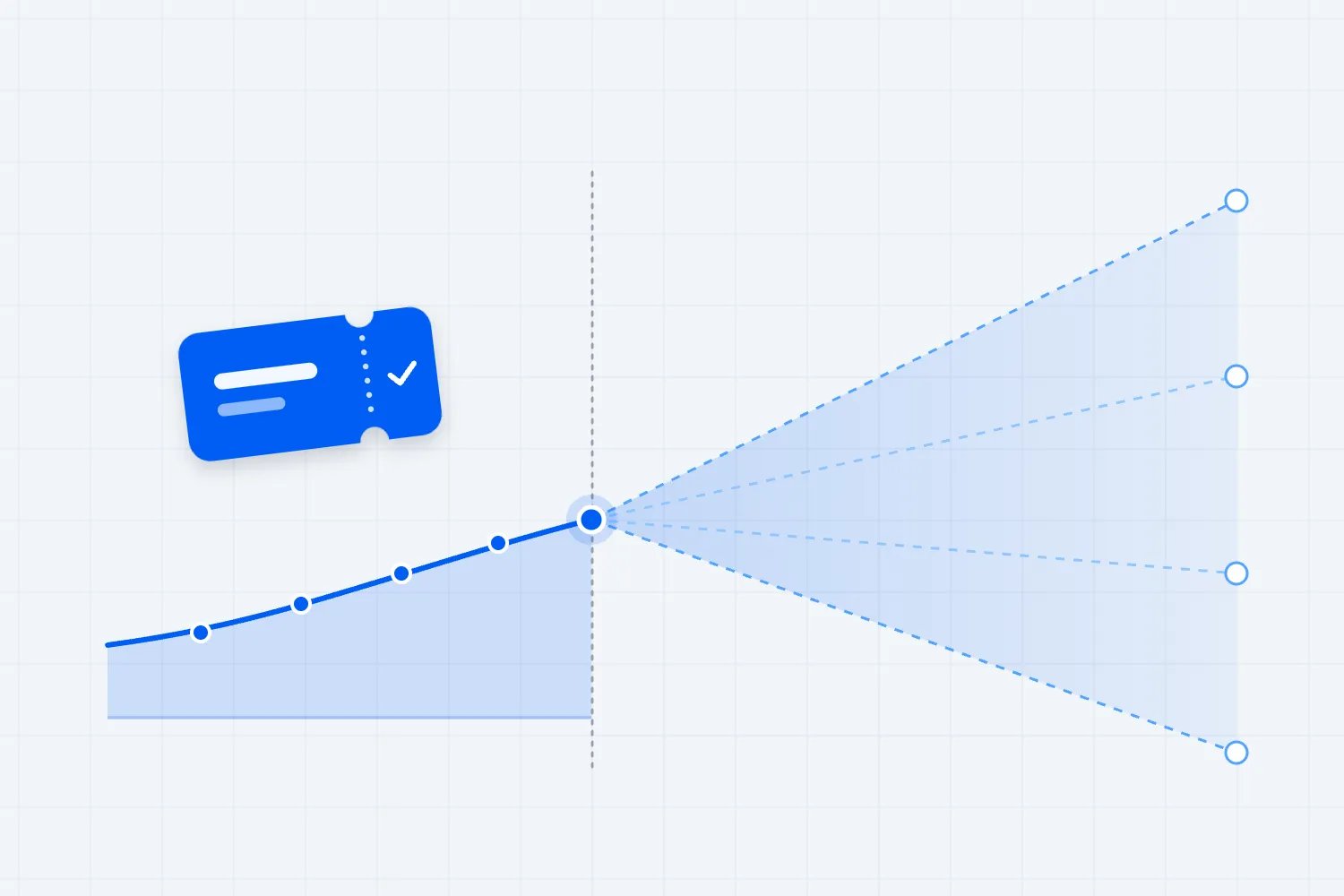
A sponsor may still need an attendance estimate. You can provide one, but explain how you arrived at it, what remains uncertain and when you'll review it. Having no historical data is a reason to be more explicit about assumptions.
Suppose Benchwork Live has room for 240 guest admissions after the organizer has allowed for the actual operating layout. That is the event's chosen guest limit for this fictional example. It is not evidence that 240 guests will come. Sponsor staff and production staff require their own venue-approved access arrangements.
You currently have 84 paid admissions and no guest allocations issued. For internal planning, you consider outcomes of 120, 180 and 240 total guest admissions issued by event day. These are invented planning cases, not probabilities or predicted attendance. They include paid and any future complimentary guest admissions, within the same 240-place limit. Actual attendance can be lower than admissions issued.
The cases help you ask useful operational questions. At the lower outcome, is the demonstration still worth staffing? At the middle outcome, does its position work with the programme? At the maximum, can the space operate without obstructing circulation? The cases don't tell you which outcome will happen.
Don't assign percentages to those cases without a defensible method. Calling the middle one "most likely" simply because it's the middle adds confidence you haven't earned. If you don't yet have a reliable attendance estimate, say that and describe the current sales position instead.
Discuss what new evidence would change your view. A paid campaign might produce ticket purchases at a cost you can afford, or it might generate visits without sales. The partner newsletter may run later than planned. A programme announcement might attract enquiries from a different audience than the sponsor needs. Record the actual results before updating the forecast.
A sponsor-facing update can be concise: "We have sold 84 paid admissions as of 1 July. The guest limit is 240. This is the first edition, and we don't have a reliable attendance prediction yet. We'll provide a fresh sales and programme update on 22 July before you authorize your final demonstration build."
That update only works if the commercial terms allow the decision you've described. Don't collect an unconditional non-refundable payment while informally suggesting the sponsor can walk away later. Agree the payment stages, cancellation terms and review decision before taking the money. Our event sponsorship agreement guide covers the wider terms to settle.
If the sponsor requires a guaranteed minimum audience, understand exactly what it means and what happens if you miss it. The event's available budget must support any agreed remedy. You can also decline that condition and offer a smaller activity without an attendance guarantee. You aren't obliged to sell a promise you cannot responsibly fund.
Make the event credible for buyers as well as sponsors
A sponsor will look at the same public event page your ticket buyers see. If that page leaves the programme, location or admission terms unclear, a polished sponsorship deck won't resolve the underlying problem. Improve the event information before you ask a partner to associate its name with it.
For a first edition, show the confirmed venue, what the programme includes, who is running it and what a ticket covers. Use material you have permission to publish. A photo from a team member's previous project needs an accurate caption; it must not appear to show an earlier Benchwork Live.
There is useful context in Loopyah's Worth It Event Index. In the survey of 500 US consumers, fielded on 11 February 2026, respondents were asked how risky buying a ticket to an unfamiliar event usually feels. The single-choice answers are shown below. They describe those respondents' perceptions, not your prospective attendees or the likelihood that your event will fail.
| Label | Respondents |
|---|---|
| A great deal | 16.2 |
| A lot | 23.2 |
| A moderate amount | 37 |
| A little | 20.4 |
| None at all | 3.2 |
The result is a reason to take first-time buyer uncertainty seriously. It doesn't establish which change will increase your ticket sales or make a sponsor buy. For your event, find out what people are asking before purchase and resolve questions you can answer with confirmed information.
Perhaps callers want to know whether the demonstrations are suitable for beginners. Perhaps the ticket description fails to explain whether materials are included. Those are specific problems you can fix. Adding a large "supported by" logo before a sponsor has agreed to participate introduces a new credibility problem instead.
Show relevant team experience accurately. An organizer may have managed production for another event, while the programme lead has taught workshops for years. Name the role and work they actually did, with permission where necessary. Don't attribute another organizer's entire event attendance or sponsorship performance to your new business.
References can help establish delivery competence when they address a real job. A venue contact confirming that your team delivered a previous installation says something about that work. It doesn't prove how many people will buy tickets for this event. Ask the sponsor which uncertainty it needs resolved, then offer the evidence that fits.
Be careful with the word "confirmed". A supplier quote isn't a booked supplier. A speaker announcement doesn't establish a signed acceptance if you haven't obtained one. Check the important arrangements internally before the proposal circulates. The person approving the sponsorship may verify them independently, and your team needs the same facts to deliver the event.
Offer a first-edition package with a manageable commitment
Once the audience case is clear, choose an activity that fits the sponsor's objective and the current level of uncertainty. A pilot can work well when it is a complete, limited offer. Calling the full headline package a pilot doesn't reduce the work or risk either side is taking on.
For Benchwork Live, consider a demonstration-table package for one supplier. Assume the venue approves a static equipment display and scheduled conversations, with no operating machinery. The sponsor supplies its display unit, staff and printed material. The organizer provides the agreed table position, two staff access passes, one event-page listing and a delivery report.
That is enough to start a useful discussion. The supplier can assess the location, hours, audience evidence and staffing cost. Your production team can assess space, access and servicing. Neither side needs to pretend every guest will have a conversation with the sponsor.
Write the limitations as clearly as the benefits. The package excludes category exclusivity, attendee contact exports, powered demonstrations, dedicated email sends and guaranteed enquiries. Those exclusions stop a small commitment expanding into a different production job after the sale.
Price the package on its actual work and the contribution the event requires. Suppose you test a $2,000 price. Your private worksheet allows $250 for setup and signage, $200 for paid coordination and reporting, $100 for access-related servicing, and a $100 contingency. You also allow $100 for sales and payment costs. These fictional inputs total $750 and leave $1,250 before shared event costs and tax.
The sales and payment allowance is an invented worksheet amount, not a Loopyah fee. Substitute the charges that actually apply. The staff access passes here serve people working the display and don't consume the guest allocation in our illustration; the venue still needs to approve total occupancy and staff access. If your setup displaces sellable places, account for the credible contribution you give up.
That $1,250 tells you what the package leaves under the assumptions. It doesn't prove the sponsor will value the offer at $2,000. The supplier must also budget for its own people, transport and materials. Ask whether the combined commitment is sensible for a first edition with the audience evidence available.
Our guide to pricing sponsorship packages develops the wider calculation. The decision here is whether a complete smaller offer can work for both parties. If the sponsor needs a lower commitment, reduce a costed part of the scope and recalculate. Don't retain all the work while assuming a first-event discount will pay for itself next year.
Let the sponsor decide at a useful point in production
First events change as sales and programme details develop. A sponsor may be willing to consider the opportunity now but unwilling to authorize its full production spend immediately. You can structure a decision around that uncertainty if both teams know what is binding at each stage.
For our fictional event, suppose the supplier wants an updated audience summary on 22 July. It must decide by 29 July whether to accept the package, so the organizer can confirm the table location before finalizing production. No sponsor package has been sold or held beyond that decision date unless the parties explicitly agree otherwise.
You can offer an ordinary proposal with an expiry date. You don't necessarily need a deposit, a complicated attendance trigger or a refund formula. If the supplier wants a temporary hold, state which inventory is held, when the hold expires and whether any payment or commitment applies. Confirm that your own production schedule can accommodate it.
A staged agreement needs more detail. If the sponsor pays for an initial research or content activity, identify that work and its price separately from later on-site participation. State whether the later stage is optional, what approval it needs and which rights have already been provided. Don't describe money as refundable while spending it on work the sponsor hasn't authorized.
Keep your event funding plan realistic during the discussion. An interested sponsor isn't confirmed income. A signed agreement with payment outstanding is different from funds available to spend. If the event cannot proceed without the sponsorship, resolve that financing issue before committing to suppliers on the strength of an encouraging call.
Offer a definite next step. "We'll send a dated summary on 22 July and ask for a decision by 29 July" is more useful than "We'll keep you posted as sales grow." The sponsor knows when it will hear from you, and you know when unsold inventory becomes available again.
If ticket sales are weak at that review, share the position promptly. Explain what is changing in the event plan and whether the proposed activity remains feasible. Don't compensate with a larger follower count or a more optimistic forecast. The sponsor needs to decide using the current event, not the version you hoped to have sold by now.
Write a proposal someone can approve without you in the room
Your sponsor contact may understand the idea after a call. The colleague approving its budget may never have heard of your event. Write the offer so that second person can identify the opportunity, uncertainty, commitment and decision date without reconstructing the conversation.
Open with the fit and the first-edition status together. For example: "Benchwork Live is a new paid event for small workshop businesses, planned for 18 September 2027. We propose a static demonstration-table package so your team can discuss equipment with relevant guests. The first edition has no previous attendance data."
Follow with the dated evidence. State the 84 paid admissions, the 30 questionnaire respondents and the 18 who self-reported as workshop operators. Explain that the interest list, followers and partner placement are separate signals with unknown overlap. Show the current programme and venue arrangements. Leave speculative future audience profiles out.
Then describe the activity, responsibilities and total fee. Include the approved static display, access, listing and report, along with the exclusions. State who supplies the equipment and people. Identify asset deadlines, payment arrangements and the current offer expiry. The sponsorship proposal guide can help organize the wider document; the evidence here is what makes this first-edition offer assessable.
Tell the sponsor what the report will contain before selling it. For this package, you might agree to record the table's operating hours, retain a photograph of the approved placement and provide the event's unique guest check-in count. The supplier can separately record conversations using an agreed definition and provide its own enquiry results if it wants them included.
Don't promise a contact list as an easy substitute for uncertain reach. The UK's ICO guidance on collecting information for direct marketing requires organizations to explain intended marketing uses clearly. Applicable requirements depend on your location, activity and communication channel. Establish a valid, transparent process before offering any personal-information sharing.
A sponsor-operated signup can be more straightforward for the proposed activity when people understand who collects their details and why. It still needs appropriate privacy and marketing arrangements. In the proposal, distinguish anonymous totals, aggregated profile information and identifiable contacts. Permission to attend the event isn't permission for every possible sponsor follow-up.
Answer objections without borrowing certainty
"Come back after the first edition" may be a perfectly reasonable answer. Some sponsors need historical evidence for their buying process. Ask what evidence they would want afterward and whether they'd welcome the report. Then focus current sales efforts on businesses prepared to evaluate a new event.
When a prospect says the audience is too small, find out whether size is the actual problem. It might need broader awareness, or it might need a small number of relevant technical conversations. Don't promise a large turnout to keep the call alive. Explain the offer you can support and let the buyer decide whether it fits.
If it asks who else is sponsoring, name only confirmed partners you are allowed to disclose. An application, a proposal under discussion and a paid partnership aren't interchangeable. You can explain that conversations are ongoing without displaying unapproved logos or implying a company has endorsed you.
When the sponsor asks for proof that people will buy its product, acknowledge the limit. Ticket purchases demonstrate interest in your event. Questionnaire responses may demonstrate interest in a topic. Neither proves future sales of the sponsor's product. Offer to measure relevant responses and agree how its own team will follow up, rather than inventing a return calculation.
A request for a money-back guarantee needs a commercial decision. What triggers it? Which count applies? When is it measured? What spending have you already committed, and can the event afford the remedy? Refer the agreed wording for appropriate review. If the condition cannot work for your budget, say so before taking payment.
You can also ask what smaller commitment would make the uncertainty acceptable. That might be a simpler display or a later decision, provided production permits it. It may also be no purchase this year. A sponsor that needs certainty you cannot provide isn't a reason to misstate the evidence or underprice a costly package.
Turn the first edition into evidence for the next offer
Plan the report while you're selling the package. Agree who will capture each record and when. Otherwise, the evidence you needed for next year's proposal may disappear during pack-down while everyone assumes someone else collected it.
At the event, record unique guest attendance using a consistent check-in method. Keep sponsor workers and other access groups distinct where relevant. Record whether the agreed display operated, whether the listing appeared and what changed. Explain limitations such as missed scans rather than presenting the count as perfect.
Collect response measures separately. A conversation tally may include repeat visitors. A signup shows a particular action under the form's stated terms. A later equipment purchase is a result in the supplier's records, and may have several influences. Don't combine these into a single "engagement" total that neither team can explain.
Compare delivery spending with the $750 planning allowance in the fictional worksheet. Record actual supplier costs and paid staff time without counting the same expense twice. The amount left after delivery helps you decide whether to repeat the package, while the sponsor's assessment tells you whether the activity helped its objective. You need both answers.
Once the offer and terms are settled, Loopyah's event sponsorship tools let you set a package price, benefits and available quantity on a private page. You can allow direct purchase or require approval before payment. Use that route for the agreed offer instead of recreating a separate purchase process for every sponsor.
The audience evidence and production decisions remain your responsibility. Keep the dated research behind the claims, make the accepted scope available to the delivery team, and use the sponsorship report guide to prepare a clear account afterward.
Before you approach your next prospect, check the evidence summary and the package together. The sponsor should understand what is confirmed today, what remains uncertain and exactly what its payment buys. If the offer still needs an invented crowd or a guaranteed sale to sound worthwhile, revise the offer before sending it.

Author: By the Loopyah Content Team
The Loopyah Content Team shares expert insights, practical guides, and industry updates to help event organizers create unforgettable experiences and stay ahead in the event planning world.