· 21 min read
How to calculate customer lifetime value for an event business

You paid to bring someone to your event. They enjoyed the night, bought again a few months later, then brought friends to another date. What was that first customer actually worth to your business? The first ticket tells you only part of the answer. The rest depends on what they buy next, what those purchases cost you to deliver, and how much you spend persuading them to return.
To calculate customer lifetime value for a recurring event business, estimate the contribution a customer will generate across future purchases over a stated period. Contribution means the revenue you keep after the costs that change because of those purchases. Keep customer acquisition cost separate so you can compare the value created with the money spent acquiring the buyer.
The first thing you want to do is measure what comparable groups of buyers have already contributed. Then use that evidence to forecast a sensible period ahead. You don't need to pretend you know how many years someone will keep coming to your shows. A carefully labelled estimate for the next few editions gives you something useful to work with.
This guide follows an invented paid workshop series. All dollar amounts are hypothetical USD calculations, not benchmarks, Loopyah prices or customer results. We'll work through the customer records, the contribution calculation, the forecast and the advertising decision that follows.
Decide whose value you are measuring
For ticket sales, start with the paying customer. One buyer might purchase tickets for several friends, while another buys only for themselves. Those are different purchase patterns. If your advertising cost is measured per buyer, your lifetime value calculation must also use buyers. Dividing order revenue by attendees and comparing it with buyer acquisition cost produces an answer with mismatched units.
Choose a consistent customer identifier that connects purchases across editions. Use a reliable account or customer record where available. An email address can help, but changed addresses, shared inboxes and guest purchases need care. Don't merge two people because their names look similar, or split one person into several customers because their ticket quantity changed.
Group bookings deserve a separate look. A company buying places for its staff may return through a different employee next year. You could measure that relationship at company level if your records support it, but label the result clearly. A business account, an individual buyer and an attendee are different things. Pick the one that matches the spending decision you're making.
Attendance still matters. A buyer who never arrived may behave differently from someone who attended, and their next purchase may need a different message. Keep check-in information alongside the purchase history without treating an entry scan as another sale. Our guide to cleaning ticket sales and attendance data explains why those records need separate definitions before you combine them.
Give the calculation a period you can defend
Lifetime value sounds like a number covering someone's entire relationship with your business. That is the ambition, but it doesn't make a short sales history into evidence about the distant future. State whether you're reporting observed contribution so far or forecasting future contribution. Put the period in the label so nobody mistakes one for the other.
For example, observed contribution over twelve months tells you what buyers actually generated during that window. Forecast contribution over the next twelve months estimates what a comparable group may generate. Neither automatically represents their complete lifetime. Both can help you make a better decision than a confident lifetime figure built from an arbitrary number of years.
Recurring events also have different buying rhythms. Someone skipping a monthly workshop hasn't necessarily stopped buying. Someone missing an annual conference may still return the following year. Wharton's Peter Fader and Daniel McCarthy explain why businesses without subscriptions face a harder forecasting problem: they cannot directly observe when a customer has permanently left.
That distinction matters when you find a calculator using the inverse of a cancellation rate to estimate customer lifespan. Your ticket buyers usually haven't agreed to renew every month, and they don't cancel a relationship when they skip a show. Don't borrow a subscription formula unless your product really has that contractual structure and the assumptions fit its behaviour.
Group buyers by when they first paid
A cohort is simply a group that started at the same time. For this calculation, put customers into groups based on their first qualifying paid purchase. You might use the month of acquisition for a frequent event series or the edition for an annual event. Keep the grouping broad enough to contain enough buyers for a useful comparison.
Suppose your spring workshop brings in a new group of first-time buyers. Keep every one of those buyers in that original group when you review later purchases. Those who never buy again remain in the denominator. Removing them would tell you the value of people who returned, while you are trying to understand the value of acquiring someone before you know whether they will return.
Now compare groups after equal opportunities to buy. A group acquired last year has had more time than one acquired last week. For an annual conference, even equal numbers of elapsed months can be misleading if one group has been offered another edition and the other hasn't. Record both time since first purchase and the events actually offered during that time.
You can keep two useful views. One follows customer age, such as the first twelve months after acquisition. The other follows editions, such as the first event and the next two opportunities to return. Use the view that matches your decision, and don't combine them casually. More available dates can increase spending without any improvement in loyalty.
Calculate the money each purchase contributes
Start with the ticket revenue your business retains after refunds and discounts. Exclude taxes collected for the authorities and amounts belonging to other parties. Add customer-linked revenue only when it belongs to you and you can support it. If a venue keeps all bar sales, those drinks don't increase your customer contribution, however busy the bar looked.
Next subtract costs that change with those purchases. These might include organizer-paid transaction fees, a per-person meal, workshop materials, a commission or a purchased add-on's delivery cost. Use your actual agreements. Don't deduct a fee paid directly by the buyer from organizer revenue unless your records show that your business bears it.
The general decision rule comes from ACCA's explanation of relevant costs and changing cash flows. Ask which costs change because you accept the purchase or take the action. A committed venue hire is different from a catering charge for another person. An extra room needed for a larger audience is different again.
Fixed costs still have to be covered. Customer contribution helps you understand what is available towards those costs and profit; it does not prove that the event makes money overall. Check the result against your event profit and loss statement. If you allocate business overhead to customers as a separate management view, show that allocation separately rather than quietly changing the contribution definition between groups.
Follow one workshop group through the numbers
Our fictional series acquires 100 new paying customers at its first workshop. Each customer buys one ticket. After discounts, refunds and tax exclusions, the series retains $80 per buyer. The materials, refreshments and organizer-paid transaction costs total $30 per buyer. That leaves $50 contribution each, or $5,000 for the original group at the first event.
At the second workshop, 40 of those original customers each buy one ticket on the same terms. They contribute another $2,000 in total. At the third workshop, 25 original customers each buy one ticket and contribute another $1,250. Some of those 25 may also have attended the second workshop. That overlap doesn't change the contribution total, although it matters when you describe repeat behaviour.
The original group has therefore generated $8,250 before acquisition and repeat marketing costs across the three observed editions. Divide by the original 100 customers and you get $82.50 observed contribution per acquired customer. Don't divide by the 40 people at the second workshop or the 25 at the third. The people who didn't return are part of the result.
The chart shows how that observed contribution accumulates. Its source is the fictional calculation in this section. It includes the first purchase and later ticket contribution, before acquisition spending and the repeat marketing costs we subtract next. No return beyond the third edition is assumed.
| Label | Contribution before marketing |
|---|---|
| After first workshop | 50 |
| After second workshop | 70 |
| After third workshop | 82.5 |
Keep acquisition and repeat marketing costs visible
Suppose acquiring the fictional group cost $2,000 in advertising and directly attributable campaign work. Divide that cost by the 100 genuinely new buyers and customer acquisition cost is $20. Use new customers in the denominator, not all orders reported by the campaign. Returning customers who happened to click an advertisement don't become new acquisitions again.
During the next two editions, the organizer spends another $300 on messages and campaigns directed at the original group. Assume that figure includes the relevant repeat marketing costs used in this example. Subtract it from the group's $8,250 ticket contribution. The result is $7,950, or $79.50 per original customer, before the initial acquisition cost.
Subtract the $20 acquisition cost per customer and $59.50 remains per original customer across the observed editions. For the whole group, that's $5,950 before fixed event costs, business overhead, financing and income tax. Keep those exclusions visible. Calling that amount net profit would give it a meaning the calculation doesn't support.
Harvard Business School Online's explanation of the lifetime value to acquisition cost ratio describes comparing customer value with acquisition spending. For your own report, state exactly which value you use. A revenue-based value and a contribution-based value produce different ratios. Also avoid subtracting acquisition cost inside the value and then treating that reduced figure as if acquisition were still excluded.
Handle passes, transfers and cancellations consistently
A season pass changes when you collect money and what that payment covers. If the customer pays once for several workshops, don't count the full pass payment at every edition. Record it once and use a consistent method to assign revenue and delivery costs to the covered events. Otherwise your most frequent attendees can appear to generate revenue that was never collected.
The same care applies to refunds. A fully refunded order should not remain a completed paid purchase simply because a ticket was originally issued. Keep any nonrecoverable costs that your business still bears visible in the contribution record. Decide how your first-purchase definition treats fully refunded first orders, document it and apply the rule to every group you compare.
For a transferred ticket, preserve the difference between the person who paid and the person who attended. A friend receiving the ticket hasn't necessarily become another paying customer. If that friend later buys independently, their own first qualifying purchase starts their customer history. You can investigate whether transfers introduce new buyers without assigning the original payment to two people.
A cancelled edition needs an explanation alongside the numbers. Customers who weren't offered another workshop didn't decline the same opportunity as buyers who received an invitation and chose not to book. Include the actual refunds and costs, but avoid interpreting that interruption as proof that the audience lost interest. Future forecasts should reflect the calendar you can realistically deliver.
For bundles sold across different event brands, decide whether the forecast covers the whole business or one series. A buyer moving between your brands may be valuable to the business while disappearing from one show's repeat report. Both observations can be true. State the scope before deciding whether you should spend more to attract a similar buyer.
Turn observed contribution into a forecast
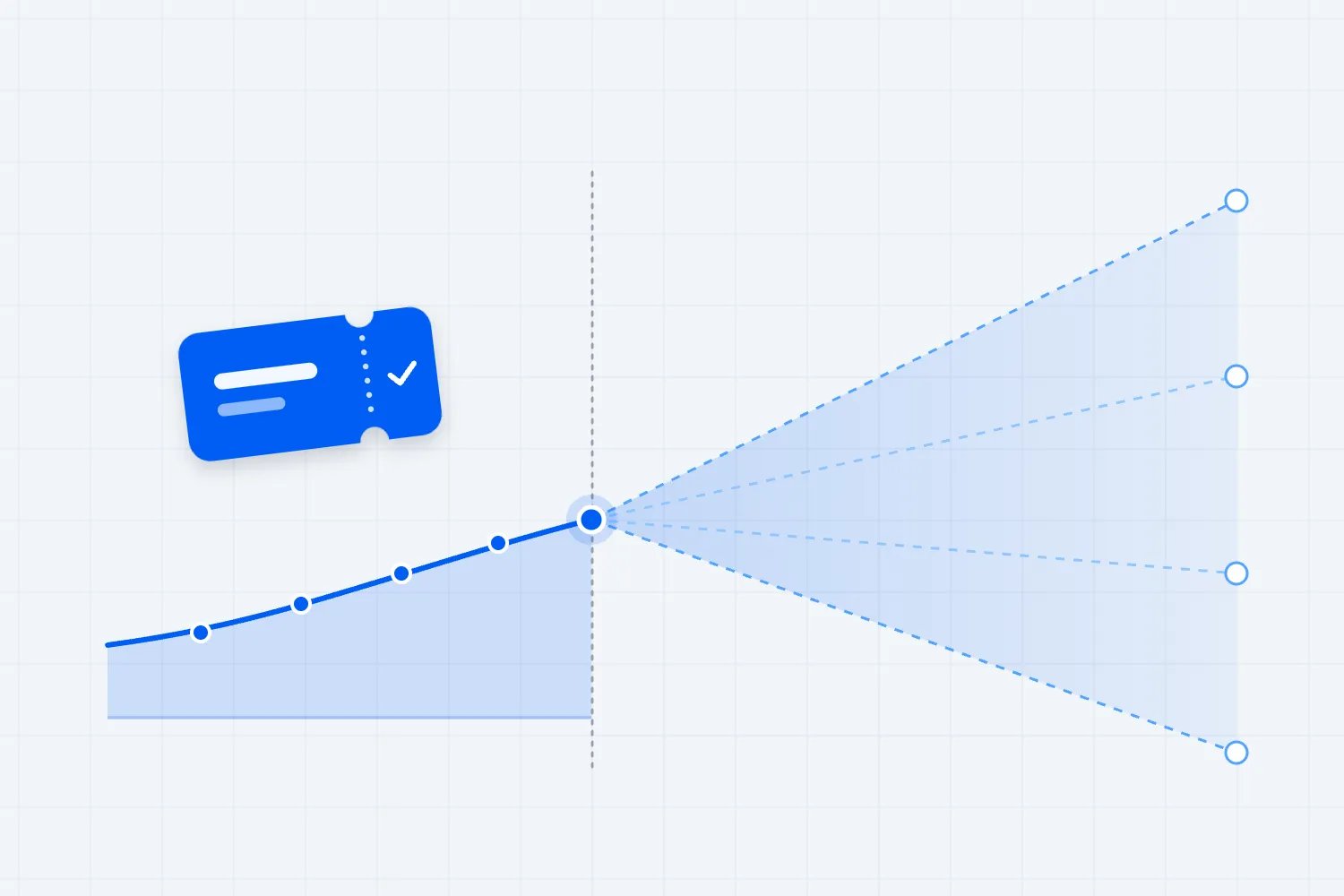
Now imagine planning the next intake of workshop buyers. You haven't earned their repeat purchases yet. You can use the completed group's behaviour as a starting assumption, provided the offer, audience, prices and opportunities to return are reasonably comparable. Write those assumptions down before the campaign starts, while it is still possible for the eventual result to disappoint them.
For a deliberately simple forecast, assume 100 new customers buy the first workshop, 40 buy the second and 25 buy the third. Assume $50 contribution per purchasing customer at each edition and $300 total repeat marketing costs. That forecasts $79.50 contribution per acquired customer across three editions before acquisition cost. It is a forecast using historical behaviour, not another observed result.
In plain words, the calculation adds each edition's expected contribution from the original group, subtracts expected repeat marketing costs, then divides by the original number of new customers. If customers can place several orders in an edition, use expected total purchases and contribution rather than counting everyone as one ticket buyer. Keep the unit consistent throughout.
Use a separate line for each future edition when the contribution differs. A premium workshop might have a higher ticket price and much more expensive materials. Applying the first workshop's margin to every later booking would hide that difference. Estimate the purchases and costs for the event customers are actually being offered, then add those edition totals together.
The forecast can also begin today for customers you already have. In that case, estimate only their future contribution from today. Their past purchases are useful evidence, but they are not future value. Their original acquisition spending has already happened. A decision about emailing them again should compare expected additional contribution with the additional cost of that message and offer.
Change the assumptions before changing the budget
A single forecast invites people to remember the answer and forget what produced it. Give yourself a cautious version alongside the central estimate. In our example, suppose only 25 original buyers return for the second workshop and 15 for the third. At $50 contribution each, the group produces $7,000 before repeat marketing, including the first workshop's $5,000.
Keep the same $300 repeat marketing budget and that becomes $6,700, or $67 per acquired customer before acquisition cost. After the example's $20 acquisition cost, $47 remains per customer towards fixed costs and profit. That is materially different from the central estimate's $59.50, even though first-event sales look identical. The uncertainty concerns later purchases.
Then test what happens if delivery costs rise or returning buyers need a discount. Don't change several assumptions and call the difference a retention effect. Show which change reduced contribution. A higher return rate can still produce less money if you gave away too much margin to achieve it. Buying more often and contributing more are related questions, not interchangeable measures.
You can also test a longer gap between editions. If the next workshop moves several months later, some customers may have fewer opportunities to buy within your chosen window. Lower spending during that window may reflect the calendar rather than a change in customer preference. Show that timing change explicitly before comparing the new estimate with a previous forecast.
Capacity matters too. A returning customer filling a seat that would otherwise be empty is different from a discounted customer taking the last seat that would have sold at full price. Before paying to increase repeat sales at a consistently full event, consider the contribution you might displace. The calculation needs to reflect the actual booking constraint.
Check when the money becomes available
A forecast can support spending in principle while leaving you short of cash next month. Your venue deposit, advertising invoice and supplier payments may fall due before later editions generate any revenue. Keep a cash schedule next to the customer value calculation. The dates matter because future contribution cannot pay a bill that is due today.
In the central workshop example, the first event generates $50 contribution per acquired customer before marketing. With $20 acquisition cost, it contributes $30 per customer towards fixed costs at that point. That sounds reassuring, but you still need to know when ticket receipts arrive and when the $30 variable delivery costs and acquisition spending actually leave the bank.
For a longer forecast, future money may also need discounting. That means expressing later cash flows in today's terms using a stated rate and their expected timing. ACCA's guidance on investment appraisal and discounted cash flows explains why the timing and basis of the forecast must agree. Your finance owner should choose a rate suited to the decision.
Don't add a decorative discount percentage to make a short calculation look sophisticated. First get the customers, costs, repeat assumptions and dates right. When you do discount, show both the timing and rate used, and label the forecast accordingly. A three-edition undiscounted contribution estimate should never quietly become a present-value estimate because someone changed its heading.
Use acquisition cost to make a spending decision
The useful question is how much you can afford to spend acquiring the next comparable buyer. Start with forecast contribution, allow for uncertainty, then reserve what the business needs for fixed costs and profit. The remainder can inform an acquisition ceiling. Don't spend the entire expected contribution on advertising and assume the event business has somehow paid for itself.
For another explicit assumption within our fictional example, suppose you require $35 per acquired customer towards fixed costs and profit. The central forecast of $79.50 before acquisition would leave a maximum of $44.50 for acquisition under that rule. The cautious forecast of $67 leaves $32. Those are planning limits generated by the chosen assumptions, not recommended targets for another organizer.
You might choose a lower limit because you need faster cash recovery, your data is thin or another expense is uncertain. Equally, a campaign below the limit still needs enough sales volume to support the event. Cheap customer acquisition for a tiny audience doesn't solve a venue commitment that requires many more paying buyers than the campaign can deliver.
As you increase advertising spend, watch the cost and behaviour of the additional buyers. The average from your earlier campaign may not hold at a larger budget. You may reach people with less interest in the series or pay more for the same kind of customer. Increase in steps you can evaluate, and compare equally mature groups before calling the expansion successful.
Compare customer groups without fooling yourself
Once the overall calculation works, separate groups that could change a real decision. You might compare first-time buyers acquired through a specific campaign with those who arrived through an existing customer's recommendation. Keep the same observation window, contribution rules and event opportunities. Otherwise the comparison will reward whichever group had longer to spend or happened to attend a more profitable edition.
Check whether a few unusually large group bookings dominate the average. If they do, show those accounts separately before using the overall figure to set advertising bids for individual buyers. The overall average remains arithmetically correct, but it may describe nobody you are about to acquire. Equally, don't remove a large buyer merely because the result looks untidy. Explain why that purchase belongs in a separate group and keep the total reconciled. When a group is small, show its customer count next to its value. A number based on a few completed purchases deserves less confidence than one repeatedly observed across comparable editions with a wider range of buyers and more complete records.
Be careful with labels such as organic and free. A buyer who finds you through an unpaid search may have encountered months of paid promotion, content work or partnerships. You don't need to force every shared cost into a precise-looking customer number. State what the acquisition figure includes, what it excludes and whether the same rule applies across groups.
An advertising dashboard can also attribute a later order to the campaign that brought someone back. Your customer record should still retain their original acquisition group. First acquisition and latest conversion describe different points in the relationship. Keep both if useful, but don't move customers between original groups every time another channel receives credit for a sale.
Google's documentation for Analytics user lifetime explorations also explains how reporting identity affects the user histories it combines. A website's user or device is not automatically the paying customer in your ticket records. Use analytics for the questions its data supports, and reconcile actual ticket purchases before using its lifetime revenue as your event customer contribution.
Improve repeat contribution through the actual experience
Once you know where repeat contribution comes from, look at what stops people returning. It might be the programme, the next date, the location or a first experience that didn't match the promise. Sending more reminders won't resolve a workshop that people found too basic. Read the feedback alongside the purchase pattern before deciding that communication is the problem.
Then make the next relevant event easy to discover. Someone who bought a beginner workshop may want the next level, while a group organizer may need dates early enough to coordinate other people. Explain why the next edition is worth buying. A returning-buyer discount is one option, but earlier access or clearer programming may answer the customer's hesitation without reducing every ticket's contribution.
For that communication, Loopyah's attendee email tools connect ticket buyers with their purchase history and let you create segments based on what they bought. You can send a relevant invitation to buyers who agreed to receive promotions, then review the tickets and revenue associated with campaign clicks. That helps you act on the customer history without rebuilding the audience for each send.
Those campaign results still don't prove that every attributed purchase happened because of the message. Some customers would have returned anyway. Keep your contribution calculation separate from the campaign report, and use the report to investigate what worked. The operator still decides which events belong together, what delivery costs to include and whether the extra sales justify the offer.
Test whether a retention offer adds money
If a repeat-buyer offer might become a regular expense, compare it with what would happen without that offer. Randomly assign eligible customers to an offer group and a comparison group where practical, then give both the same period to buy. NIST's description of completely randomized experimental designs explains the role of assigning treatments randomly.
Judge the result by additional contribution per eligible customer after discounts and campaign costs. The offer group might buy more tickets but generate less contribution if many existing repeat buyers simply use a discount. Include customers who didn't purchase in both group averages. Otherwise you're comparing the people who responded after the fact instead of the customers eligible for the decision.
For a small audience, results can move sharply because of a handful of buyers. Report the group sizes and avoid turning a narrow difference into certainty. If you cannot run a useful comparison, describe the outcome as observed sales after the offer. You can still learn from it without claiming you measured the sales that the offer caused.
Keep service standards independent of the spending forecast. A lower predicted customer value isn't a reason to withhold necessary event information or provide a worse experience. Use the calculation to make spending and programming decisions. Customers are allowed to attend occasionally, buy for someone else or stop coming without your records explaining every reason.
Make the next review easy to repeat
Write a short definition alongside the report so another person can recreate it. State the paying customer unit, qualifying first purchase, included events, observation period, revenue adjustments, variable costs, repeat marketing costs and acquisition costs. Keep the data cutoff visible. If refunds or supplier settlements are still provisional, say which figures may change before you use the result to approve spending.
Give one person responsibility for approving changes to those definitions. If marketing changes the acquisition denominator while finance changes the cost allocation, the next report may look different even when buyer behaviour hasn't changed. Record the change and, where practical, recalculate the earlier comparison using the new rule. That keeps a reporting correction from being presented as a commercial improvement.
At the next review, compare your earlier forecast with the contribution actually generated at the same point. Keep the forecast rather than replacing it with the eventual answer. You want to discover whether you overestimated return purchases, understated delivery costs or acquired a different audience. Each explanation leads to a different change in the next campaign.
If you have only one edition's history, start there. Calculate first-purchase contribution accurately and treat repeat spending as an assumption to test with a limited budget. As completed groups accumulate, extend the forecast only where the evidence supports it. Your next acquisition decision should use the contribution buyers can reasonably generate, the costs your business must still cover and the cash you can afford to commit.

Author: By the Loopyah Content Team
The Loopyah Content Team shares expert insights, practical guides, and industry updates to help event organizers create unforgettable experiences and stay ahead in the event planning world.