· 28 min read
How to produce a ticketed cabaret night

You've found a singer people will come out for, a comedian who can work a room, and a variety act that would make the evening feel different. Put them on the same poster and you have a line-up. Making them work together, while guests find their tables and the kitchen gets dinner out, is the production job.
To organise a cabaret night, decide what the audience is buying before you book the whole bill. Match the acts to a room where people can see and hear them, build a running order that includes the host and every changeover, and agree exactly when service can happen. Then price the seats you can actually sell against the complete cost of delivering that experience.
For a first show, I'd start with a seated mixed bill and keep substantial food service outside the performance blocks. Dinner can be a good addition when the venue can deliver it reliably. It becomes an expensive distraction when the audience spends a quiet song passing plates and asking where their main course has gone.
We'll work through that decision using a fictional small production. The names, timings and US dollar figures below are planning examples, not a customer case study or industry benchmarks. You can replace them with your own quotes and rehearsal results.
Define the night before choosing the acts
Cabaret leaves plenty of room for interpretation. One buyer imagines songs and stories at a small table. Another expects comedy, dance and a lively host. Someone else thinks they're buying dinner with occasional entertainment. You need a description that lets the right people recognise your show before they pay.
Start with the audience experience. Will guests watch a continuous performance, or talk and eat between short appearances? Is there a unifying subject, a musical style, or simply a host introducing contrasting acts? Does the event invite participation? If it does, explain whether that means answering the host, singing along, or volunteering for something more involved.
For our example, producer Maya is planning a seated evening of live vocals, comedy and visual variety. Guests can buy admission on its own or admission with a pre-show meal. There is one interval, a clearly advertised finish, and no expectation that customers will go on stage. That description already helps her make booking decisions.
An act built around long audience conversations may struggle in her limited programme. A small visual trick might disappear behind dinner tables. A singer who needs a full band changes both the sound requirements and the cost. Those artists might be excellent, but excellence alone doesn't make them right for this production.
Write a short working promise you can send to the venue and performers. Maya's might read: "A seated cabaret with live songs, comedy and visual variety, presented by a host. Optional dinner is served before the show. Guests return to the same seats after an interval. Audience participation is optional, and the performance has an advertised end time."
Add the actual content description and age conditions once you've checked the bill and venue permissions. Don't use "adult cabaret" as a substitute for explaining whether the show contains strong language, sexual references, nudity or direct audience interaction. Equally, don't imply that every cabaret must contain those things. Describe the production you're making.
If the main attraction is specifically burlesque, our guide to producing a ticketed burlesque show develops those performance requirements. Here the central problem is making different forms of entertainment, hospitality and seating work as one evening.
Build a mixed bill that works in this room
Choose acts by watching enough of their work to understand a complete performance. A promotional montage can show applause without telling you how an act begins, what it asks of the audience, or how much equipment appears between the first and last moment.
Ask for the proposed act, its tested runtime, its intended audience and its practical requirements. For a singer, establish whether the booking includes an accompanist, a band or prepared tracks. For comedy, discuss content and the amount of audience conversation. For visual variety, ask what the audience must be able to see and whether any materials, props or actions need specific venue approval.
Maya initially considers two singers with similar material. Both are good, but putting them consecutively would make the second set feel like a repeat. She can change the sequence, ask whether one artist has a suitable contrasting set, or book a different performance. The decision should follow what each artist actually offers, rather than an instruction to become a different act after accepting the booking.
Look for connections as well as contrast. A host can link different disciplines through a shared subject or a running conversation with the audience. That gives the evening continuity without forcing every performer into the same costume or asking them to rewrite their material for free.
Think about who opens each half. An opener needs to establish the sort of attention the show requires. A delicate piece that depends on silence may be poorly placed while the last tables are still settling. The closing act needs to work after everything that precedes it, including any audience participation and the time needed to reset the stage.
Be selective about technically demanding additions. An aerial act, fire performance or substantial moving structure needs its own competent assessment, appropriate venue and specialist arrangements. A mixed bill doesn't make those requirements smaller. For a first production in a restaurant room, it can be more sensible to book an act that fits the existing stage than to convert the building around one number.
Prepare an alternative sequence with the same confirmed acts. If the singer needs longer after the interval or a prop cannot be reset in time, you want a reviewed option that the host and technicians understand. An untested swap during the show can create another problem, particularly when one performer is also the accompanist for someone else.
Agree the host's job and the booking terms
The host connects the evening. They introduce people accurately, explain how the room works, manage audience expectations and help the production recover when something changes. Book them for that responsibility, then involve them while you can still change the running order.
Ask how much preparation the fee includes. Will they attend a planning call, write links, rehearse names and cues, and stay available during the technical session? If you expect additional promotional filming or a separate appearance, agree that work and payment too. "You're hosting" doesn't explain all of those obligations.
For each act, confirm the performance, duration, arrival and soundcheck arrangements, fee, expenses, payment dates and cancellation terms. Record what equipment each party supplies. The UK performers' union Equity explains the value of collecting agreed details in its guidance on one-off live performance bookings. Use an agreement appropriate to your jurisdiction and any applicable union requirements; that guidance isn't a universal contract template.
Give performers the information needed to quote accurately. A useful enquiry explains the audience, venue, stage arrangement, proposed date, performance length, rehearsal commitment and whether food service continues during the act. Ask them to identify requirements that the room must meet before they accept. That is easier to price than a message asking what they charge for "a quick slot".
Be specific about substitutions. If Maya books a named singer, a different performer changes what some customers thought they were buying. Agree how illness, travel disruption and replacement proposals will be handled. Keep the audience communication and refund implications within the producer's decision, with suitable local advice on the terms.
Separate performance permission from promotional and recording permission. Ask which photographs and short clips you can use, where they may appear and whether paid advertising is included. A booking doesn't automatically clear a song for a video advert or allow you to upload the complete act after the event.
Finally, name the person who can approve changes. Performers should know who can agree extra rehearsal, altered material or an additional fee. The host shouldn't discover at rehearsal that a venue manager has asked every artist for another number. Once the bookings are confirmed, distribute the current agreement and practical details to the people doing the work.
Test table sightlines before counting saleable seats
A room advertised as holding a certain audience may hold fewer customers in a cabaret arrangement. Tables need space, service needs routes, and the acts need somewhere to perform. The useful question is how many people can watch this particular show in the approved layout.
Visit with the venue manager and whoever is responsible for the technical production. Sit in the actual chairs. Check the stage at a singer's face height and at the height of any lower action. Look from the sides, behind pillars and across occupied tables. An empty room can hide the problem created by someone sitting directly in front of you.
Use a person on stage to demonstrate the intended performance area. If a magician works with objects on a low table, can the rear audience see them? If a dancer uses the floor, does the stage edge conceal it? Explain the issue to the artist and technical team before deciding whether a different arrangement is possible.
Great Britain's HSE says shared venue responsibilities should be clearly assigned in its venue and site design guidance. Have the responsible venue and safety specialists confirm the layout, occupancy and routes for your event. A ticket map is a sales tool, not a calculation of safe capacity.
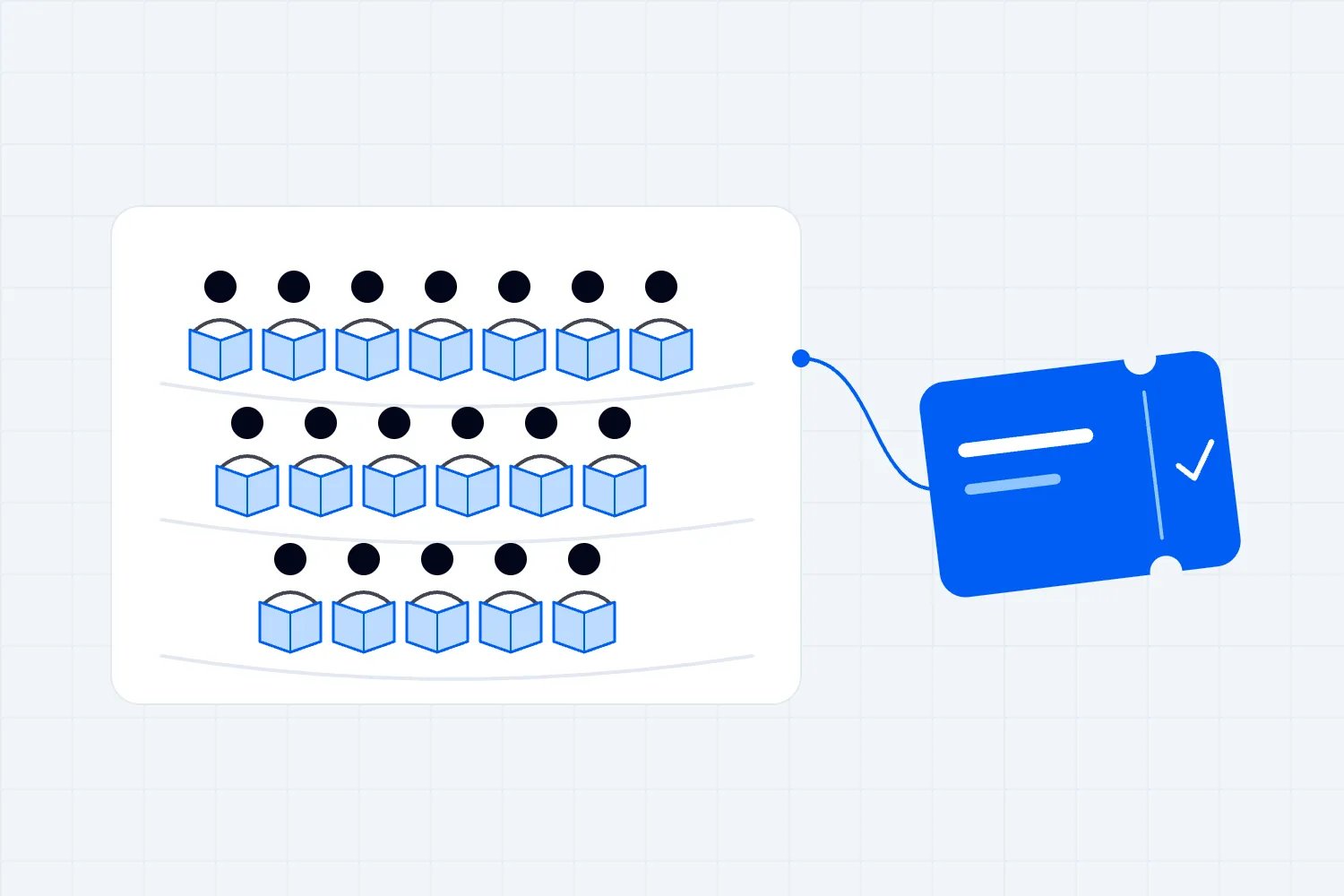
For a simple inventory example, Maya's agreed audience layout initially has 120 positions. After testing, she removes eight with poor views. Another four are held for operational needs, and four are complimentary allocations. That leaves 104 paid places. This is fictional inventory arithmetic, not a recommended layout, and staff and performers still need counting under the venue's occupancy arrangements.
Plan accessible positions and companion arrangements as part of the approved layout. Confirm the route into the room, toilets and the viewing experience, and publish accurate details. Avoid solving access requests by squeezing another chair into a service route. Ask how the venue accommodates different requirements without making assumptions about what a customer can do.
Table allocation needs equal care. If strangers may share a table, say so. If a group buys separate seats, explain how they can choose adjacent places or request an arrangement you can actually deliver. Never promise an exclusive table when you're selling individual chairs around it.
Loopyah's seat charts let you draw tables and seats, assign categories and let buyers select places. Use the approved room plan to configure that choice and price meaningful differences in the view. You still need to check the physical arrangement with the venue and keep the sales description accurate.
Choose admission, dinner or a clearly defined combination
Admission-only is the easiest offer to explain. The buyer gets the show and the seating arrangement described on the page. Food and drinks, if available, are purchased separately under stated arrangements. You can concentrate the production budget on the performance while the venue runs its existing hospitality operation.
A dinner package adds another promise. The buyer now expects a meal of a stated kind, at a stated time, with a workable process for dietary requirements. That can make the evening more convenient, but it also creates supplier commitments and service decisions that your show must accommodate.
For Maya's first night, I'd offer dinner only through a venue that can quote for and demonstrate the service. She doesn't need to start a temporary catering operation to prove the show works. Our guide to starting a paid supper club explains the separate business questions if food is the main attraction.
Put the options in plain words before inventing ticket names. "Show admission, meal not included" and "Show admission with pre-show dinner" tell a buyer more than silver and gold. Describe the meal, arrival time, service deadline, drinks policy and whether the package changes the seat location. If it doesn't buy a better view, don't imply that it does.
Decide whether dinner customers and admission-only customers can share a table. The venue may need to serve a table together, or it may be perfectly capable of handling mixed bookings. Find out. The answer affects how you allocate seats, collect meal choices and respond when someone wants to add dinner later.
Make the kitchen cutoff an actual operational deadline. Agree when quantities become committed, whether substitutions are allowed, what a late addition costs and what happens if the customer doesn't arrive. A public sales cutoff that falls after the supplier's final order deadline leaves you promising meals you haven't secured.
Count each customer once in the audience inventory. A dinner upgrade is a meal for an existing admission, while a dinner-and-show package includes admission. If you sell both forms, design and test the booking process so that an upgrade cannot accidentally become another place in the room. Confirm the supported setup with your ticketing provider rather than assuming two separately named products share an attendance limit.
Keep drinks equally explicit. State whether any are included, which choices apply and who supplies them. Ask the licensed venue to approve the arrangement and the advertising. Don't build the show's profit forecast on customers purchasing alcohol or describe an optional drinks spend as if it were guaranteed event income.
Make the kitchen part of the running order
The show and service teams need to plan together. Asking the chef to "finish before we start" is not a service plan, especially if most dinner customers arrive at the latest permitted time. Ask what the kitchen and floor team can deliver with the agreed menu, staffing and table arrangement.
For Maya's proposed evening, dinner customers arrive from 6.00 pm. Admission-only entry begins at 6.45 pm, with the performance due at 7.30 pm. The venue proposes finishing main-course service and clearing before the show, with an interval for drinks and a pre-agreed dessert offer. Those are proposed windows to test with the venue, not targets every kitchen should be able to meet.
Work backwards through the last possible dinner arrival. Does the customer have time to be seated, ask an allergen question, receive the meal and finish without rushing? If not, move the advertised dinner arrival earlier, simplify service or sell fewer meal packages. Don't make the performer wait because the package was easier to sell with a later arrival.
The Food Standards Agency's allergen guidance for food businesses, applying to England, Northern Ireland and Wales, explains allergen information and handling responsibilities. Agree how the actual food business will answer questions before purchase and during service. Elsewhere, check the relevant local food authority's requirements.
The practical division matters. Your box office can tell a customer whom to contact, but it shouldn't guess whether a dish is suitable. Make sure the caterer receives and confirms requests through an agreed process, with appropriate handling of personal information. A meal preference recorded during booking doesn't itself confirm that the kitchen can safely meet an allergy requirement.
Agree the service rules during each performance block. You might suspend routine plate clearing during a quiet song, permit discreet water service, and direct new drinks orders to the interval. Decide what is realistic with the venue. Customer needs and urgent incidents still take priority; the instruction is about routine service, not stopping someone from getting help.
Then rehearse the route. Can staff reach the far tables without crossing the stage entrance? Will a tray block the view? Where do used glasses go? Ask the floor manager to walk it while someone watches from the back. Changing a table position now can save an evening of interruptions.
If dinner runs late on the day, give one person authority to coordinate the response with the stage manager. They may adjust service, delay seating briefly or use a previously agreed schedule option. Nobody should promise tables a different show start while the host is already preparing to walk on.
Write the whole running order, including the gaps
Add the booked performance minutes, then add everything that happens between them. Introductions, applause, microphone changes, furniture moves and the host's announcements all occupy time. An evening with several short acts can run long even when every artist keeps to the agreed set.
Maya's fictional programme contains 78 minutes of act material. She allows 12 minutes for the host's opening and links, eight for changeovers and applause beyond the act runtimes, and five for final thanks. With a 20-minute interval, the planned total is 123 minutes. Starting at 7.30 pm gives a planned finish at 9.33 pm within a public window ending at 9.45 pm.
That leaves 12 minutes of room in the schedule. It is an example allowance to test in rehearsal, not evidence that every show needs that amount. Check venue operating hours, staff bookings and customer transport needs before advertising the end time. If the rehearsal already uses the full public window, shorten the programme or change the promise before launch.
Here's how Maya could divide the proposed act material. The first half has a 15-minute vocal set, 12 minutes of comedy and 12 minutes of visual variety. Those 39 minutes, plus six minutes of host material and four for transitions, finish at 8.19 pm. The 20-minute interval then ends at 8.39 pm. The second half uses another 39 minutes of different act material, six of host links and four of transitions, followed by five for final thanks. That reaches the planned 9.33 pm finish.
Those allocations only become useful once the artists confirm what they can deliver. A performer appearing in both halves needs distinct agreed material and enough preparation time. The sound operator needs to test the transitions within those allowances. Maya shouldn't divide the minutes neatly, send the document out and assume the show now fits.
During the technical session, time the sequence with the host's actual introductions. If a changeover takes longer, identify the work causing it. Moving a heavy instrument might need more time or a different sequence. Shortening the host's introduction won't solve a problem that requires a clear stage and additional crew.
Write a timed order showing who is on stage, what they need and who confirms the next start. Place any repeated performer appearances far enough apart for their actual change and preparation. Where an artist uses a shared instrument, check that moving or resetting it won't disturb equipment the next act relies on.
Give the host practical information for each link. They need the correct name and pronunciation, an accurate introduction, any audience boundary and a clear handover. They also need to know what to omit if the show is running late. Agree optional host material in advance rather than asking an artist to lose a contracted section unexpectedly.
The interval has work inside it too. Customers visit the toilets, the venue serves orders, performers change and technicians prepare the second half. Ask each team what must be completed and who confirms readiness. A host announcing a return in five minutes should have information from the room, not just a glance at the clock.
Use a running order with information that people can act on. For each entry, record the planned start, duration, performer, essential equipment, cue and responsible person. Keep a version number and issue the same copy to the host, stage manager, technicians and floor manager. If you change it, tell them what changed.
Don't fill an unresolved technical delay with an instruction to improvise indefinitely. Agree what the host can do briefly, when the stage manager will give an update and when the show should pause. The audience deserves a clear explanation when a problem changes the evening they were promised.
Check sound, cues and backstage access together
Cabaret can change its sound needs several times in one half. A singer with accompaniment, a spoken set and a visual act with recorded music may each need a different arrangement. Give the technician the full requirements before agreeing the equipment quote.
Collect the final tracks and cue information by an agreed deadline. Ask the operator which file formats they accept, then check the supplied files on the show system. Listen for unwanted silence, a different ending or a version the performer hasn't rehearsed. Keep a tested offline backup in a form the operator can use.
Run the transition between acts, not only the acts themselves. Who takes the handheld microphone away? Who puts the chair down? Can the next performer reach their starting position while the host is speaking? If one person has been assigned all those tasks, time the sequence and see whether it is possible.
Ask performers what lighting is essential to the act and what is a preference. A small room may not reproduce the equipment in their reference recording. Resolve that honestly. If a visual effect depends on a blackout the venue cannot provide, you need a different plan before the audience arrives.
Check backstage space for the complete cast. People need suitable places to prepare, store equipment and change, with access arrangements agreed directly. A public corridor isn't automatically a usable changing room, and a locked storage cupboard isn't helpful if nobody knows who has the key.
Give performers the actual access route and call times, including load-in arrangements. If they need assistance or a different route, work that out during booking. The public entrance and stage entrance can present different barriers. Don't assume an accessible audience room means the artist can reach the stage.
The technical session should end with a tested start, a tested interval restart and a clear final exit from the stage. Record what remains unresolved and who will fix it before doors. Resolve essential venue and equipment questions before sales open. If the final technical session exposes a new failure, agree whether you can safely adapt or must delay or cancel, then tell customers about any material change.
Confirm permission for the actual mix of activities
Take the programme to the venue before committing to ticket sales. Describe the live and recorded music, comedy, dance, audience participation, performance hours and hospitality. Add any unusual act requirements. "We host entertainment" is too broad to confirm that your planned evening fits the premises and its conditions.
In England and Wales, the Home Office's September 2026 licensing guidance treats different entertainment activities and exemptions separately. Ask the venue and local licensing authority to check the actual programme. A permission or exemption relevant to one part of a mixed bill doesn't settle every other part, alcohol service or venue condition.
Check music rights separately. The UK government's guidance on playing live or recorded music explains when permission is usually needed and routes businesses to the relevant licensing organisation. Confirm the actual usage, including theatrical material where relevant. A venue's existing arrangement may need checking against your show, and an artist owning a recording doesn't establish public-performance permission.
Other countries have their own authorities and rights organisations. Find the applicable route rather than importing a UK answer. Record who obtains permission, who pays and what evidence the producer needs before advertising. If the programme changes, ask whether that changes the answer.
For a first production, choose live performance without an organiser-made recording unless recording has a clear purpose and budget. Filming adds performer permissions, music and other rights questions, equipment and audience information. You can commission separate promotional material with the necessary approvals without promising to publish the whole evening.
Agree the audience behaviour rules and how staff will respond to harassment, unwanted participation or disruptive filming. The host should be able to protect performers without becoming the only person handling a difficult customer. Tell the audience how to get help, and brief the team on who takes over when an issue needs action.
Check whether the paid seats can cover the show
Build the budget from confirmed quotes and realistic sales. The maximum ticket income comes from the paid places left after the layout, holds and complimentary allocations are settled. The room's headline capacity isn't a revenue forecast.
For Maya's fictional show, suppose the fixed budget is $3,000. That includes $500 for venue hire, $900 for the acts, $300 for the host, $350 for technical and stage work, $250 for front-of-house and assessed event support, $150 for insurance and permissions, $150 for marketing, $100 for travel and hospitality, $150 for Maya's work and overhead, and $150 contingency. These invented amounts aren't suggested fees or staffing levels. Real quotes must include the provision your event assessment requires, including medical and security arrangements where needed.
Assume each admission leaves $36 after selling taxes and transaction charges, with another $1 of attendance-related cost per paid customer. Each sale therefore contributes $35 towards the fixed budget. Nonrecoverable purchasing taxes and complimentary guest costs are included in the fixed figures; borrowing costs and business income tax are excluded. The base example assumes no refunds.
The U.S. Small Business Administration explains break-even calculations as fixed costs divided by the selling price less variable costs. Here, $3,000 divided by $35 is about 85.71, so Maya needs 86 paid admissions to cover the modelled costs. This applies a standard calculation to invented assumptions; it doesn't predict demand.
With 80 paid customers, the result is a $200 loss. At 86 it is $10 ahead, at 96 it is $360 ahead, and at all 104 paid places it is $640 ahead. That's before any costs omitted from the example. The small surplus at break-even is hardly a reason to spend the contingency in advance.
Now test dinner separately. Suppose the meal adds $28 retained income after relevant selling taxes and charges, while the supplier and extra service cost is $23 per dinner. It adds $5 per dinner, provided there is no additional fixed service charge or minimum purchase. At 40 dinners, that is $200 more, making the result at 96 admissions $560.
If the caterer instead requires payment for 60 meals but only 40 sell, the extra dinner income is $1,120 and the meal cost is $1,380. Dinner loses $260, taking that same $360 show surplus down to $100. The package price is higher, yet the event makes less. Check the supplier commitment before assuming an upgrade improves the result.
Check when the money must leave your bank as well as whether the final calculation works. Suppose Maya owes a $500 venue payment and $450 in artist deposits before sales open. That's $950 to fund before a customer buys anything. If those payments are included in the $3,000 fixed budget, they aren't extra costs, but they are earlier cash commitments. List the remaining payment dates against money you can actually access.
Then ask what happens at the decision point. If Maya must confirm the meal quantity while admission sales are still uncertain, she needs to understand the minimum purchase she is accepting. Could dinner sales close earlier? Could a smaller guaranteed quantity be agreed, with later additions only if the kitchen confirms them? Would admission-only be a better first event? Negotiate before collecting money for a package that depends on an unconfirmed service.
Keep money available for the refund and cancellation obligations that apply to the event. Deposits you can no longer recover, supplier balances and customer refunds can fall due together. A forecast surplus after the show doesn't explain how you'll pay those bills if the show cannot happen. Record the exposure at each commitment date and decide whether you can afford it.
Price and promote what people will actually receive
Choose prices after reviewing the budget and the audience's reasons to attend. A higher price needs an offer people value, while a cheaper ticket still has to contribute enough to the production. If the only viable forecast assumes a full room at an untested price, reconsider the cost, format or commitment before launch.
Separate premium seating from meal value. Better sightlines can justify a different seat category when the difference is real and described. Dinner is a separate service with its own costs. If you combine them in one package, keep the internal calculation clear enough to see which part contributes money and which part adds expense.
For broader sensitivity checks, our guide to best-case and worst-case event budgets develops changes in price, attendance and costs. In Maya's admission-only example, removing another eight paid places reduces the maximum to 96 and the modelled sell-out result to $360. Discounting 20 of those tickets by $5 reduces it to $260. Small decisions matter when the room is small.
The event page should describe the disciplines, confirmed performers, seating, shared-table arrangements, meal inclusions, timings, content and access information. State whether the time shown is doors, dinner arrival or the performance start. Put applicable mandatory charges into the advertised price as local rules require, and get cancellation and material-change terms checked for the market you're selling in.
Promote the complete evening with material you have permission to use. A short introduction by the host can explain why these acts work together. Performer clips can show the actual style of entertainment. Avoid selling everything through the most provocative moment if the rest of the programme offers a different experience.
Ask artists what promotional support they have agreed to provide, then make it easy. Supply the correct description, date, booking link and approved artwork when it's ready. Their audiences may overlap, and a follower count isn't a promise of ticket sales. Maya should still have her own plan to reach suitable local customers.
Use the venue's audience with its agreement, through its own permitted communications. You don't need a copy of its customer database to arrange a relevant announcement. Review paid sales against the dates when supplier commitments increase, and decide in advance which costs you can still avoid. A busy comment section doesn't pay the final balances.
Deliver the promised evening, then decide what to repeat
Before show day, send buyers a clear reminder of the arrival they booked, the performance time, seating arrangement and food details. Include accurate access information and a contact for unresolved questions. Don't leave a dinner customer to discover at the door that arriving at the show start means missing the meal.
Loopyah's attendee email tools let you select recipients and schedule messages. Use that to send the relevant reminder to the right ticket holders, checking the audience selection and wording first. The caterer's confirmed meal and allergy arrangements still need their own agreed handling; an email campaign doesn't replace that work.
Brief the whole team before doors. Confirm who runs the show, who controls service, who manages entry and who can approve refunds or changes. Great Britain's HSE recommends clear responsibilities and proportionate contingency arrangements in its event emergency planning guidance. Work within the venue's approved procedures and the provision required for your event.
Distinguish an ordinary delay from a situation requiring the performance to stop. A missing microphone needs a technical response; a blocked exit or medical incident needs the appropriate safety response. Staff should know how to communicate with the responsible person without asking the host to make decisions outside their role.
Give the door team a small set of agreed responses to likely problems. If dinner customers arrive late, who checks whether food can still be provided? If two friends expected a private table, who can explain the published shared-table arrangement and look for a workable move? Staff need accurate information and a person with authority to help, rather than permission to promise whatever ends the conversation fastest.
If the programme changes materially, tell customers what changed and apply the appropriate terms and local consumer requirements. Record the decision and any refund or additional cost in the event accounts. Treat it as something to resolve clearly, not as a reason to hide the change until people are already seated.
Afterwards, settle the actual costs and compare them with the assumptions. Review admissions sold, meal quantities paid for, discounts, refunds, additional labour and any unplanned purchases. Ask the cast, technicians and floor team where the schedule failed. Customer feedback about the view or service can explain problems that applause won't reveal.
Then choose what to repeat. If the show worked but dinner added little and caused delays, keep the bill and simplify the hospitality. If dinner was valued and delivered smoothly, secure terms that make the next service worthwhile. Before announcing another date, revise the budget and running order using what this production actually cost and how long it actually took.

Author: By the Loopyah Content Team
The Loopyah Content Team shares expert insights, practical guides, and industry updates to help event organizers create unforgettable experiences and stay ahead in the event planning world.