· 21 min read
How to test ticket-sales email offers without discounting every buyer

Test one reason to buy against your usual ticket-sales email, send both versions to comparable groups at the same time, and judge the result on the money left after the offer's costs. Start with a useful benefit or a clearer explanation of the event. You don't need a cheaper ticket to find out what gets people buying.
So you've got an event to fill, a list of previous buyers, and an email that needs to bring in sales. Someone suggests a discount. It feels like the quickest thing to try, especially when the sales report is quieter than you'd like.
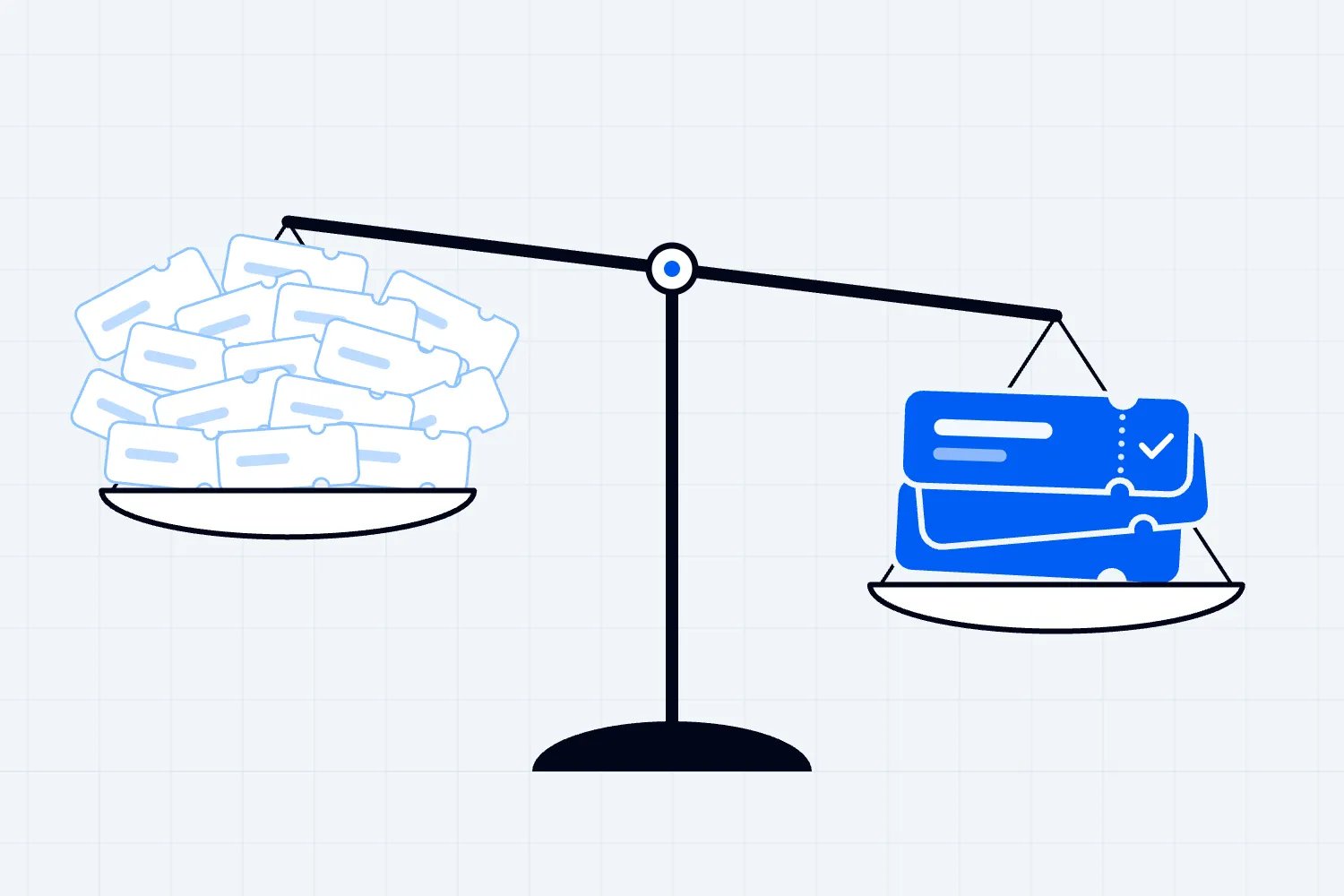
The problem is that a busy checkout doesn't tell you whether the offer helped your business. You might have encouraged people who were already going to buy to pay less. You might have sold more tickets while leaving less money to cover the venue. Or you might have found an offer that genuinely brings in enough extra business to pay for itself. Those are different outcomes.
This guide walks you through choosing an offer, setting up a fair comparison, measuring its costs and sales, and deciding what to send next. We'll use a worked example to show why the email with the most tickets can still be the wrong choice. All example figures are hypothetical, so you can replace them with your own numbers.
Start with the reason someone hasn't bought
The first thing you want to do is write down what you think is holding the buyer back. That gives your test a job. "Try a better email" is too loose. "Help previous attendees understand what's different this time" gives you something you can actually change.
Look at the replies you already receive. Look at the questions people ask before buying. A buyer who wants to know whether they can sit with friends has a different problem from someone who thinks your workshop is too advanced. Cutting both people's ticket price doesn't answer either question.
Suppose you run a paid workshop and previous attendees keep asking what they'll be able to use at work afterwards. You could test an email showing the specific exercise and take-home material against the usual announcement. The price stays the same. You're testing whether a clearer account of the value changes buying behaviour.
Keep the question narrow enough that the result tells you what to do. "Does explaining the included workbook help eligible previous workshop buyers purchase?" is useful. "What does our audience want?" needs much more than one email comparison.
The US National Institute of Standards and Technology recommends writing down and prioritising an experiment's objectives before selecting its design. For an event operator, that means deciding whether this test is supposed to improve money earned, bring purchases forward, or answer a specific buyer objection. Choose the main objective before the sales arrive.
Choose something useful that you can afford to deliver
A ticket-sales offer is the reason you're giving someone to book. It can be access, convenience, a benefit, or a clearer explanation of what they already get. A lower price is one option, and it deserves the same commercial scrutiny as everything else.
Start with something the audience wants and your team can deliver reliably. A cheap extra that nobody values just adds work. A generous extra that creates a queue at the door can make the event worse for everyone.
Explain value that's already included
This is usually the simplest place to start. You're changing what the email explains, rather than changing the ticket itself.
For a conference, you might highlight the session that helps a particular audience solve a work problem. For a workshop, show the finished exercise people will leave with. For a performance, explain the programme and the experience the ticket includes.
Be accurate about what every buyer receives. If the workbook is already included with all tickets, say that. Don't turn it into an "email exclusive" just because this is the first time you've mentioned it.
This is also a useful test when you don't have the budget or operational room for extras. You can learn whether the event needs a better explanation before paying to change the offer.
Offer earlier access at the regular price
Earlier access can matter when people care about a particular date, session, ticket type, or seat. The benefit is the opportunity to choose sooner. It doesn't require a cheaper ticket.
Only use this when the access is genuinely earlier and the eligible audience is clear. An email sent after everyone can already book isn't a presale. If desirable places are limited, explain that availability can change rather than promising every recipient their preferred place.
An access test needs extra care. If one group books earlier than another, availability and time can influence the result. Record those differences and don't call it a clean comparison of email wording. Sometimes testing how you describe an existing presale is easier than randomly granting different access.
Include an extra with a known cost
A workbook, a short follow-up session, or a practical resource may help a buyer decide. Choose an extra connected to the event, with a cost you can calculate and a clear way to fulfil it.
A digital file may have little delivery cost, but creating it takes time. A follow-up session uses someone's working hours. Printed material costs money for every person who receives it. Include those costs when you decide whether the test is worth running.
Check whether the extra can be delivered to everyone who qualifies if the offer performs well. You don't want a successful email to create a promise your team cannot keep. If there is a real limit, make it visible before purchase and reserve the stock or time needed.
Make an existing group option easier to understand
Some buyers need to organise other people before booking. Your email can explain how your existing group arrangement works, how many tickets it covers, and what the buyer pays.
Keep the comparison honest. If the group offer includes a lower price, you're still testing a discount, even if the email calls it a package. If the benefit is reserved seating together or a clear booking route, explain exactly what that means and whether it is guaranteed.
Don't assume a group purchase is automatically better. More tickets in one order can help, but any extra administration, service, or price reduction belongs in the calculation. Count ticket quantity and order quantity separately.
Choose one of these approaches for your first test. You'll learn more from a clear comparison than from an email offering a presale, a free extra, a new package and a discount all at once.
Decide what success means before you send
Your main measure should match the business question. If you're trying to improve the money the event earns, measure ticket contribution per person assigned to each version. Ticket contribution is the ticket income left after the relevant selling costs and costs of serving those buyers. It helps cover the event's fixed bills and profit.
The venue hire doesn't disappear from your budget. But if it stays the same whichever email you send, subtracting it from one test version and not the other would distort the comparison. Keep the overall event budget separate from the extra costs and income you're comparing here.
Write down which costs you'll include. Usually you need the ticket money you actually keep, refunds, fees you absorb, per-attendee costs and the cost of the benefit. Include additional email costs and any extra work created specifically for the test. Avoid counting the same deduction twice if your ticket report already shows it net of fees.
Then divide each group's contribution by its assigned recipients. That makes different group sizes easier to compare. Someone who doesn't open or click still belongs in the group they were assigned. Removing them would give the email credit only for people who engaged with it.
Track delivered emails as a check too. If one version has an unusual delivery problem, investigate it. The difference might be an issue with how the message reached people, rather than the appeal of the offer. Don't quietly change your main denominator after seeing which one looks better.
A separate objective might be earlier cash collection. In that case, record when paid orders arrive and review later sales too. A message that pulls next week's purchases into today can help your cash position without increasing final ticket sales. Describe that outcome accurately.
Open rates can help diagnose an email, but they aren't the right winner measure for this test. Apple says Mail Privacy Protection prevents senders from seeing whether someone opened an email. A report showing more opens doesn't prove that more people read your offer, and it certainly doesn't prove that the offer earned more money.
Record unsubscribes, complaints and questions as well. You don't need to put a speculative lifetime value on every unsubscribe. You do need to notice when a short-term result comes with a clear problem for your audience or team.
Keep the comparison focused on one change
For a straightforward first test, version A is your usual email at the regular ticket price. Version B changes one part of the offer or the way you explain it. Keep the other important parts as similar as you can.
That means the same event, sender, ticket price, send time, booking route, audience eligibility and measurement window. Keep the subject line the same if you're testing the offer inside the email. Keep the offer the same if you're testing the subject line. Otherwise you won't know which change mattered.
There will be cases where the offer needs a different button or landing-page explanation. Make the necessary changes so buyers understand what they're purchasing. Describe the test as a comparison of those complete offer versions, rather than claiming you've isolated a single sentence.
Here's a hypothetical workshop test. Both emails promote the same paid session at the same price. A explains the workshop using your usual description. B keeps that description and adds a clear paragraph about the included take-home workbook, with a preview of what it contains. Everyone receives the workbook whether they buy through A or B.
Now compare a different test. A sells the ordinary ticket. B sells the same ticket with a new printed resource included. This changes what the buyer receives, so its fulfilment cost matters. Don't combine these two tests in your notes. One tests communication of existing value; the other tests an additional benefit.
Write the buyer-facing sentence before designing the email. If it takes several caveats to explain the benefit, simplify the offer. A clear promise makes the email easier to read, the checkout easier to check, and the result easier to interpret.
Split eligible buyers fairly and keep the groups separate
Start with people you can legitimately send promotional email to, who are relevant to this event and haven't already bought the ticket you're promoting. An order confirmation or an important event update doesn't become a sales-test email because it gets delivered to more people.
On Loopyah, event email marketing uses your ticket-buyer contacts and lets you select audiences using what they bought. Promotional emails exclude opt-outs and dead addresses, and campaign reports connect clicks with ticket sales. That helps with audience relevance and sales reporting. The test design and interpretation still need your attention.
Randomly assign the eligible audience to the versions. Don't send A to loyal buyers and B to people who haven't attended for years, then attribute the difference to the offer. The groups brought different buying histories into the test.
An A/B test is simply a comparison of two versions. Assign roughly equal numbers to each so neither version gets most of the available buyers.
NIST's guidance on completely randomised experimental designs describes randomly assigning the versions being compared. Here, the practical aim is to give each eligible buyer a fair chance of receiving either version, rather than letting your selection favour one.
Check that your email or experiment tool supports random assignment before preparing the groups. A segment sorted by name, signup date or spending isn't a random split. Each eligible person should have the same chance of receiving either version. Keep that assignment fixed, so a later click doesn't move someone into the other group.
Keep a record of who was assigned to which version. Don't move people into a new version because they didn't click. Check for duplicates and overlapping lists so the same buyer doesn't receive both. Where you already know several contacts belong to one buying group, consider keeping that group together and record that choice.
Choose a stable audience cutoff before the send. If new contacts join afterwards, put them in the ordinary campaign or a later test rather than adding them opportunistically to whichever version is behind. Recheck suppressions before sending, because a buyer may purchase or unsubscribe after you prepared the groups.
The emails should go out at comparable times with comparable ticket availability. If A runs before a lineup announcement and B after it, your result includes the announcement. If one version sells out the relevant ticket type before the other has had a fair opportunity, record the capacity problem and avoid declaring an offer winner.
Make the terms clear enough to survive a forwarded email
Buyers can forward offers to friends. They can screenshot the email. They can ask why someone else got a benefit they didn't. Write the offer so you can explain the answer without getting uncomfortable.
Testing how you describe an existing benefit is straightforward because both groups can buy the same thing. Testing different benefits needs more thought. Choose a transparent offer structure and clear eligibility, check that it is appropriate in your market, and avoid promising identical treatment while quietly changing what people get.
For a targeted presale, say who it is for and when it ends. For an extra, say what is included, which ticket qualifies and how it is delivered. For a limited quantity, say what happens if the extra runs out. Don't hide the condition in a place buyers will only discover after paying.
The UK's Advertising Standards Authority sets out promotional marketing rules on significant conditions, including restrictions, availability and closing dates where applicable. The exact requirements depend on your market and promotion, but the useful writing test is simple. Can someone understand whether the offer applies to them before they commit?
Decide how support will handle a forwarded offer before sending. If someone outside the intended group can claim it, can you afford that? If they can't, is the eligibility clear at the point of purchase? For an early test, an offer that depends on arguing with buyers about who deserves it is probably too complicated.
Check the purchase and fulfilment before the audience sees it
Send yourself a test and follow the full purchase route on a phone. Read the subject, preview text, email, event page, checkout and confirmation as one experience. Each step should describe the same offer.
If your email says a resource is included, the booking page shouldn't suggest an extra charge for it. If the offer applies to one ticket type, make that type easy to identify. If the terms depend on a date or time, use a clear time zone and confirm the checkout behaves as expected.
Check the price buyers actually pay, including the way fees are presented. Keeping the headline price steady doesn't create a fair test if one route adds a charge the other route doesn't. The ticket-selling tools you use should make the ticket types and current prices clear; your offer still needs to match them.
Test your reporting links too. Give A and B distinct campaign identifiers and confirm they survive the route you expect buyers to take. Google's guidance on campaign URL parameters explains how source, medium and campaign values help identify traffic. They help you label visits; they don't establish that a purchase would never have happened without the email.
Finally, do a fulfilment rehearsal. Can the team recognise a qualifying ticket? Is the resource ready? Is the promised session booked? A nice-looking email can't compensate for discovering those answers after buyers have paid.
Compare the money left, even when more tickets sell
Let's work through a hypothetical comparison. These are invented figures to explain the calculation, not a Loopyah result or a benchmark for your event. Every buyer in this simplified example buys one ticket, and all the costs listed are assumptions.
Each group has 1,000 assigned recipients. A sells the usual ticket for $50 and produces 40 tickets. B keeps the $50 price, adds a benefit costing $3 per ticket, and produces 44 tickets. A separate discount version, C, sells for $45 and produces 46 tickets. A and B would be enough for a first test; C is included here to show why ticket quantity alone can mislead you.
Assume the organizer absorbs $4 in selling fees per ticket and spends $6 serving each attendee. Assume each version costs $10 to send. There are no refunds or additional setup costs in this example. The fixed $4 fee is for simple arithmetic, not a statement of Loopyah's pricing.
For A, each ticket leaves $40 before the send cost. That's $50 minus $4 minus $6. Forty tickets leave $1,600, and the $10 send cost brings contribution to $1,590.
For B, the extra reduces contribution per ticket to $37. Forty-four tickets leave $1,628 before the send cost, or $1,618 afterwards. B brings in four more tickets and leaves $28 more than A.
For C, each discounted ticket leaves $35. Forty-six tickets leave $1,610 before the send cost, or $1,600 afterwards. It sells the most tickets, but leaves less money than B. Compared with A, it improves the observed contribution by only $10.
Divide those totals by 1,000 assigned recipients. A leaves $1.590 per recipient, B leaves $1.618 and C leaves $1.600. Those are the observed results of the invented example. They don't establish that any version is reliably better in future sends.
You can also work out what the benefit needs to sell just to match A. With the same $10 send cost, B needs enough tickets at $37 contribution each to cover A's $1,600 before sending costs. Forty-three tickets leave $1,591, which falls short. Forty-four leave $1,628, which clears it.
The discount needs 46 tickets at $35 each to clear that same $1,600. Forty-five leave $1,575. This tells you the minimum whole-ticket result needed under these assumptions, not how many tickets the offer will actually produce.
Use your actual fee structure when doing this for your event. Recalculate costs when prices change. Add the time spent creating or fulfilling the benefit if it creates extra work. If B required another $100 of work, its $1,618 would become $1,518 and the apparent advantage would disappear.
Separate tracked sales from extra sales caused by the offer
A campaign report can show tickets connected with an email click. That's useful. It helps you see what people did after engaging with the message. But some of those buyers might have bought anyway through your website, a social post or a friend's link.
So distinguish the comparison you can make from the one you want to make. Comparing A and B helps estimate how the versions performed against each other when the groups and conditions were comparable. It doesn't automatically tell you the effect of emailing instead of sending nothing.
If you need that second answer and your audience is large enough, you can plan a randomly assigned group that doesn't receive this promotion during the test window. Give that group the same access to ordinary ticket sales and compare its purchases with the emailed groups using a consistent method. Important service messages should still reach the people who need them.
That adds complexity and reduces the number of people receiving each version. Don't add it casually to a small list. You need a reliable way to compare purchases by assigned group, including purchases that don't follow an email link, rather than comparing tracked clicks in one group with no tracked clicks in another.
Forwarding also complicates the picture. If buyers share a benefit or book together, the groups can influence each other. Record what you can observe and avoid claiming perfectly isolated results when the offer spread outside the assigned group.
On Loopyah, the email report describes ticket sales from people who clicked. Use that verified connection for campaign reporting, then keep the limits of that measure clear. Your wider event-management reporting can help you review the event's sales position alongside the campaign. It doesn't remove the need for a sound comparison.
A practical result might be, "B recorded more contribution in this test, and we should repeat it." That is a perfectly useful conclusion. You don't have to turn every campaign result into a claim that the offer created every ticket sale attributed to it.
Give small samples an honest reading
Small event lists can make email tests frustrating. You can do the setup correctly and still finish with too few purchases to distinguish a real difference from ordinary variation.
Suppose A produces eight buyers and B produces ten. B has two more buyers. Calling that a dependable improvement for your whole programme would go beyond the evidence. One group booking, one refund or a few ordinary decisions could change the ranking.
There isn't one audience size that makes every test trustworthy. It depends on your normal purchase rate, the size of improvement you need to detect, and how certain you need to be. A test intended to catch a large difference needs a different amount of information from one intended to distinguish two very similar offers.
For a small list, use two versions, choose a meaningful difference, and plan a repeat on comparable events or eligible audiences. Keep each event's results visible instead of adding everything together and pretending a Friday concert and a weekday workshop are the same conditions.
Set the measurement window before sending. It should fit your booking cycle and leave both groups the same time to purchase. Don't stop the test the moment your preferred version takes the lead, then call that lead the final result.
Before a large rollout, use statistical advice or a suitable analysis tool to assess uncertainty. Check that it can evaluate your main measure. A calculator comparing click rates doesn't establish a winner on ticket contribution. You can make a cautious commercial decision without claiming a result is statistically conclusive.
Turn the result into the next sensible send
After the window closes, review the result with the person responsible for the event budget and whoever has to deliver the promise. Put the figures beside the buyer replies. Both matter when deciding what happens next.
If the benefit leaves more money and you have credible evidence that the difference will hold, check its capacity before expanding it. Stock, staffing or session space can make an offer workable for a small group and expensive for the full list.
If the versions perform similarly, favour the simpler one unless the more complex offer delivers another benefit you deliberately set out to achieve. You don't need to create permanent fulfilment work for an uncertain gain.
If neither version sells well, return to the buyer question. Check whether the event, audience, price, timing or booking route is the real problem. A second discount won't tell you why people aren't convinced.
Keep a short test record with the audience rules, exact versions, assignment method, dates, costs, results and what you learned. Save the email and landing-page wording too. Next time, you'll want to know whether you're repeating the same offer or changing something important.
A useful note might read, "We tested the workbook explanation with previous workshop buyers who had permission to receive promotions and had not booked this session. Both versions went out together. B recorded more contribution, but the purchase count was too small to call it a dependable improvement. We will repeat the wording comparison at the next comparable workshop, with the same price and included materials." That note gives your team an action without pretending the test proved more than it did. It also prevents someone turning a tentative result into a permanent extra or a bigger discount when you revisit the campaign later.
For your next campaign, choose one useful reason to book at a price your event can support. Compare it fairly with your usual email, account for the cost of delivering it, and be honest about what the result proves. The useful test is the one that helps you decide how to sell the next ticket without casually giving away the money you need to run the event.

Author: By the Loopyah Content Team
The Loopyah Content Team shares expert insights, practical guides, and industry updates to help event organizers create unforgettable experiences and stay ahead in the event planning world.