· 11 min read
Dynamic Ticket Pricing vs Variable Ticket Pricing: Which Should You Use?

Use variable ticket pricing for differences you can plan before launch, such as a more popular date or a better seating section. Consider dynamic pricing when actual sales give you a reason to change the price of the remaining tickets. If you're running a new event or have little sales history, we'd start with fixed prices by date or section and planned ticket releases.
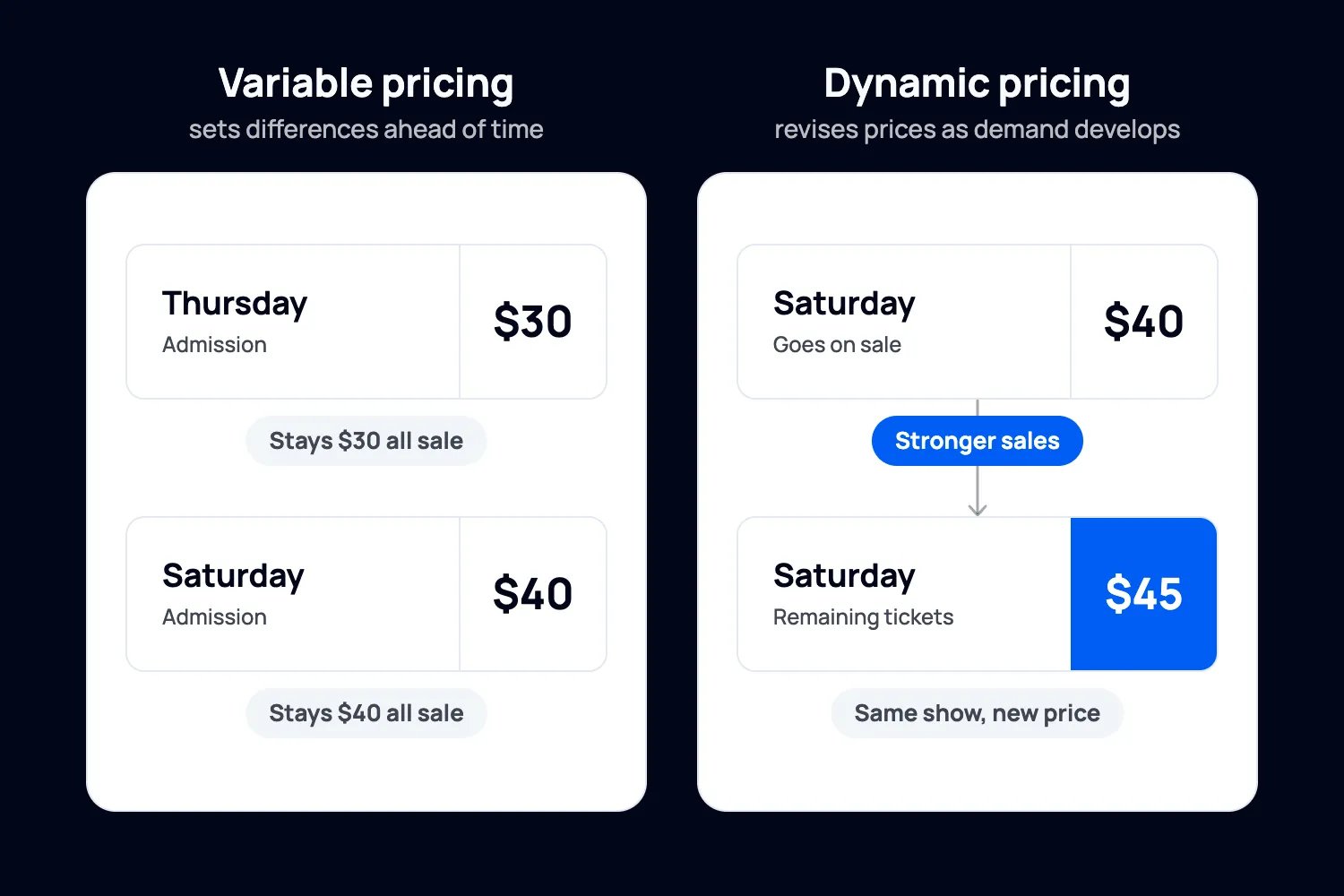
Say you run the same show on Thursday and Saturday. You expect Saturday to sell faster, so you charge more for that performance. Have you introduced dynamic pricing? No. You've priced two dates differently before anyone bought a ticket.
The distinction matters when you're choosing software, explaining prices to buyers or deciding whether a struggling event needs a discount. This guide compares the models, separates both from ticket releases, and works through the money before you choose one.
What is the difference between dynamic and variable ticket pricing?
The useful question is whether the price for the same ticket changes in response to new demand information.
Variable pricing sets differences ahead of time
You might set Thursday admission at $30 and Saturday admission at $40, then leave both prices alone throughout the sale. You could also price the front stalls differently from the balcony. Those are examples of variable pricing: the price depends on the date or category someone chooses, with the differences established in advance.
University of Virginia professor Pnina Feldman makes this distinction in a September 2026 Darden interview. She describes variable prices as predetermined and dynamic prices as responses to current supply and demand.
Dynamic pricing revises prices as demand develops
Now imagine Saturday goes on sale at $40. Sales run well ahead of your forecast, so you raise the price of remaining admission tickets to $45. That decision responds to what happened after sales opened.
The direction can also be down. You might reduce the price of remaining tickets if demand is weaker than expected. Dynamic pricing describes that responsiveness; it doesn't mean every change has to be an increase.
Cornell's explanation separates preplanned price differences from prices that change over the booking period as demand becomes clearer. For your event, the practical distinction is simple: did you follow a price plan established earlier, or revise the price because the sales outlook changed?
You can combine the models. A theatre can start with different prices by section, then adjust only selected sections during the sale. Setting different opening prices and revising those prices later are separate decisions.
Are early bird tickets and ticket releases dynamic pricing?
Not automatically. A cheaper early bird ticket is usually part of a planned offer. The name doesn't tell you what controls the price.
Take three hypothetical setups:
A scheduled increase: admission costs $30 until a stated date, then $35. The calendar triggers a change you decided earlier.
A quantity-based release: the first 50 tickets cost $30 and the next 100 cost $35. Sales determine when the first allocation runs out, but you already chose the prices and quantities.
A demand-based adjustment: you review sales against expectations and revise the price of remaining tickets. New information changes the plan.
Terminology varies between sellers, so ask what the system actually does. Does it move through prices you entered, recommend new prices, or change prices within limits you set? Those functions create different responsibilities for you.
Loopyah's ticket releases let you set a release name, price and quantity. When one sells out, the next becomes available automatically. You choose the prices and quantities; Loopyah handles the change between releases.
When should you choose variable ticket pricing?
Start here when the differences you want to price are already clear. Your Friday evening workshop might attract a different audience from Sunday morning. Better sightlines may justify a higher price in one part of the theatre. You can make those choices before the launch.
Variable pricing is particularly useful when you need to:
Give buyers stable prices they can compare across dates or sections.
Keep an affordable option available while charging more for a premium location or performance.
Publish a straightforward price list that your venue partners and staff can explain.
Learn what sells before introducing more decisions during the campaign.
The tradeoff is that your original assumptions may be wrong. Saturday might disappoint while Thursday sells out. Stable pricing gives you predictability, but it also limits your response if you commit to holding every price.
If your event is new, treat the opening structure as something to learn from. Record which dates and sections sell, how far ahead people buy, and which prices produce too many unsold tickets. Use that evidence when setting the next event's prices.
Our pricing strategies guide covers the wider choices, including bundles and different ticket offers. You don't need demand-based changes to have more than one useful price.
When is dynamic ticket pricing worth considering?
If Saturday reliably sells better than Thursday, start by pricing the dates differently. Dynamic pricing becomes useful when actual sales change your view of what the remaining tickets can sell for during the campaign. You can make that decision yourself or use software to help. An algorithm isn't what makes a price change dynamic.
Compare bookings at the same number of days before the event, using a similar performance where you have one. Account for differences in capacity, promotion and the offer. Selling 100 tickets six weeks out tells you something different from selling 100 the day before doors open.
Before changing the price, estimate how many remaining tickets you'll sell if you leave it alone and explain what supports that estimate. A slow week could mean the price is wrong. It could also mean your ads stopped, the ticket page is unclear or buyers normally book later. Investigate those causes before reaching for a discount.
You need a reasonable view of expected sales, access to current results and someone accountable for the decision. That person should be able to explain why a change happened and reverse it if the reasoning fails.
Ask a potential pricing provider to demonstrate its controls using your actual type of event. Can you hold some tickets at a fixed price? Can you set a minimum and maximum? What happens to a buyer already paying? Who can stop or override changes?
Then count the cost of running it. A system that produces a little more ticket income may still leave you worse off after software, staff time, refunds or extra support. For a small event, a clear release plan may be the better commercial choice even when a more complicated model is available.
Compare the money before you change the model
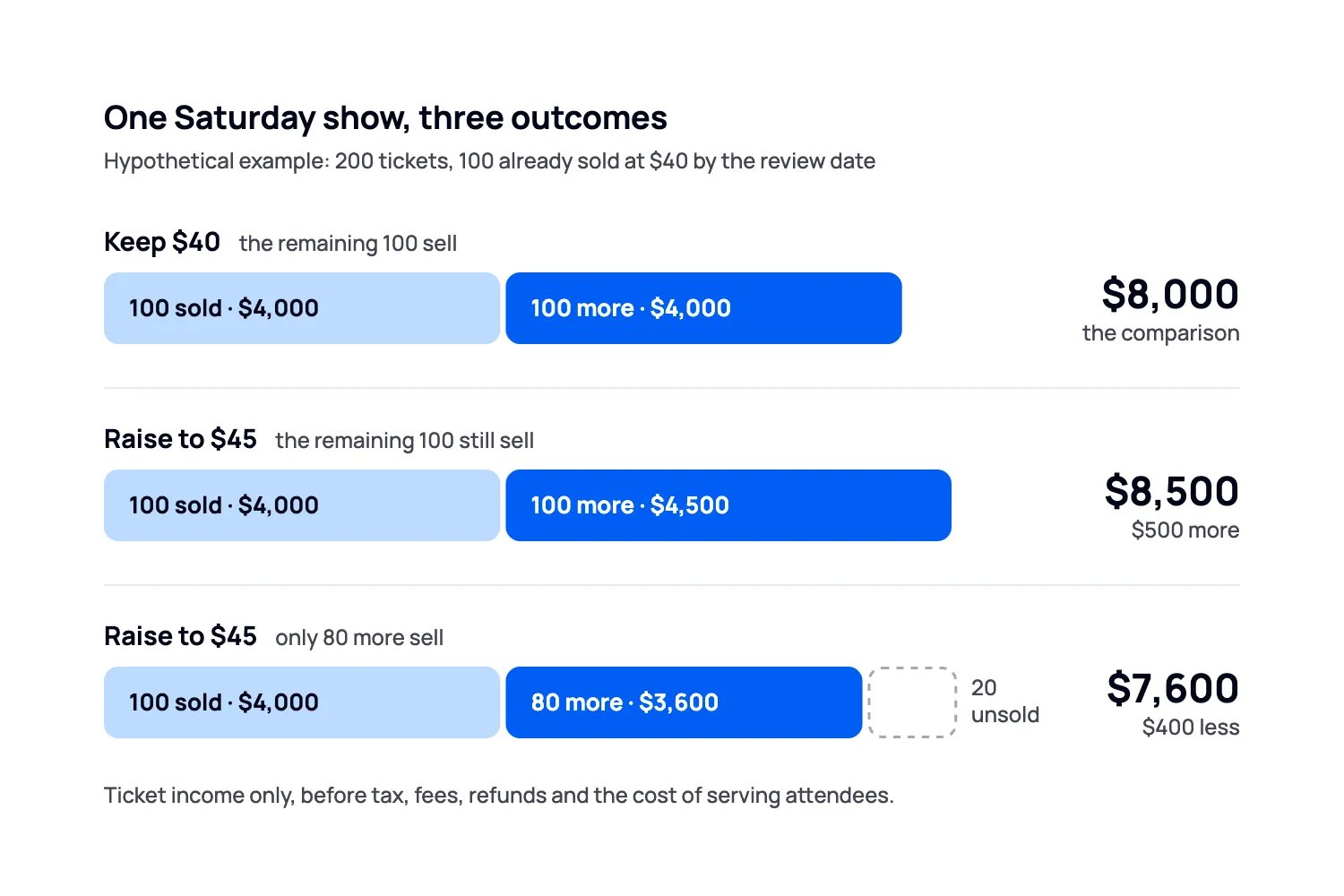
Here's a hypothetical example, not a forecast or a Loopyah customer result. It isolates ticket income; tax, ticketing fees, refunds and any extra cost of serving attendees must be added to a real event budget.
You're selling 200 tickets for one Saturday show at $40. By your review date, 100 have sold, bringing in $4,000. The first 100 buyers keep their original price under every option below.
Keep the remaining tickets at $40
If you sell the remaining 100 tickets, they bring in another $4,000. Total ticket income is $8,000 from 200 sales.
That's the full-sale comparison, not a promise that leaving the price alone will fill the room.
Raise the remaining tickets to $45
If all 100 remaining tickets sell, they bring in $4,500. Total ticket income reaches $8,500, which is $500 above the comparison.
But if only 80 more tickets sell, they bring in $3,600. Total income is $7,600 from 180 tickets, leaving you $400 below the full-sale comparison.
To equal the remaining $4,000 at a $45 price, you need at least 89 more sales: 89 multiplied by $45 is $4,005. If the change also costs an extra $200 to operate, you need 94 more sales to cover $4,200 before other costs. Ninety-four multiplied by $45 is $4,230.
That calculation tells you what must happen. It doesn't tell you whether buyers will accept the increase.
Lower the remaining tickets to $35
For the discount decision, use a different forecast. Suppose you now expect only 60 more sales at $40, rather than selling all 100 remaining tickets. Those 60 sales would bring in $2,400, taking total ticket income to $6,400.
At $35, you need at least 69 more sales to exceed that remaining $2,400: 69 multiplied by $35 is $2,415. Selling 80 at $35 would bring in $2,800, taking the total to $6,800 before additional costs.
A lower price makes commercial sense only if the extra sales and any other income you keep cover the discount and the cost of serving more people. The 69-ticket threshold above matches ticket revenue, not profit.
To see the difference, use another illustrative calculation. Assume you keep $40 or $35 per ticket after taxes and organizer-borne fees, then spend $5 serving each extra attendee. Sixty sales at $40 leave $2,100 toward fixed costs and profit. At $35, each sale leaves $30, so you need 70 sales to match $2,100 and 71 to improve it, before any extra advertising or administration cost.
Write down the extra sales you expect the discount to produce. If that estimate isn't credible, the lower price hasn't solved your budget problem.
Explain the model before buyers encounter it
You may understand the difference between a planned release and a demand-based change. A buyer sees the price they expected and the price they're now being asked to pay.
For a planned release, explain the trigger. For example: "The first 50 tickets are $30. The next release is $35." Use that wording only when it matches the actual setup, and show applicable mandatory charges clearly.
For variable date pricing, make the choices easy to compare. Tell people which performance or section each amount buys. A label such as "premium" should describe a meaningful difference they can understand.
For dynamic pricing, explain that prices may change and what drives those changes. The UK's Competition and Markets Authority recommends prominent explanations and advises businesses not to change prices while customers are paying. Its business guidance also warns against pressuring people into rushed decisions. Check the requirements in the markets where you sell.
Apply the explanation across the buying journey. An old social post promising a fixed price can conflict with a changing ticket page. Give whoever answers customer questions the same explanation, and check whether scheduled emails still describe the available offer accurately.
Also think about returning buyers. If you repeatedly cut prices late, some may decide to wait next time. Judge the result across a series of events, including complaints and repeat bookings, before declaring the pricing change a success.
Put your choice into a workable ticket setup
The first thing you want to do is separate the ticket someone buys from the rule that determines its price.
For a seated event, Loopyah's seat charts connect each seating category to a ticket type you price through releases. You can price the balcony separately from the stalls and give each section its own release quantities and prices. Buyers choose their seats from the map.
For a general admission event, start with the ticket types you actually need, then give each at least one release. Keep the descriptions clear about what admission includes. Adding more price labels won't help if buyers can't tell the offers apart.
Keep separate ticket types for different admission offers or seating areas. Use releases when the admission stays the same but you want later allocations sold at another price. That keeps the buyer's choices understandable and lets you see which offer is selling.
Before launch, check the quantity at each price, the total available capacity and the explanation buyers will see. Work out the income your planned mix produces if every allocation sells, then repeat the calculation with fewer sales. The second calculation is often the one your budget needs most.
Which model should you use?
Choose variable pricing when you can make the important price decisions before sales start. Add planned releases if you want defined allocations to move through prices you've already chosen.
Consider dynamic pricing when changing demand is a recurring problem, you have enough evidence to act on it and the likely benefit justifies the work and cost. Keep the test small enough that you can understand the outcome.
For your first test, choose one performance or ticket category. Record the current price, remaining inventory, expected sales without a change and the sales needed at the proposed price. Set a review date and decide who can stop the test.
Afterward, compare the money left after costs as well as ticket count. Note any simultaneous change in advertising, availability or the programme, because a better result alone doesn't prove the price change caused it. Keep the approach only if the evidence supports using it again.

Author: By the Loopyah Content Team
The Loopyah Content Team shares expert insights, practical guides, and industry updates to help event organizers create unforgettable experiences and stay ahead in the event planning world.