· 12 min read
How to run a paid speed-dating event

To run a speed dating event people will pay for, define who should meet, price a format you can deliver, and sell only the places that format can accommodate. Then give guests a clear arrival process, a reliable rotation schedule and a private way to choose whether they want further contact.
Your job is to make introductions comfortable and organised. You can't promise chemistry. You can provide a host who welcomes guests, explains each round and steps in when someone needs help.
This guide covers the audience, budget, venue, ticket sales, running order and follow-up for a paid event. We'll use one illustrative 24-person evening throughout so you can see how the decisions connect.
Choose the audience and meeting format first
Start with who the event is for and who guests want to meet. An adults-only singles evening needs a clearer description than "meet interesting people". State the intended age range, location, format and any relevant dating preferences respectfully. Explain the experience before asking someone to buy.
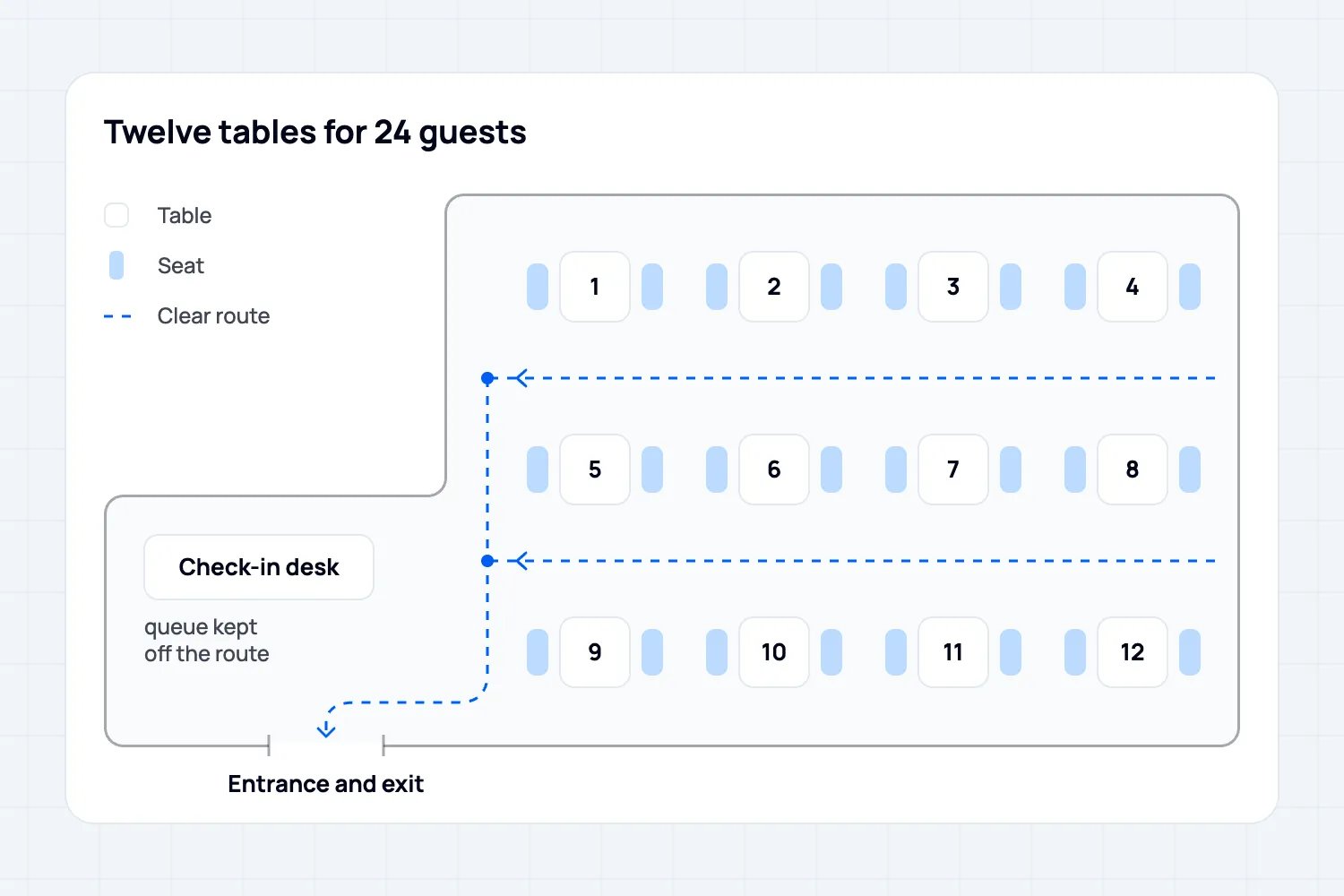
For our example, assume 24 adults in two groups of 12, with participants joining because they want introductions to people in the other group. Twelve tables allow twelve conversations at once. One group stays seated while the other moves, so everyone can meet the twelve people in the other group.
That arrangement suits some events. It isn't a universal template for gender, sexuality or attraction. An evening where guests choose different age ranges, a mixed-preference audience or an event where everyone wants to meet everyone may need an individual pairing schedule. Build and test that schedule before selling the capacity. Don't force people into categories that don't describe them.
Write down what the ticket includes: the planned number and length of conversations, hosting, any refreshments and how introductions continue afterwards. For this example, describe a planned ten-to-twelve-conversation format, depending on attendance, and explain what happens if you can't provide it. Don't advertise twelve guaranteed dates and quietly substitute ten at the door.
Give guests a contact for access questions. If you're still choosing a theme, our format ideas can help; settle the operating plan before spending on decoration.
Price the event before you book the room
A full room doesn't automatically pay you properly. Count the preparation, hosting and follow-up work alongside the venue charge. Ask the venue whether the quote includes furniture, cleaning, staff and exclusive use, and whether a minimum bar spend leaves you paying the difference.
Here is an invented planning example in US dollars. These are assumptions, not typical market prices or Loopyah fees:
Venue hire: $200.
Host, including preparation and matching follow-up: $180.
Check-in and floor assistant: $120.
Promotion: $100.
Contingency allowance: $60.
Total fixed budget: $660.
Assume a $40 ticket and a further $4 per ticket for payment fees and consumable materials. That leaves $36 per sale toward the fixed budget. Drinks are bought separately from the venue, so neither drink revenue nor drink costs appear in this example.
Divide $660 by $36. You need 19 paid tickets to cover those itemised costs, rounded up from 18.33. At 24 sales, ticket revenue is $960. Subtract $96 in variable costs and $660 in fixed costs, leaving $204 before tax and any business overhead not included here.
But 19 buyers won't give our two-group format equal numbers. Set a separate operating minimum of 20 confirmed guests, ten in each group, and prepare a ten-round version. Twenty sales leave $60 under these assumptions. Eighteen sales leave a $12 loss, even before wider business costs.
Keep paid sales and expected arrivals separate. Twenty paid tickets split twelve and eight across the groups can cover the itemised budget while failing the meeting plan. A paid no-show can leave money in the account and still reduce other guests' introductions. Recheck both counts at the decision date and again at check-in.
Replace every allowance with your actual costs. Recalculate for discounts, refunds or included drinks, and use an event budget that includes your own time. Choose a decision date before venue cancellation charges or extra supplier commitments make changing course expensive.
Pick a room where people can hear each other
Visit at the time of day you'll run the event. A quiet afternoon viewing won't tell you what happens when the evening music starts. Test a conversation across a table while someone speaks at the next one. Check lighting, toilets, access, table spacing and where coats and bags will go.
Confirm the permitted capacity with the venue, including staff. Our 24 guests and two event staff already make 26 people before any venue staff are counted. A room's standing capacity doesn't tell you whether twelve tables and clear routes will fit.
The UK's Health and Safety Executive recommends checking exits, pedestrian routes and emergency arrangements before admission. Apply that crowd guidance to your layout: don't turn the check-in queue, spare chairs or bags into an obstruction. Agree responsibilities with the venue and use our accessibility checklist when checking the guest journey.
Give the host responsibility for explanations, timing and announcements. Give the assistant the arrival list, late arrivals and private requests for help. This is the staffing choice for our example, not a universal staffing ratio. Discuss additional needs with the venue.
Brief both people on conduct expectations and who can intervene. Guests should know they can skip a conversation or leave. Nobody should have to negotiate with an uncomfortable date to get assistance. Put the same expectations on the event page and repeat them briefly at the start.
Sell the places your format needs
For the two-group example, make twelve places available in each group. Describe the groups in language the intended audience recognises, and give unsure buyers a private way to ask which ticket is suitable. Don't use an unexplained label on a public checkout and expect people to guess.
On Loopyah, ticket types let you name and describe the categories. Each needs a release with its price and available quantity. Use ticket releases to set those quantities, and check the combined stock across releases before opening sales. Your team still owns the pairing plan and decisions about the attendee mix.
Make the page answer the practical questions: where to arrive, when introductions begin, what is included, who the evening suits and when match results will arrive. Explain your late-arrival and cancellation terms. Our refund policy guide can help you make those terms clear before purchase.
Promote to the audience you selected. Ask the venue to share the booking page, use relevant local communities where promotion is welcome and send invitations to your own opted-in list. Track which promotion produces purchases. If one group is filling faster, focus the next effort on the missing places instead of selling more tickets you can't accommodate.
Send a reminder with directions, arrival time and a way to report cancellation. Check confirmations before the decision date. Don't overbook on the assumption that a particular percentage will stay home; you don't have that evidence for a first event.
Rehearse the rotations and the no-show plan
Number the tables and give each guest a separate event ID for recording choices. Put their preferred first name and guest ID on a badge. The ID belongs to the person and stays with them as they move; the table number only tells them where to sit. Keep contact details off badges and choice sheets that other guests could see.
Walk through the first two rounds with your team, including where the moving group goes after the last table. Rehearse a late arrival and a guest choosing to sit out, so the assistant can handle either without stopping every conversation.
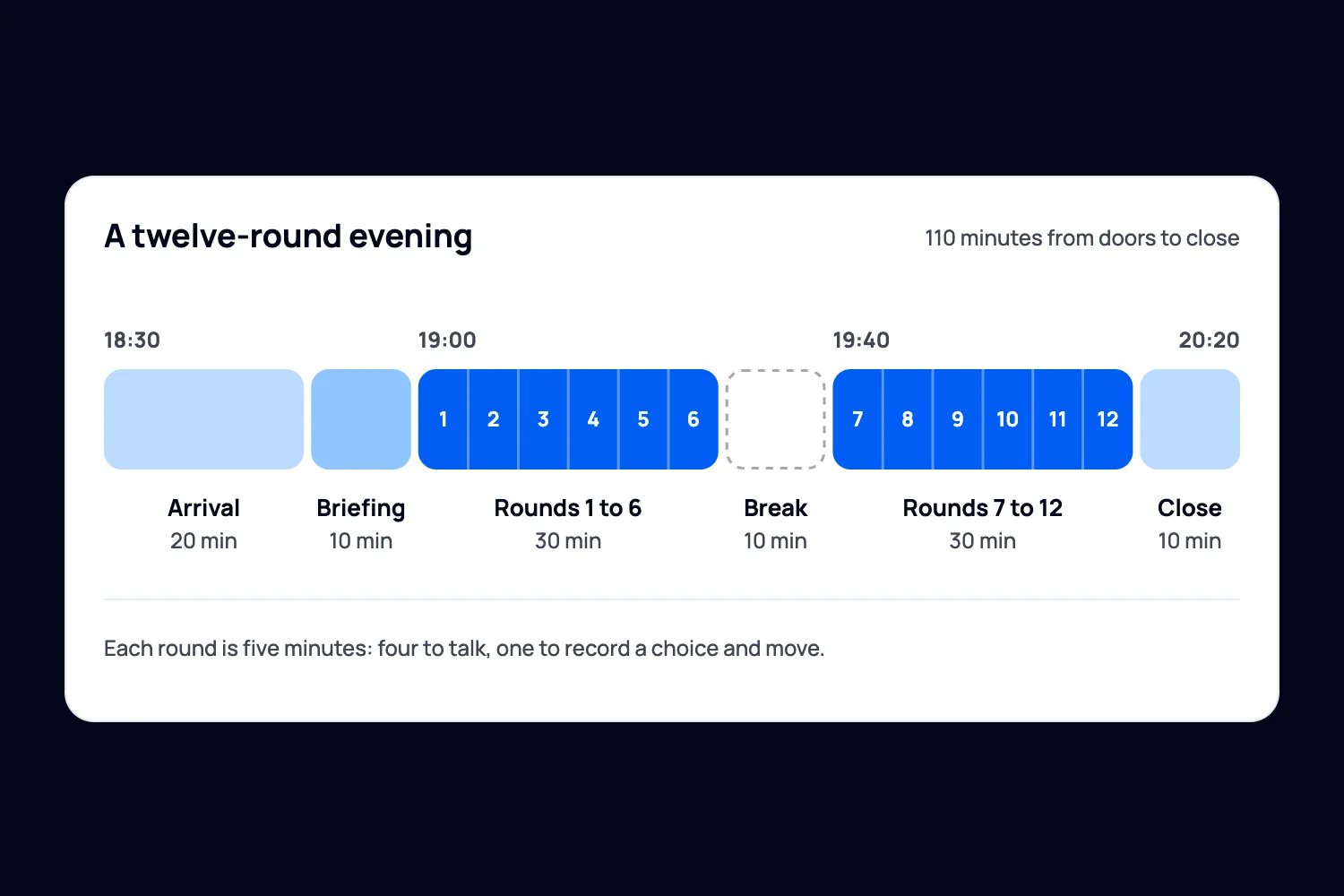
For twelve people in each group, use twelve rounds. A four-minute conversation plus one minute to record a choice and move makes each round five minutes. Six rounds take 30 minutes. This is a proposed schedule, not a claim that four minutes is the ideal date length.
The full evening can run like this:
18:30 to 18:50: arrival, check-in and seating.
18:50 to 19:00: welcome, conduct expectations, choice recording and a rotation demonstration.
19:00 to 19:30: rounds one to six.
19:30 to 19:40: a ten-minute break.
19:40 to 20:10: rounds seven to twelve.
20:10 to 20:20: final choices, questions and closing instructions.
That's 110 minutes from doors opening to the formal close. Leave separate time in the venue booking for setup and clearing the room. Confirm whether guests can remain afterwards without extending your hire charge.
If all 24 attend and rotations work, each guest has twelve conversations. Each person in the moving group starts at a different table, advances one table per round and wraps from table twelve to table one. Avoid moving both groups at once.
Loopyah's attendee check-in supports QR scanning or finding a buyer by name. Use the actual arrivals to confirm your running order. A sold ticket doesn't tell you someone is in the room.
If ten people arrive in each group, switch to the rehearsed ten-round schedule. Two blocks of five five-minute rounds, the same break, briefing, arrival period and close make a 100-minute evening. Tell guests about the revised finish time before the first round.
If twelve arrive in one group and ten in the other, seat the twelve and rotate the ten across those tables. A twelve-round schedule gives each seated guest ten conversations and two rest rounds; each moving guest has twelve conversations. Explain the rests so nobody mistakes one for being left out. Never fill an empty seat with a staff member pretending to be a guest.
For this example, fewer than ten arrivals in either group means you can no longer offer everyone the planned minimum of ten introductions. Explain the shortfall before starting and follow the cancellation or changed-format terms guests saw before paying, including applicable refund obligations. Don't present a credit as the only answer when a refund is due. Brief late arrivals separately and bring them in between rounds without promising they can recover missed conversations.
Keep choices private and introductions voluntary
Tell guests exactly how to submit their choices and when you'll respond. For this example, ask for choices by noon the next day and send checked results by 18:00. Pick a timetable your team can meet, including time to resolve an illegible ID or missing submission.
Share contact details only when both participants have selected each other and agreed to that specific sharing process. Say which contact detail will be shared before collecting permission. Someone choosing "yes" shouldn't unexpectedly discover that you have sent their phone number, surname and social profiles to another guest.
The UK's Information Commissioner's Office says organisations should collect information that is relevant and limited to their purpose. Its data guidance is UK-specific, but the planning question is useful anywhere: do you need this field to run the event? Avoid collecting personal histories or keeping dating choices in a general marketing list.
Where preferences or choices reveal sexual orientation, UK rules give that information additional protection. The ICO's sensitive-data guidance requires both a lawful basis and an additional condition for using it. Establish those before collecting it; permission to share a match's contact details does not settle every privacy requirement.
Restrict access to matching records, explain how long you keep them and delete them when no longer needed. Check local privacy requirements for the information your format collects. Keep permission for future marketing separate from agreement to share a match's contact details.
Australia's eSafety Commissioner warns that sharing extra personal information and moving conversations into channels that expose contact details can make unwanted contact harder to stop. Its dating advice supports giving people control over that decision. Don't add the whole room to a group chat or circulate an attendee directory.
Use guest IDs to check mutual choices. If guest 07 selects guest 18 and guest 18 selects guest 07, check that both agreed to share the stated contact detail, then send each a private introduction. If only one selected the other, share neither the contact detail nor the one-way choice. A missing submission is not permission.
Have the host prepare the results and the authorised assistant check the IDs, permissions and recipients before sending. Tell guests with no mutual selections that their results are complete, without listing who declined them. Resolve an unclear ID privately rather than guessing.
You own that matching process; ticketing and attendee communications don't perform it for you. Send results individually and provide a private contact for questions or complaints.
Decide whether the next evening earns its place
After the event, compare paid tickets, actual arrivals, refunds and the costs you really incurred. Review attendance by the groups your format required. Ask whether people could hear, understood the rotations and felt comfortable asking for help.
Separate the event experience from whether someone found a partner. A guest can enjoy the evening without making a match. Someone who does find a relationship may stop buying dating tickets, so repeat purchase alone won't describe success.
Track recommendations, feedback and purchases from guests who want another event. Loopyah's event CRM keeps buyers' event history and email permission together, so you can invite an appropriate, opted-in audience to the next date. Leave private matching decisions out of that campaign.
Before booking again, fix the weakest part of the first evening and rerun the budget with actual costs. Keep a format that people value and that pays for the work involved. Change a room, price or capacity that only worked because you quietly supplied hours of unpaid labour.
Final thoughts
Choose an audience and a meeting format you can deliver. Price the work, set both a financial and an attendance minimum, and cap tickets accordingly. Rehearse arrivals, rotations and the smaller-room version before doors open.
Then protect guests' choices, send accurate results on time and review the real economics. A paid speed-dating event becomes repeatable when guests know what they're buying and you know what delivering it costs.

Author: By the Loopyah Content Team
The Loopyah Content Team shares expert insights, practical guides, and industry updates to help event organizers create unforgettable experiences and stay ahead in the event planning world.