· 21 min read
Event venue contract template: costs, access and cancellations
A useful event venue contract template should tell you exactly what you're buying, when you can use it, what you'll pay and what happens if the event can't go ahead. For a paid event, it also needs to connect the room's approved capacity and access hours to the tickets you can sell and the money you have to commit.
The venue looks right. The date works. The hire fee fits your budget. Then you discover that setup starts too late, the sound technician costs extra and your deposit doesn't settle the cancellation bill. That's an expensive way to learn what was missing from the agreement.
Below, you'll find adaptable contract wording, notes on the terms worth negotiating and a completed example with the numbers worked through. Use it for commercial conferences, workshops, performances and other ticketed events. If you're still discussing the deal, our venue negotiation guide will help you settle the commercial terms first.
Before you copy the event venue contract template
The first thing you want to do is get the full booking pack. That means the quote, hire conditions, room plan, equipment list and any supplier rules. A friendly email saying you can use the loading bay won't help your production team if the signed terms only give you access through the front entrance.
Find out which company is actually hiring the space to you. Put its legal name in the agreement, along with yours. Check that the person signing can commit that business and that the venue has authority to grant the agreed use.
You don't need complicated language to make this useful. The Australian government's guide to preparing a contract recommends plain wording and clear payment, work and dispute terms. Here, the event-specific detail matters just as much. "Room hire" doesn't tell you whether the room arrives empty or ready for ticket holders.
If the venue insists on its own contract, use the clauses below to prepare an amendment. Both parties need to agree which document takes priority where wording conflicts. Don't assume your booking email overrides the venue's standard conditions.
Copyable venue hire agreement
Replace every bracketed field, remove options you haven't selected and attach the documents you name. Copy the numbered clauses into your agreement; keep the explanations and worked example below out of the signed version. A blank field is an unresolved decision.
1. Parties, event and contract documents
This agreement is between [venue legal name, registration number and address], called the Venue, and [organizer legal name, registration number and address], called the Organizer. The Venue grants the Organizer use of [named rooms and areas, full address] for [event name and permitted activities] on [event date].
The agreement comprises these clauses and [list each attached quote, layout, technical specification and hire conditions by title, version and date]. If documents conflict, the following order applies: [agreed order]. Only the listed versions form part of this agreement. Later policy changes require the process in clause 7, except changes required by applicable law.
The booking becomes confirmed when [specified confirmation requirements]. Any provisional hold ends on [date, time and time zone]. Neither party may treat a provisional hold as permission to announce a confirmed booking.
2. Rooms, layout and capacity
The Venue will supply the rooms, furniture, equipment and facilities listed in [attached specification]. The Organizer has exclusive use of [areas] and shared use of [areas and restrictions]. The Venue must disclose any overlapping bookings or works that could affect the agreed use.
The approved event layout is [drawing reference and date]. Its maximum permitted occupancy is [number and basis for counting people], including [applicable categories]. The agreed ticket allocation is [paid admissions], with [complimentary admissions] and [staff, performers, contractors and other allocations] accounted for separately. All allocations remain subject to lawful occupancy and safe operation.
Neither party may change the room, layout or agreed allocation without written agreement and any required approval. The Venue must promptly report any restriction affecting use or capacity. A change that materially prevents the agreed event triggers clause 9 if the parties cannot agree a suitable remedy.
3. Access, setup and departure
The Venue will make [areas] available for deliveries from [date and time], setup from [date and time] and technical checks from [date and time]. Public admission begins at [time], the event ends at [time], and audience departure finishes by [time]. Removal of equipment and reinstatement must finish by [date and time]. All times use [time zone].
Access includes [loading bay, vehicle restrictions, lifts, storage, staff entrance and keys]. The Venue will provide [named duty role] during [hours]. Any restrictions on sound checks, deliveries or storage are [details].
Extensions require approval from [authorized roles] and cost [rate, charging increment, minimum charge and taxes]. An extension does not override licensing or safety limits. Charges caused solely by the Venue failing to provide agreed access will not be payable by the Organizer. Other delay remedies are governed by clause 9.
4. Charges, payment and deposits
All amounts are in [currency]. The fixed hire fee is [amount]. Additional agreed charges are [item, quantity, rate and total for each]. Taxes are [type, rate, taxable items and amount]. Mandatory service charges and minimum spends are [amounts and calculation, or none]. The total agreed price is [amount], subject only to the changes and usage charges expressly allowed here.
Any minimum spend counts [qualifying purchases], excludes [items] and is measured over [period]. Any shortfall is calculated as [formula], with [tax treatment]. Revenue shares, catering commissions and ticket levies are [formula and reporting arrangements, or none]. No charge may be imposed twice under different labels.
The booking payment is [amount], payable on [date or trigger], and is credited against the total price. Further installments are [amounts and dates]. Refundability is governed by clauses 8 to 10; describing a payment as a deposit does not create a separate cancellation charge.
The refundable damage bond is [amount], payable on [date]. It is separate from the hire price and booking payment. The Venue may apply it only to evidenced amounts permitted under clause 11 and must return the undisputed balance by [deadline].
Payments require an itemized invoice sent to [address]. The payment method is [method]. Each party will verify changes to payment instructions through an independently confirmed contact. Late-payment terms are [agreed lawful terms]. Disputed invoice items follow clause 12; undisputed sums remain due.
5. Suppliers, equipment and commercial rights
Mandatory suppliers are [supplier, service, agreed rate and appointment responsibility, or none]. Outside suppliers permitted without further approval are [list]. Other supplier requests must include [required information] and receive a written response within [period]. Reasons for refusal must relate to [agreed safety, licensing, technical or other stated criteria].
The Venue will supply [equipment and operator hours], ready for use by [time]. The Organizer will supply [equipment and services]. Technical requirements, power, internet, rigging and permitted sound levels are set out in [attached specification]. Responsibility and timing for testing are [details].
Rights to sell tickets, merchandise, food and drinks, display sponsor branding and record the event are [agreed allocation and restrictions]. Use of either party's name or logo requires [approval process]. This agreement does not grant rights in third-party performances or materials.
6. Safety, accessibility and venue responsibilities
The Venue is responsible for [premises readiness, building systems, agreed utilities, fixed facilities and specified venue staffing]. The Organizer is responsible for [event activities, contractors, ticketing, audience management and specified event staffing]. Responsibilities for security, first aid, cleaning, waste and accessible routes and facilities are [named allocation, service levels and hours].
Required licences, permits and approvals are [list], with [party] responsible for each and evidence due by [date]. Each party must provide information reasonably needed by the other to plan safely, including known hazards and relevant emergency procedures.
The safety contacts are [names and phone numbers]. Authority to stop unsafe activity and the communication procedure are [details]. Nothing in this agreement removes a duty imposed by applicable law. A safety intervention does not, by itself, decide who bears the resulting costs; clauses 7 to 10 apply according to the cause.
7. Changes and extra spending
Only [named Organizer role] and [named Venue role] may approve changes to price, scope or timing. Each approval must record the change, total cost including taxes, operational effect and any revised payment date. Both parties must agree in writing before the changed work proceeds.
For immediate action reasonably required to protect people or property, [responsible role] may authorize necessary spending up to [amount]. The other party must be informed as soon as possible, with an itemized record and explanation. This provision does not transfer liability for a party's own failure to the other party.
8. Cancellation by the Organizer
The Organizer may cancel by written notice under clause 12. The applicable cancellation amount is [complete schedule with exact date bands, fee basis and amounts or percentages]. The bands are determined by the date and time notice is received. The booking payment and other prepaid hire amounts count toward this amount; they are not added to it.
Approved third-party commitments may be charged only if [listed in the agreement or separately approved in writing], genuinely unrecoverable and supported by evidence. They must not duplicate costs already included in the cancellation amount. The Venue will take reasonable agreed steps to reduce losses, cancel avoidable orders and seek replacement bookings, with credits calculated as [precise method].
Within [period], the Venue will provide a settlement showing the applicable charge, permitted costs, prepaid sums and credits. Refunds or additional payments are due within [period]. Any later replacement-booking credit is reconciled by [deadline]. The damage bond is returned separately, less only valid deductions. These terms remain subject to applicable law.
9. Venue failure and other breach
If either party materially breaches this agreement, the other must give written notice describing the failure and a reasonable remedy deadline of [period], shortened where the event timetable reasonably requires it. If the breach remains unresolved, the affected party may terminate. An immediate serious safety risk or a failure that cannot be remedied in time may justify immediate termination, subject to applicable law.
If the Venue cancels for its own convenience or cannot supply the agreed venue for reasons within its responsibility, it must refund [specified prepaid sums] within [period]. Treatment of approved relocation costs and other recoverable losses is [agreed terms], subject to clause 13 and applicable law. A replacement venue or date requires the Organizer's written agreement.
Where the Organizer's breach causes termination, settlement follows [agreed method and relationship to clause 8], without duplicate recovery. Neither party may recover the same loss more than once. Refund obligations, unresolved payments and dispute provisions survive termination.
10. Events outside the parties' control
For this agreement, a qualifying disruption is [locally reviewed definition and covered circumstances]. Ordinary poor ticket sales, a change of preference or lack of funds are not qualifying disruptions. A party claiming relief must promptly describe the event, affected obligations, expected duration and reasonable steps being taken to limit its effect.
Only affected obligations are suspended for [period or event-specific deadline]. The parties will discuss lawful, safe alternatives. A replacement date requires written agreement on the date, charges and treatment of existing payments by [deadline]. Neither party must accept an indefinite credit.
If no agreed alternative is available by that deadline, either party may terminate by written notice. The settlement will return payments for undelivered services, less only [specifically agreed, lawful and evidenced unrecoverable costs], without duplicate recovery. The damage bond is returned less any valid existing deduction. Settlement and payment are due within [period]. Applicable law prevails where it requires different treatment.
11. Condition, damage and final settlement
The parties will inspect the hired areas at [handover time] and [return time], record existing damage and retain dated photographs. The Organizer is responsible for damage attributable to [agreed scope of its responsibility], excluding existing defects, ordinary wear and damage caused by the Venue.
The Venue must notify any proposed deduction within [period], identify the contractual basis and provide evidence of the damage and reasonable repair cost. It must not charge for unrelated improvements. Disputes follow clause 12. The Venue will return the undisputed bond balance within the deadline in clause 4, without waiting for resolution of a separate disputed amount.
The final invoice will reconcile agreed fees, approved changes, measured usage, credits and all payments already received. Supporting records must accompany variable charges. No item may be recovered through both the invoice and the bond.
12. Notices and disputes
Formal notices must be sent to [Organizer notice email] and [Venue notice email]. A notice is treated as received [agreed delivery rule, business hours, time zone and failed-delivery treatment]. Event-day operational contacts are [names and numbers]; an operational conversation alone does not change this agreement.
A dispute notice must describe the issue, evidence and requested remedy. Authorized representatives will meet within [period]. If unresolved within [period], the parties will use [agreed mediation process and cost allocation] before further proceedings, except where urgent relief or applicable law requires otherwise. This agreement is governed by [jurisdiction], with disputes heard in [agreed courts or locally reviewed alternative].
13. Insurance and allocation of liability
Each party will maintain [specified policies, limits, dates and any required endorsements] and provide evidence by [date]. Any liability limit, indemnity, exclusion of loss or exception is set out in [locally reviewed wording attached and incorporated here]. Neither party assumes an additional indemnity merely because it supplies insurance evidence.
No provision excludes or limits liability where doing so is unlawful. The parties must complete and review this clause before signing, including how it interacts with refunds, cancellation settlement, third-party claims and damage to property.
14. Agreement and signatures
This agreement and its listed attachments record the agreed booking terms, subject to rights that cannot lawfully be excluded. Changes follow clause 7. Each signatory confirms authority to sign for the named party.
For the Venue: [legal name], signed by [name and role], signature [signature], date [date]. For the Organizer: [legal name], signed by [name and role], signature [signature], date [date].
Check the clauses against your actual event
The template gets the questions onto the page. Now walk through the event with the venue manager. Read the agreement as if you're the person arriving with the equipment, approving an extra charge or processing the final invoice.
Price the services you're required to buy
A room quote can look affordable until you add the services you aren't allowed to arrange yourself. Ask for the compulsory supplier list before accepting the hire price. If the venue requires its own audiovisual team, get that team's written quote for your actual equipment and hours.
Check the basis of every minimum spend, too. Does a bar commitment include tax? Do attendee purchases count? Do purchases at another bar in the building count? Who supplies the sales report, and when can you challenge it? The answers belong beside the amount in the agreement.
For a ticket levy or revenue share, define the sales being counted and the treatment of refunds, complimentary tickets and taxes. "A percentage of sales" is unfinished wording. You need a calculation that both finance teams can reproduce from the same records.
Know what the liability clause asks you to pay
The liability section is deliberately a local-review field. A generic promise to cover "all losses" can reach far beyond a broken chair or your own team's actions. Ask your lawyer to explain which losses you could have to pay, whether there is a limit and which claims sit outside it.
Ask your insurance adviser a separate question: does the actual policy cover the responsibilities you're accepting? Send the wording, not just the venue's requested insurance amount. A certificate showing a limit doesn't tell you that every contractual promise is insured.
Read the venue's protections alongside your remedies. If its failure leaves you finding another room, can you recover any relocation cost? Does a general exclusion erase the specific remedy you negotiated? The refund and liability clauses need to agree with each other. Settle that before suppliers start spending against the booking.
Access time determines what your crew can deliver
"The event starts at 10" tells the venue almost nothing about when you need the building. Your crew may need several hours to unload, build, test and fix something before doors open. Put those hours in the booking, including the time after the audience leaves.
For the illustrative workshop below, access begins at 7 am, technical checks start at 9 am and doors open at 9:30 am. The event runs from 10 am to 5 pm. Attendees leave by 5:30 pm, and equipment is out by 7 pm. That's twelve hours of venue access for seven hours of programming.
Confirm that the duty manager, loading bay and lifts are available during the same hours. Your contract needs to work at the loading door, too.
Capacity needs an approved layout
Ask what the capacity figure describes. A standing reception, seated performance and workshop with tables can use the same room very differently. Get the layout approved before building your sales forecast around it. Account for staff, performers and other occupants as the applicable rules require.
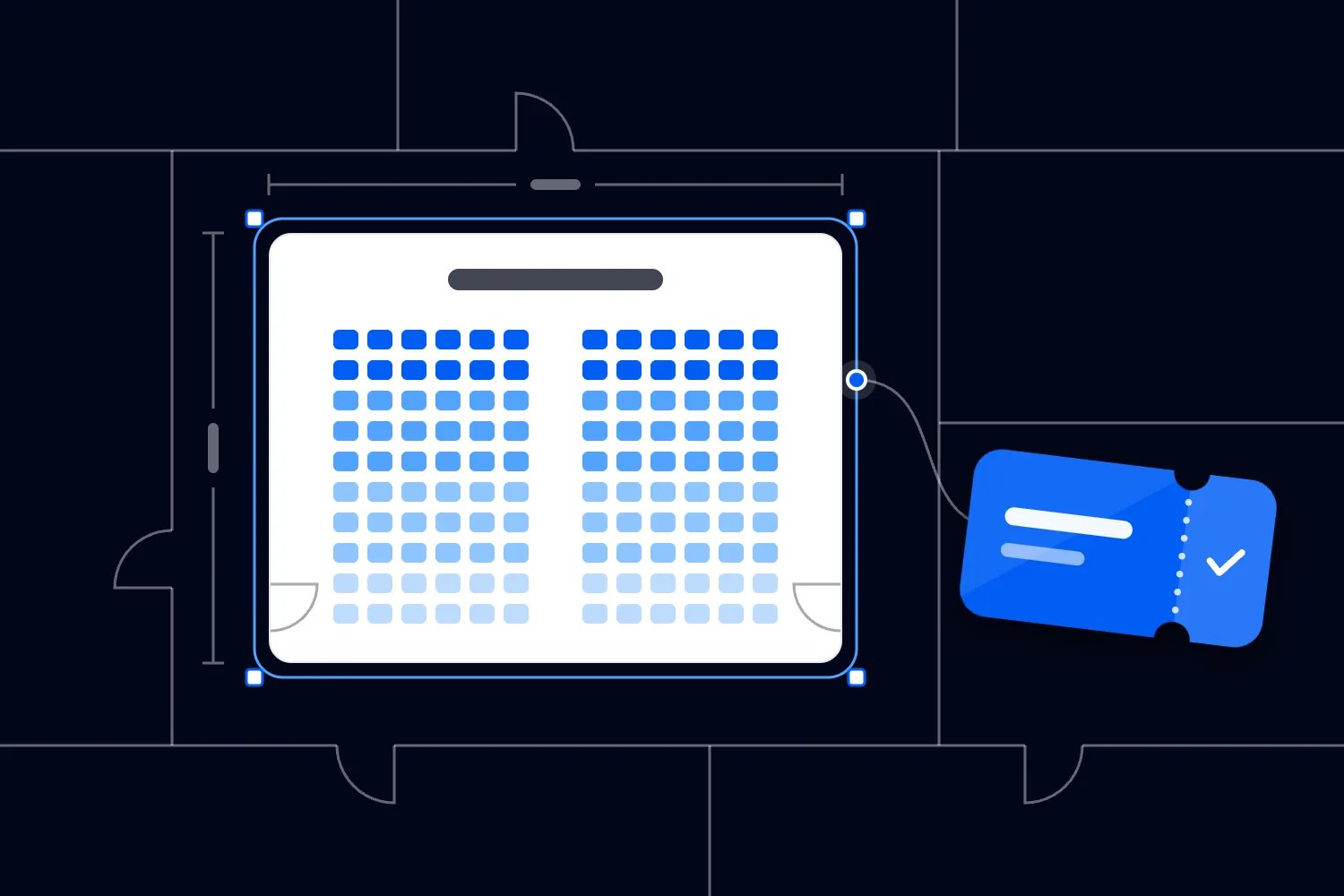
Then turn the approved allocation into what buyers can actually book. With Loopyah's seat charts, you can build a venue layout, price sections and let buyers choose seats. Use the agreed plan as the starting point. Software doesn't approve a building's capacity or replace the venue's safety process.
The UK's HSE guidance on event roles distinguishes organizer and venue responsibilities and says shared control needs clearly assigned duties. That's useful discipline for the agreement wherever you're operating, while the legal duties themselves depend on location.
Cancellation needs a calculation and a payment date
Get the venue to work through a cancellation using your numbers. What does the percentage apply to? Does it include the booking payment? Are taxes and supplier commitments inside it? When does any refund arrive?
Actual hire terms vary. Cheltenham Borough Council's park hire conditions link some organizer cancellation refunds to the land being hired again. That is one specific venue arrangement, not a general rule. Read your venue's wording rather than assuming you'll get money back when it finds another booking.
Also distinguish a negotiated charge from an enforceable one. Australia's ACCC guidance on business contracts explains that unfair-term protections can cover eligible small businesses using standard form contracts. Business bookings don't have one universal cancellation rule, and consumer advice for weddings isn't a substitute for reviewing your commercial agreement.
For disruption outside either party's control, writing "force majeure applies" leaves too much open. The International Chamber of Commerce's force majeure and hardship guidance provides models and drafting notes, but your agreement still needs an event-specific decision deadline and treatment of prepaid money. A workshop next weekend can't wait months for the parties to decide what happens.
A completed example with the money worked through
Let's put a fictional paid workshop into the template. All amounts below are USD. The tax rate, prices, timing and cancellation terms are illustrative assumptions for arithmetic, not a jurisdiction's rules or a claim about normal venue pricing.
The organizer books a main workshop room and foyer for 7 am to 7 pm. Its approved layout permits the agreed 120 ticket-holder places plus 10 separately accounted-for staff and speakers, within the applicable occupancy limit. The hire includes tables, chairs, heating, basic power and the duty manager. A named outside caterer is approved, with no commission or minimum spend.
The completed charge schedule reads:
Room hire: $4,000.
Audiovisual equipment and operator for the agreed hours: $600.
Security for the agreed hours: $400.
End-of-event cleaning: $250.
Subtotal: $5,250.
Illustrative tax at 10% on that subtotal: $525.
Total venue price: $5,775.
Separate refundable damage bond: $750.
The headline room fee is $4,000, but the venue costs $5,775 under this example. You'll also need to fund the $750 bond, making total cash paid before the event $6,525. Don't add the booking payment again. It's part of the price.
| Label | USD |
|---|---|
| Headline room fee | 4000 |
| Total venue price including tax | 5775 |
| Cash paid including refundable bond | 6525 |
The chart compares three different amounts, not three costs to add together. The $750 bond is expected back if no valid deduction applies. Keep it in your event cash flow forecast, while your event budget records the actual expense and your accountant handles any recoverable tax appropriately.
Completed payment and change terms
"The Organizer will pay $1,500 on confirmation, credited against the $5,775 total venue price. The remaining $4,275 is due 14 calendar days before the event. The separate $750 damage bond is due seven calendar days before the event. The Venue will return its undisputed balance within ten business days after the event."
"Additional hire time requires written approval from both event leads and costs $165 per started hour, including the illustrative tax. No extension may breach the venue's operating restrictions. No additional catering, equipment or staffing expenditure is authorized without the Organizer's written approval."
Notice what the payment schedule does. The organizer must have paid $5,775 two weeks before doors open, whether every ticket has sold or not. The later bond adds another cash requirement. Put those dates beside confirmed cash receipts before signing.
Completed cancellation and settlement terms
The following cancellation schedule is invented for the calculation. Have a local lawyer assess the amounts and conditions you intend to use before putting them in a real agreement.
"If the Organizer cancels at least 61 calendar days before the event, the cancellation amount is $1,000. If cancellation occurs 31 to 60 calendar days before the event, it is $2,000. If cancellation occurs 30 calendar days or fewer before the event, it is $4,000. These amounts apply to the room hire only and include any applicable cancellation-related tax for this example. Booking payments count toward the amount due."
"No supplier commitment is chargeable unless separately approved as unrecoverable in writing. Any such charge requires evidence and must not duplicate the room cancellation amount. Net replacement room-hire receipts for the same date and hours reduce that amount, after documented reasonable additional costs of arranging that booking, to a minimum of zero. The Venue will reasonably seek a replacement booking."
"The Venue will issue the initial settlement within five business days after notice, with payment due within ten business days after that settlement. Any later replacement-booking credit will be reported and refunded within ten business days after the original event date. The damage bond is settled separately."
Now assume the organizer cancels 45 days before the event. Only the $1,500 booking payment has been made. The applicable room cancellation amount is $2,000, and one separately approved, evidenced supplier commitment costs $300. There is no replacement booking yet.
The initial amount due is $2,300 less the $1,500 already paid. The organizer pays another $800. The total cancellation cost is $2,300, not $3,800. No damage bond was paid, so there is no bond refund to count.
Later, assume the venue receives $1,400 of replacement room-hire revenue for those hours and incurs $200 of evidenced additional costs to arrange that booking. The $1,200 net credit reduces the room cancellation amount to $800. Add the separate $300 supplier cost and the final cancellation cost becomes $1,100. Because the organizer has now paid $2,300, the venue refunds $1,200 under the agreed deadline.
Your buyer refunds are a separate obligation. Don't promise ticket holders that their money will arrive when the venue repays you. Review your event refund policy and available cash against the commitments you've made to buyers.
Before you sign
Send the completed agreement to the people who have to deliver it. Your production lead should check access and technical requirements. Whoever runs ticketing should check the approved allocation. Your finance lead should check payment dates, variable charges and cancellation arithmetic. Get local legal review of the provisions that allocate risk.
Then resolve every blank, attach the agreed versions and save the signed pack where the event team can find it. Put payment dates, approval deadlines and access times into the working plan.
You should be able to answer four practical questions from the final document: what can we use, when can we use it, what will it cost and what happens if something changes? If the answer still depends on a conversation nobody recorded, finish that part before you commit the money.

Author: By the Loopyah Content Team
The Loopyah Content Team shares expert insights, practical guides, and industry updates to help event organizers create unforgettable experiences and stay ahead in the event planning world.