· 12 min read
How much does it cost to sponsor an event?

Event sponsorship costs depend on the audience and what the sponsor gets. For a concrete starting point, DjangoCon US lists 2026 packages from USD 2,300 for Bronze to USD 20,000 for Diamond. That's the package fee. A sponsor may also need money for staff, travel, displays and follow-up, depending on the offer.
If you run paid events, this is the question sitting behind every sponsorship conversation. A brand wants to know what it will spend and whether the opportunity deserves that money. You want sponsorship revenue that helps your event make a profit. Both sides need a clear account of what's included.
Let's look at published prices, build the full sponsor budget, and work out how to assess an offer without pretending there's a standard price for every event.
What real event sponsorship packages cost
These are conference sponsorship offers checked on 7 October 2026, quoted in their original currencies. Tax treatment differs, and the packages buy different access. Use them to check what a fee includes, not to calculate an average sponsorship price. They are advertised offers, not evidence of completed deals or sponsor returns. Some packages may already be unavailable.
DjangoCon US 2026
The DjangoCon US prospectus lists Bronze at USD 2,300, Silver at USD 3,500, Gold at USD 6,000, Platinum at USD 10,000 and Diamond at USD 20,000. Bronze includes a sponsor ticket, a website listing and an insert that the sponsor supplies for attendee bags.
Gold includes four sponsor tickets and an exhibit table, subject to space. The table is not included at Bronze or Silver. The page specifies USD but does not state whether the package prices include taxes.
So the cheaper package won't work for a buyer whose main plan is to run demonstrations at a dedicated table. Start with the activity the sponsor wants to run, then check which package permits it.
PyConES 2026
PyConES publishes a Bronze price of EUR 1,000, Silver at EUR 3,000, Gold at EUR 6,000 and Platinum at EUR 8,000. VAT is excluded. Bronze has a ticket, a small website logo and a social post, but no booth. A small booth starts at Gold.
Its booth information says tables, chairs and power outlets are provided. That matters when comparing an offer with one that only gives a sponsor an empty patch of floor. Gold and Platinum showed no remaining availability when checked, so these are reference prices, not an invitation to book those tiers.
Festival of Business Analysis 2026
The Australian festival prospectus lists State Bronze at AUD 1,500 in Brisbane, Adelaide and Perth, and AUD 2,500 in Sydney and Melbourne. Prices include GST. Bronze includes a registration at the selected event, including the online programme, and specified branding placements.
Its national package costs AUD 9,900 including GST and covers Australian and online events, with eight in-person registrations and eight online registrations. A local package and a national package buy different coverage. Compare them against where the sponsor actually needs customers or recruits.
These examples are ticketed professional conferences. They help you read a sponsorship offer, but they don't establish prices for a music festival, comedy series or food event. The useful comparison is the audience, access and work involved. A Bronze label tells you very little by itself.
Separate the package fee from the full budget
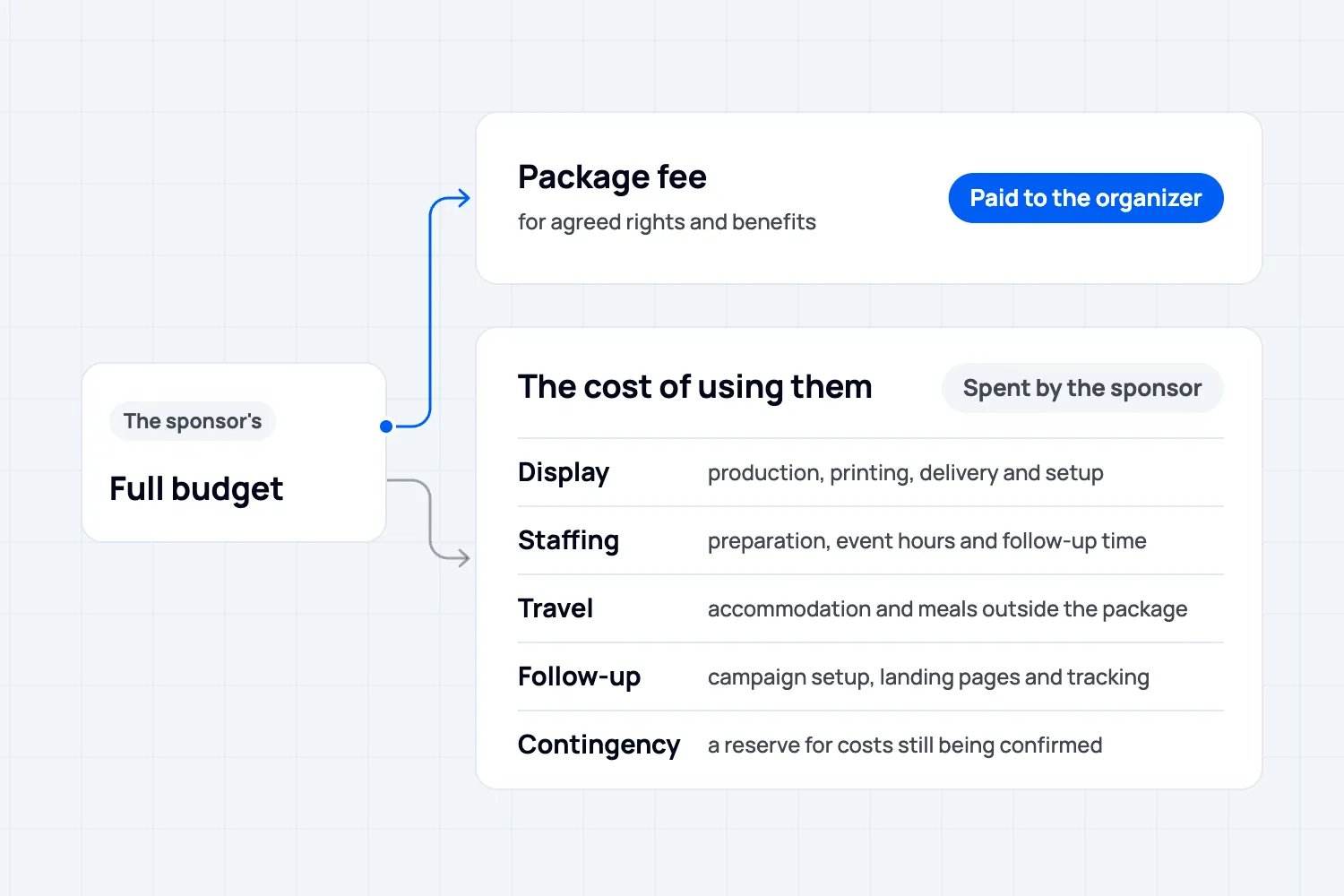
The package fee pays the organizer for agreed rights and benefits. These might include naming rights, a display area, a sponsored session or promotion through the event's channels.
The sponsor then needs to use those benefits. In sponsorship, this is often called activation. In plain terms, it's the work that makes the sponsorship happen, such as building a display, sending staff or making the samples people will try.
Before treating a quoted fee as the full cost, check these items:
Display production, printing, delivery, setup and removal.
Staff preparation, event hours and follow-up time.
Travel, accommodation and meals outside the package.
Samples, demonstrations, prizes or other items supplied by the sponsor.
Venue services, such as extra power, furniture or internet access.
Creative work, landing pages and tracking for the campaign.
Taxes, payment charges and a reserve for costs still being confirmed.
Don't add a cost twice. A package may cover furniture or passes already. Equally, a complimentary pass gets a staff member through the door; it doesn't pay their wages or flight.
Ask the organizer to mark each item as included, supplied by the sponsor, or separately quoted. Organizers can put those answers in the offer before a buyer has to ask. It makes your price easier to understand and stops missing costs becoming an argument during setup.
A worked sponsor budget
Here's an illustrative budget in Australian dollars. These are invented planning assumptions, not market rates or a report from a real sponsor. Taxes are left out of the example and would need to be added where applicable.
Sponsorship package fee: AUD 5,000.
Display, printing and delivery: AUD 1,800.
Staff time for preparation and attendance: AUD 1,600.
Travel and accommodation: AUD 1,100.
Campaign setup and follow-up work: AUD 500.
Reserve for unconfirmed costs: AUD 1,000.
The total planned budget is AUD 11,000. Only AUD 5,000 goes to the organizer as the package fee.
That difference explains why a sponsor can like your offer and still struggle to afford it. A discount on the fee may be less useful than a package they can deliver with their existing team and equipment. A local business may value a staffed demonstration, while a distant brand may prefer an offer that doesn't require travel.
For the sponsor, separate cash payments from the value of employee time already covered by payroll. Both belong in the decision, but they affect the cash budget differently. Check when invoices fall due, too. A package payable now and travel paid later still need funding before any sales arrive.
For the organizer, ask about the buyer's total available budget early. If they give you a figure, establish whether it includes the event fee, production and staff. That saves both sides from building a proposal the buyer cannot use.
What makes a sponsorship worth a higher fee?
A bigger audience can support a higher price, but attendance alone doesn't establish value. The sponsor needs people who are relevant to its business and a practical way to reach them.
The audience matches the buyer
A regional service business needs people it can serve. A company recruiting specialists needs the right skills in the room. A consumer brand might care about product trials and repeat purchases.
Give sponsors the audience information you can support. Separate previous attendance from this year's forecast, ticket buyers from checked-in attendees, and social followers from people who saw a particular post. Don't add those figures together and call the total unique people reached.
If you're running a first edition, use current bookings and a clearly labelled forecast. Agree how you'll report actual attendance afterward. A sponsor can assess an honest forecast; it can't assess a figure that mixes confirmed buyers with people you hope will attend.
The access supports the sponsor's plan
A logo placement can support recognition. A demonstration area lets a buyer try something. A hosted session gives a sponsor time to explain a topic. Those benefits serve different goals and require different work.
Ask where the display sits, when it opens and whether the programme leaves attendees time to visit. A large event with an empty exhibition area during sessions can be less useful to a sponsor than a smaller event with time set aside for demonstrations.
Our guide to sponsorship goals helps connect the activity to the result the sponsor wants. Make that connection before discussing an upgrade.
The rights are specific
Exclusivity should say what it covers. Does the agreement exclude other beverage sponsors, only energy drinks, or only another sponsor on the main stage? Does it apply for one event date or the full series?
Likewise, write down how many packages can be sold, the number of placements and their duration. A buyer needs to know whether its promotion will appear alone or beside several other sponsors. An organizer needs those limits to avoid promising the same thing twice.
Treat guaranteed delivery and expected results separately. You can commit to placing an approved logo in an agreed position. You can't assume every attendee will notice it or become a customer.
How to decide whether the total cost works
Choose the result before choosing the package. A sales campaign, recruitment campaign and customer hospitality programme need different measures.
For a sales campaign, compare the full cost with the profit expected from additional sales. Sales revenue alone leaves out what the sponsor spends serving those customers. Use the sponsor's own order values and costs, rather than borrowing a conversion rate from an unrelated event.
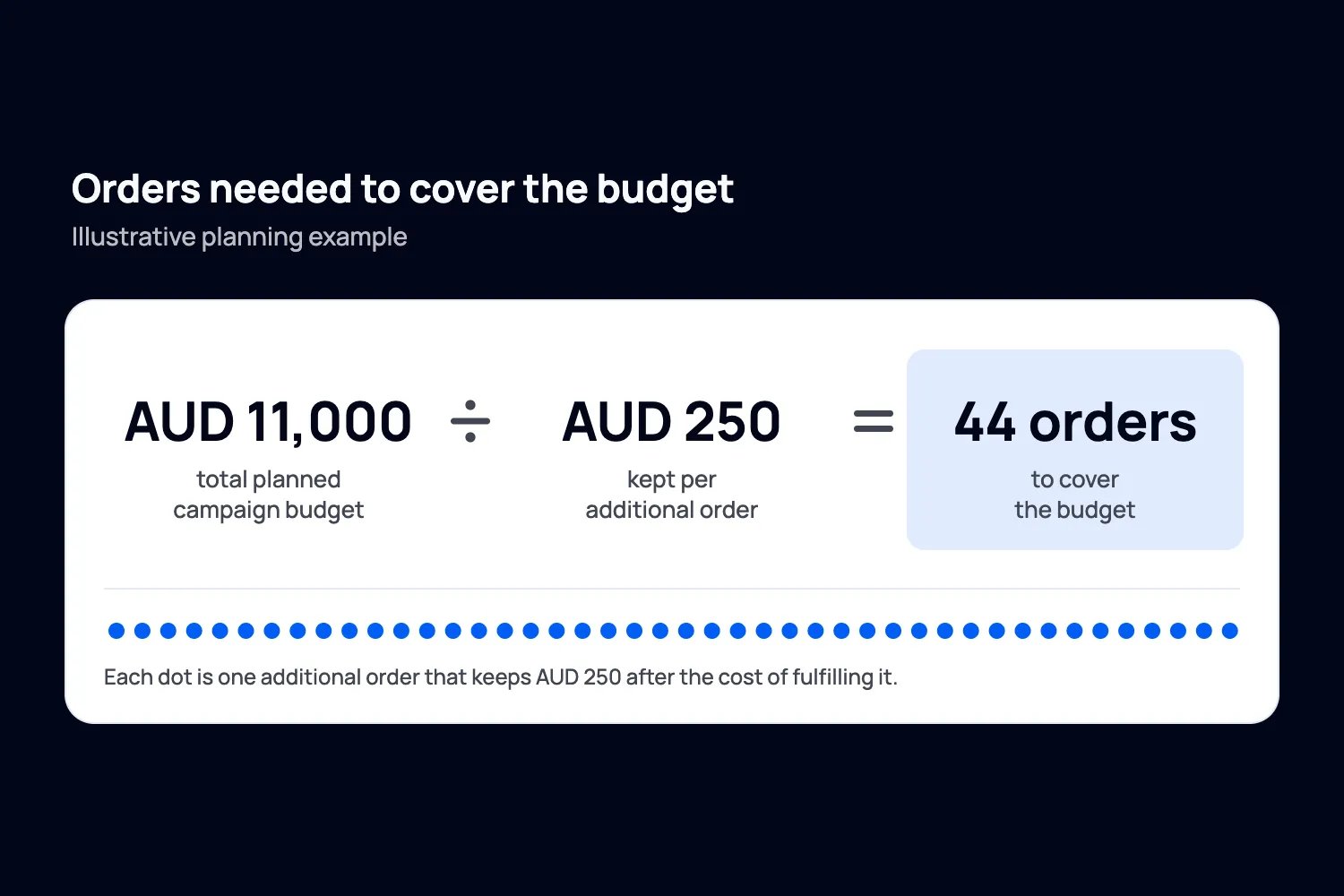
Using our illustrative AUD 11,000 budget, suppose the sponsor keeps AUD 250 from each additional order after the costs of fulfilling that order. It would need 44 additional orders to cover the planned budget. Those 44 orders are the target your forecast needs to support, not a promised result.
The AUD 11,000 includes a reserve and employee time, so it isn't necessarily the cash eventually spent. After the event, replace estimates with actual costs, remove unused reserve and keep the treatment of staff time consistent. State whether you're assessing cash spent or the full cost of the team's work.
Work backwards from those 44 orders. Estimate how many relevant conversations the team can have and how many additional orders those conversations could produce within an agreed period. Use the sponsor's own sales history where it has comparable evidence.
If that forecast supports only ten additional orders, they would contribute AUD 2,500 against the AUD 11,000 planned budget. Reduce the cost, choose another opportunity or assess the sponsorship against a different objective agreed in advance. Calling it an awareness campaign after the sales target fails doesn't make the original decision work.
For recruitment, agree what a useful candidate conversation means. For hospitality, identify the customers the sponsor wants to invite and what the visit should achieve. A badge scan or business card is a contact, not automatically a qualified sales opportunity.
Decide who collects the information and when the sponsor will review it. The organizer can report delivery and attendance. The sponsor usually needs to track its own meetings, sales and follow-up results. Agree how contacts opt in before promising attendee details.
What the fee leaves for the organizer
The sponsor's full budget tells you whether it can participate. Your delivery costs tell you whether selling the package helps your event.
Use the amount you keep after applicable taxes and payment charges, then deduct the extra costs of serving that sponsor. Include production, supplier charges, hospitality, staff time and reporting. If a sponsor asks for custom content, someone has to make and approve it.
Here's a separate hypothetical organizer calculation in Australian dollars. You retain AUD 5,000 after taxes and payment charges. Production and suppliers cost AUD 1,200, while staff time and reporting cost AUD 800. That leaves AUD 3,000 toward the event's other costs and profit. If the sponsor adds a video that costs AUD 900 to make, the amount falls to AUD 2,100 unless you charge for it or remove another benefit.
Use that calculation in negotiations. A lower-priced package with fewer deliverables can work better for both sides than a discount that leaves all the original work in place.
Also consider what you give up. Sponsor passes can displace ticket sales when an event is likely to sell out. Broad exclusivity can stop you selling another suitable partnership. Those consequences belong in the decision even if no supplier sends you an invoice for them.
Keep these costs in your event budget. A sponsorship deal should leave money to support the event after you fulfil it. If it doesn't, reduce the work included, change the offer or walk away. More sponsorship revenue is little help when the extra work consumes it.
For ways to group the actual benefits, use our package guide. The budget here answers a different question: what will each side spend, and what must each side get back?
Put the full offer where the buyer can review it
Before asking a sponsor to commit, give them the fee, currency, tax treatment, inclusions, exclusions and payment dates together. Add asset deadlines and the person responsible for each delivery. Make the cancellation and postponement terms easy to find.
The Festival of Business Analysis terms, for example, expressly say associated participation costs fall to the sponsor unless otherwise agreed in writing. Read those terms alongside the benefit list. A prospectus can promise useful access while still leaving the buyer responsible for the practical costs of using it.
Once you've agreed the offer, Loopyah's sponsorship tools let you set package prices, perks and quantities on a private page. You can require approval before payment, then collect sponsor logos and activation notes after they pay. You still decide what to charge and deliver; the offer and its administration stay connected.
The right sponsorship budget covers the package and the work needed to use it. The right fee gives the sponsor a credible opportunity and leaves the organizer money after delivery. Start with published offers for context, then make the decision using your own audience, costs and agreed benefits.

Author: By the Loopyah Content Team
The Loopyah Content Team shares expert insights, practical guides, and industry updates to help event organizers create unforgettable experiences and stay ahead in the event planning world.