· 21 min read
Food truck rental costs: how to compare event quotes
Food truck rental costs depend on what you're buying: a prepaid meal service, a truck selling directly to guests, or a booking with a minimum sales guarantee. Compare the complete cost for the same menu, number of meals, service window and site conditions, then check what you owe if attendance falls short.
That's the useful answer to "how much does a food truck cost?" A headline price on its own won't tell you whether your event can afford the booking. One quote may include staff, travel and packaging. Another may look cheaper because those costs arrive later.
So you've got a paid event, a hungry audience and a few food truck quotes in your inbox. You want good food without a queue that eats the programme or a bill that eats your profit. The first thing you want to do is get clear on who pays for the food. Everything else follows from that decision.
This guide walks you through the booking models, a worked quote comparison, demand and service checks, and the terms to agree before paying a deposit. The calculations use invented planning figures in US dollars. They're examples of how to compare quotes, not local prices or industry averages. Replace them with written offers for your event.
Decide who pays before you ask for prices
At a ticketed event, food can be included in admission, sold separately or partly funded by you. Those arrangements have different costs and different promises to buyers. Don't send suppliers a vague request for "a truck for 500 people" and expect comparable answers.
If a meal is included in admission, you buy food for the agreed number of people. The supplier might quote a price per meal, a package for a fixed count or a minimum catering charge. Ask what one meal contains, which menu choices it allows and whether a drink is included. A tasting portion and a full lunch are different purchases.
A prepaid booking gives you more control over what guests receive. It also puts the food bill in your event budget. You can owe for the agreed count even when some ticket holders don't arrive. That's a reason to negotiate the final count deadline, not a reason to promise everyone lunch and hope you ordered enough.
If guests pay the truck themselves, the vendor takes customer payments and carries the food sales risk unless you've agreed otherwise. You might charge a pitch fee, collect a share of sales, pay an attendance fee or provide the site without charge. Put the arrangement in writing. A guest-paid truck isn't automatically free to the organizer.
A minimum sales guarantee changes that arrangement again. You promise an agreed level of qualifying sales and pay a shortfall if sales don't reach it. This can help a supplier justify committing staff and stock to your event. It also creates a bill that gets bigger when the audience spends less.
Suppose a truck has a $1,500 sales guarantee and makes $1,100 in qualifying sales. Under a shortfall-only agreement, you owe $400. You don't pay $1,500 on top of the $1,100. Some suppliers use "minimum" to mean a prepaid catering minimum instead. Ask which meaning applies before comparing anything.
You can also fund part of the meal. A ticket might include a defined food voucher while the guest pays for extras. Agree which items the voucher covers, whether it has cash value, how the truck records redemptions and who pays for unused vouchers. Keep voucher reimbursements separate from public food sales so nobody counts the same meal twice.
Choose the model that matches your admission offer. Our guide to running a paid food festival covers the wider decision about what admission includes. Here, the job is narrower: know exactly which food costs belong to you.
Send every truck the same booking brief
Quotes become useful when suppliers price the same job. Write one brief and send it to every truck you're considering. A supplier can propose a better service plan, but ask them to price the original scope as well so you can see what changed.
Start with the event date, address and format. Describe the audience and what they are coming for. A paid conference lunch during a short break needs a different service plan from a music festival where people browse food throughout the afternoon. Give the supplier the meal period, rather than just the event's opening hours.
Separate total attendance from the number of meals you're buying or forecasting. Include staff, artists, speakers and complimentary guests if they need food. If they're using separate meal vouchers, say so. The person preparing the quote shouldn't have to guess whether your 400 ticket buyers become 450 meals once the crew eats.
Give the proposed menu scope and portion. Say whether you want one main, a main with sides, several tastings or drinks and dessert as separate purchases. Describe dietary requirements you know about and ask what the truck can safely provide. Leave room for the supplier to explain limits before you advertise an option.
The site details deserve their own paragraph. Include vehicle access, parking surface, available space, load-in restrictions, the serving side of the truck and the proposed location. Ask for the vehicle's dimensions and any additional operating space. A truck that fits through the gate can still be impossible to serve from in the pitch you've allocated.
Explain what power and water the venue can actually supply. "Power available" is a start, but the supplier needs the connection type, capacity and location. If you don't know those details, get the venue and supplier to speak before the quote is final. Don't become the person relaying guesses about electrical equipment.
Then request an itemised total and a list of exclusions. Ask the supplier to identify taxes, service charges, travel, staffing, equipment, packaging, waste handling and overtime. Ask who supplies each item, which amounts are fixed and which depend on usage. A total with unexplained exclusions is an unfinished quote.
Finish with the booking deadlines. When does the offer expire? What payment reserves the truck? When is the final count due? How late can you change it, and what does each additional meal cost? These dates need to work with your ticket sales plan. If they don't, resolve that gap before you accept the offer.
Work out the complete food truck cost
For a prepaid meal booking, start with the agreed meal charge. Add every compulsory charge and every site cost you must supply separately. Subtract only confirmed credits. Keep optional upgrades outside that total until you've decided to buy them.
The calculation is straightforward: meal or package charge, plus supplier extras, plus organizer-provided services, plus applicable taxes and mandatory charges. That is the amount you're comparing. A discount on food won't mean much if the discounted quote adds travel and equipment that the other supplier includes.
For a guest-paid booking with a sales guarantee, calculate the organizer's cost separately. Add any fixed booking or site costs to the shortfall you could owe. The vendor's total customer sales aren't your revenue unless your contract gives you an agreed share. They also aren't a cost you pay again.
If you receive commission, define the amount it applies to. Is it calculated before or after sales tax, refunds, discounts and voucher reimbursements? Does commission reduce the sales figure used for the guarantee? These aren't accounting details to leave until settlement. They decide how much money changes hands.
Travel is one obvious source of variation. A distant truck may charge for mileage, tolls, accommodation or a longer working day. A nearby supplier might avoid some of those costs. Check whether the quoted travel covers both arrival and departure, and whether an early load-in changes staffing hours.
Service length also matters. A truck operating across the full event may need different staffing and stock from one serving a fixed lunch break. Ask when paid service time begins and ends. If your programme runs late, does the truck extend service automatically, require approval or leave at the contracted time?
Packaging and clearing often disappear between quotes. One truck supplies disposable containers and cutlery. Another assumes you will provide them. Neither may clear guest tables or remove event-wide waste. Allocate those jobs once, cost them once and check that somebody has accepted them.
You also need to distinguish a service charge from a tip. Ask whether each is compulsory, what it covers and whether it is already included in the total. The same applies to taxes. Have the supplier identify which charges apply to your booking instead of adding a guessed percentage from another event.
Before requesting quotes, decide whether the truck is feeding the whole audience or adding an optional purchase. For example, a film screening may need a compact snack menu that operates before doors and during arrival. A full day conference may need an included lunch with a firm collection period. The same truck could price those jobs differently because the preparation, staffing and demand are different.
If you want food to help sell admission, make the benefit specific. Tell buyers what they receive and when. A named meal or defined voucher is easier to understand than a promise of catering. If food is separate, say that plainly on the event page so someone buying admission doesn't assume dinner is covered.
Ask suppliers for practical alternatives when the original brief is too expensive. You might reduce the number of menu choices, remove an included drink, shorten an unnecessary service period or choose a different portion. Check whether each change reduces the bill. Cutting guests below a catering minimum may leave the invoice unchanged.
Don't negotiate by asking the supplier to absorb undefined risk. Show the scope you can afford and ask what they can deliver within it. A truck agreeing to a lower food price while removing staff could leave you with a slower service that harms the event. Find out what changed before celebrating the saving.
Copy this request and fill in the details: "Please quote for [event name], on [date], at [full address], for [meal count] meals served between [start time] and [finish time]. We need [menu and portion], with [confirmed dietary requirements]. The venue provides [power, water and access details]. Please give the complete price, including travel, staffing, packaging, equipment, taxes and mandatory charges. List every exclusion and its cost, the deposit, final count deadline, additional meal price and cancellation terms."
Compare two quotes for the same 200 meals
Here's a hypothetical prepaid lunch for 200 people. Both trucks must provide the same agreed meal, the same service window, the same dietary scope and the same usable service arrangement. The example assumes each has confirmed it can deliver that scope. Every figure below is illustrative.
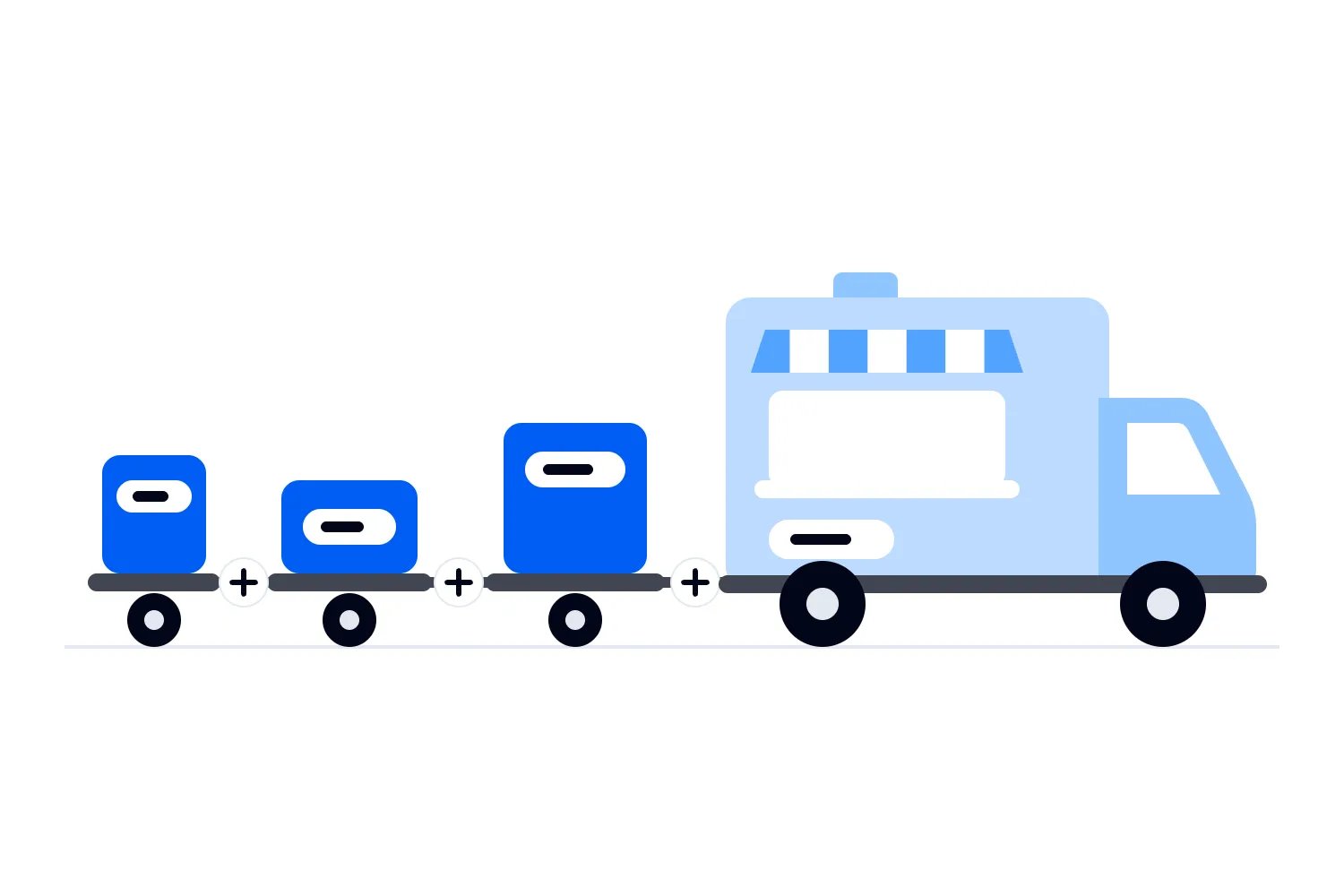
Truck A charges $14 per meal. That gives you $2,800 for food. Its quote then adds $250 travel, $350 staffing and $100 packaging. Your venue arrangements require another $200 for power. The complete cost is $3,700, or $18.50 per booked meal.
Truck B charges $16 per meal, so its food line is $3,200. Travel, staffing and packaging are included. You still need $200 for power, making the complete cost $3,400, or $17 per booked meal. For simplicity, both fictional offers include applicable taxes and mandatory service charges in those figures.
Truck A looks $400 cheaper when you compare food alone. It becomes $300 more expensive once you've priced the whole booking. Nothing clever happened. You just stopped comparing one line of a quote with another supplier's complete offer.
The cheaper complete offer isn't automatically the better booking. First check that both suppliers meet the required menu, capacity, access and dietary conditions. If Truck B can't serve the agreed lunch break, its $3,400 quote doesn't solve your problem. Ask for a workable revised offer before ranking it on price.
Now test the attendance risk. Suppose you commit to 200 meals but only 160 people collect them. If the contract still requires payment for 200, Truck B costs $21.25 per meal actually served. That calculation doesn't change the agreed invoice. It tells you what the unused commitment did to your event economics.
Don't use that number to blame the supplier for your no-shows. Use it to decide whether next time you need a later count deadline, preorder choices, smaller initial commitment or a different food promise. You can reduce waste without quietly moving the risk onto a truck that has already bought ingredients.
Test a sales guarantee against a quieter event
For guest-paid food, a supplier wants enough trade to make the date worthwhile. You want food available without committing to a bill your ticket income can't support. A sales guarantee can bridge that gap, but only if you've tested an ordinary day and a disappointing one.
Use the agreed formula. In a shortfall-only model, the top-up is the guarantee minus qualifying sales when sales are below the guarantee. When sales meet or exceed it, the top-up is zero. Add any fixed organizer costs separately. Don't assume the guarantee includes pitch services or an attendance fee.
Take a hypothetical $1,500 guarantee and an average qualifying sale of $15. At 60 buying guests, the truck records $900 and you owe a $600 top-up. At 80 buying guests, sales reach $1,200 and the top-up falls to $300. At 100 buying guests, sales reach the guarantee and the top-up is zero.
At 120 buying guests, sales reach $1,800, and the shortfall-only top-up remains zero. These examples assume one qualifying $15 purchase per buying guest and no other deductions. Real orders vary. Use the supplier's approved menu and your agreed definition of sales before treating the model as a budget.
If you also pay $200 for site services, your organizer cost in those scenarios is $800, $500, $200 and $200. That $200 doesn't vanish because the truck sells enough food. It's an independent cost of hosting the service.
Here's where operators get caught. They estimate attendance, then assume every attendee buys from this particular truck. People may eat before arriving, buy from another vendor, choose a snack or leave early. Give the truck an honest demand picture. Inflating it can produce a booking that disappoints both businesses.
Build your forecast in stages. Estimate who will attend during food service, how many will buy food, how purchases may split between vendors and what each purchase might be worth. Use results from a comparable event where you have them. When you don't, make the assumptions visible and test lower demand.
Don't add trucks just because choice looks good on the event page. More vendors divide the same spending unless they attract additional demand you can substantiate. If every vendor has a guarantee, your possible top-ups may grow while each truck's sales fall. Ask whether a smaller, complementary menu mix would serve guests better.
Agree what proves sales at settlement. You might need a till summary with the agreed exclusions, a voucher count and a record of refunds. Set a reporting deadline and a process for disputed amounts. A guarantee without a way to verify it is a bill you're agreeing to calculate later in an argument.
Check whether the truck can feed the peak
The audience count tells you how much food might be needed. The programme tells you how quickly it must be served. A truck can have enough stock for your event and still be the wrong supplier for the break you've scheduled.
Suppose 200 people need lunch during a 45-minute conference break. That's an average of about 4.4 meals handed over per minute across the service window. It isn't a claim that any truck can achieve that rate. It's the demand you're asking the supplier to evaluate against the menu, ordering process and working space.
Ask the truck to explain how it will serve that peak. Will guests order individually? Can they select their meals before arriving? How much preparation happens before the break? Who checks entitlement, handles extras and hands over meals? Those tasks compete for the same small serving window if nobody separates them.
A complicated menu can cost you time as well as money. Ask whether a shorter event menu, agreed portions or preselected choices would make service easier. Don't change the menu after quoting without checking the price and dietary implications. Simplifying one thing can create a different problem elsewhere.
Prepaid guests shouldn't need to complete a full payment transaction for the meal you've already bought. Agree a redemption method the supplier can use reliably. It could be a separate meal voucher or an approved guest list process. Test duplicates, missing vouchers and guests asking for extras before the public queue exists.
Plan ordering and collection as different activities where the layout allows. Keep the menu readable before guests reach the window. Give people a place to wait that doesn't block the next order, an accessible route or emergency access. The UK's HSE recommends planning crowd controls inside the venue around the activities that draw people and the routes they use.
That guidance is a useful prompt for the site discussion, not a universal layout approval. Have your venue and responsible event team review the actual location. The food truck's serving side, queue, hot equipment and service access need to work together. A neat drawing doesn't make a cramped pitch workable.
If the supplier can't explain a credible service plan for your peak, change the plan before booking. You might extend the break, stagger meal collection, arrange a simpler menu or add a confirmed service point. Price that revised scope. Don't buy two hours of theoretical availability when everyone needs lunch in the same few minutes.
Price the site and permissions before confirming
A food truck arrives with a kitchen. It doesn't arrive with permission to operate anywhere you park it. Ask the venue and the relevant authorities what applies to the exact event, site and food service model. Then identify who arranges each requirement and who pays.
In the US, the FDA's Food Code is a model used by regulators to develop food safety rules. It isn't a single national permit for your truck. Ask the local health authority which rules and approvals apply rather than assuming a permit from another location covers the booking.
New York City illustrates why the detail matters. Its temporary food service permit guidance distinguishes existing restaurant and mobile food vending permits from the temporary permit route. It also places conditions on where a mobile unit can operate. That's a New York City example, not a rule for other cities.
Request the supplier documents your venue and authorities require, with enough time to resolve missing items. Check names, dates and whether the documents cover the booked business and unit. Ask your venue about insurance evidence and any required cover. Don't prescribe one universal insurance limit across different events.
Fire arrangements also affect the usable pitch. NFPA's food truck safety fact sheet addresses permits, fuel systems and cooking operations. Use it to inform questions for the supplier and local fire authority. Have the responsible authority confirm the requirements for your site instead of copying a clearance measurement into every event plan.
For power, get competent people involved. HSE's UK event electrical safety guidance covers power requirements, generators, weather exposure and cable routing. Ask who supplies and installs the equipment, how it is protected and who handles a fault. Budget for the agreed setup before accepting the food quote.
Water and waste need equally clear owners. Confirm potable water, handwashing arrangements, wastewater handling, rubbish collection and what the truck removes. Ask what the venue permits, particularly on surfaces that could be damaged. A disposal charge you discover after the booking still comes out of your event.
Make the dietary promise the supplier can deliver
Guests read "food available" and "meal included" differently. They also need to know whether the available menu works for them. Publish the confirmed offer, including how they should raise dietary or allergy questions, before those questions turn into a problem at the serving window.
Ask the truck for dish-specific ingredient and allergen information and its process for handling requests. Who answers the guest? Can the team provide a separately handled meal? Which requests can't it accommodate? Obtain the answer from the supplier rather than deciding a menu symbol means more than it does.
The Food Standards Agency's allergen guidance for food businesses, applying to England, Northern Ireland and Wales, recommends written information supported by a conversation for non-prepacked food. It also explains why a vegan claim doesn't automatically mean a meal is free from animal-based allergens. Keep those distinctions in your guest information.
If you collect requirements in advance, tell guests what the request process can and cannot confirm. Pass necessary information to the supplier through an agreed, appropriately restricted process. A submitted request isn't a supplier's acceptance. Close that loop before selling an included meal as suitable for someone.
You can send confirmed food arrangements to ticket holders through Loopyah's attendee email tools. We support audience selection and scheduled emails, so you can tell the relevant buyers where service is, when it runs and what their ticket includes. The supplier still has to confirm the menu and safe handling. An email makes that information easier to reach; it doesn't replace the food service plan.
Agree the bill when something changes
Your contract needs to explain what happens when sales disappoint, timing slips or the event can't go ahead. Work through the actual situations while you still have a choice. "We'll sort it out" feels friendly until both businesses have already spent money.
For prepaid meals, agree the count deadline, the smallest billable count, permitted reductions and the price of additions. Ask whether extra meals can be supplied at all. For guest-paid food, agree the guarantee, qualifying sales and every fixed charge. Record any pitch fee or commission in the same document so the arrangements don't contradict each other.
Set the service window and overtime approval. Name the person who can authorize additional spending on the day. If you want staff to stay because your headline act starts late, they need a price and a decision maker. Your team also needs to know when extending food service would be unaffordable.
Cancellation and rescheduling are separate decisions. Ask what is refundable, what is retained, how notice changes the amount and whether a new date requires a new quote. Define what happens if the truck cancels or arrives unable to trade. A replacement promise needs enough detail to be usable.
Treat weather carefully. Agree the decision deadline, who decides whether service can proceed and what happens to committed costs. Don't assume your event insurance pays every supplier bill. Check the actual policy and agreed booking terms before you put an expected reimbursement in the budget.
Our event vendor agreement guide gives you a broader structure for responsibilities and cancellation terms. Use the food truck's specific scope alongside it. The menu, service obligations, price and contingency arrangements should all describe the same booking.
Check how the deposit affects your remaining bill. Ask whether it forms part of the quoted total or is an additional booking charge, and record the remaining balance after paying it. Confirm when that balance is due. If your event team changes suppliers, make sure somebody checks the cancellation bill before treating the original deposit as the full loss. Keep payment evidence with the accepted quote, rather than in a separate inbox. When the supplier sends the final invoice, you should be able to trace the agreed price, approved changes and payments already made without guessing.
Book the quote your event can carry
Put the complete food cost into your event budget before deciding the truck is affordable. For prepaid service, test the committed count against realistic ticket sales. For a guarantee, keep enough cash available to pay the shortfall in your quieter scenario. Supplier payments may be due before all ticket income is available.
After the event, reconcile the agreed scope with the invoice and approved changes. For a guarantee, check qualifying sales before calculating the top-up. Record meals ordered, meals served, waiting problems and any waste. Those results make the next quote request more accurate.
Choose a truck that can deliver the food promise within the complete cost you've approved. Give it a clear brief, compare the same scope and agree the disappointing-day bill before you pay. That's how you turn food truck rental costs into a booking decision your event business can actually use.

Author: By the Loopyah Content Team
The Loopyah Content Team shares expert insights, practical guides, and industry updates to help event organizers create unforgettable experiences and stay ahead in the event planning world.