
Event Staff Guide: How Your Team Should Look for Different Event Sizes
If you want attendees to rave about your event, start with the people wearing the lanyards—not the lights or the stage set. The right event staff structure, tailored to your headcount and complexity, is the quiet engine behind smooth check-ins, on‑time sessions, safe crowds, and memorable interactions with experts. This event staff guide distills industry research and on‑the‑ground best practices into a practical playbook you can scale from intimate workshops to multi‑thousand‑person gatherings.
Below, you’ll learn how to right‑size your team, what roles to prioritize, and how to coordinate them with lightweight processes and mobile‑first tools. Whether you’re running a 75‑person training or a 5,000‑person festival, you’ll walk away with clear staffing models, training tips, and a checklist‑ready structure to put into action.
“Attendees increasingly value meaningful, hands-on interactions and access to expertise over spectacle—so staff for substance, not sizzle.” (Freeman/PCMA trends insights)
Understanding Event Sizes: Headcount + Complexity = Your Staffing Plan
Event size matters—but complexity matters just as much. Use these practical thresholds as your starting point, then adjust for program and venue complexity.
Small: 50–100 attendees. Typically single-track, limited AV, simple registration.
Medium: 100–500 attendees. Multi-track or breakouts, more AV, sponsor areas/exhibits, formal safety roles.
Large: 500+ attendees. Multi‑day, multiple venues or zones, security screening, medical footprint, transport planning.
Complexity multipliers that increase staffing: multiple tracks and room turns, exhibits and sponsorship activations, VIP or security protocols, high outdoor exposure (weather/heat), multi‑venue layouts, and high media/production demands.
For scoping and sequencing your plan, cross‑reference with your existing workflows and budgets. If you’re building your run of show and staffing plan side‑by‑side, this event planning checklist and event budget guide can help you align staffing with timing and cost controls.
Core Event Staff Roles (Map to Risk, Ops, Tech, and Service)
Ground your org chart in a few core domains: on‑site operations, guest services/registration, technology and production, safety and medical, and reporting. For each domain, designate a clear lead and deputies.
Event/Operations Manager: Owns run of show, change control, vendor coordination, and escalation. Keeps decisions visible, time‑boxed, and documented.
Registration and Guest Services Lead: Manages check‑in, badging, help desk, ADA services, wayfinding, lost and found, and attendee communications at doors.
Technical Producer / AV-IT Lead: Oversees stage management, presenters and slide ops, audio/lighting/video, streaming, networking/Wi‑Fi, and backup plans.
Safety and Security Lead: Coordinates crowd management, screening, credentialing, emergency procedures, and liaison with venue security/local authorities.
Medical Lead: Aligns on patient presentation rate (PPR) expectations, first aid posts, roving medics, and EMS integration (especially outdoors/heat‑exposed).
Sustainability and Reporting: Tracks waste, energy, DEI/accessibility, and ROI metrics; feeds post‑event reporting.
These roles align well with recognized professional standards in event operations, risk management, and technology integration, and they scale elegantly as your event grows.
Staffing for Small Events (50–100 Attendees)
Small events run best on lean, cross‑trained crews with standardized workflows, simple comms, and just enough slack to absorb rushes at doors or session transitions.
Suggested team structure
Event Lead (1): Owns the run of show, vendor check‑ins, and escalations.
Registration/Help Desk (2): Badge pick‑up, on‑site ticketing fixes, and attendee questions; one can peel off to support room turns during lulls.
Floor Rover (1): Wayfinding, speaker support, light AV (clicker/mic), and ad‑hoc errands.
AV/IT Support (1): Sets and checks mics, slides, backup laptop, and stream/record if applicable.
If your program is single‑track, the rover can also function as a stagehand and runner. For any outdoor elements, add a part‑time safety marshal to monitor weather and line flow.
Cross‑training that pays off
Create a simple run‑of‑show with owner names beside every task. Cross‑train registration staff to flip rooms, and train the rover on basic speaker support (timers, mic handling). Operate with a small buffer in scheduling so someone can be pulled to a bottleneck for 15 minutes without derailing everything else.
Recommended tools for small teams: a single mobile stack for comms and scheduling. For example, use push‑to‑talk on staff smartphones for quick voice calls, a team scheduling app for shifts/swaps, and a shared checklist template for run‑of‑show and day‑of tasks. This reduces radio clutter and spreadsheet sprawl.
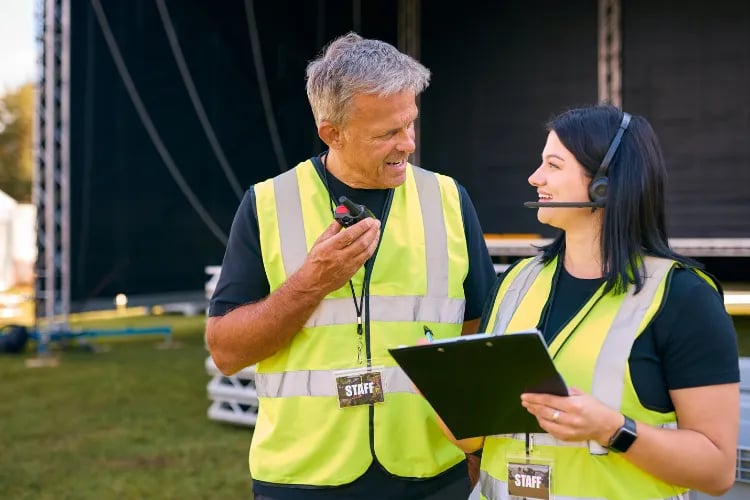
Mini‑case: A 90‑person product workshop. Staff the door with two cross‑trained registration pros, have your rover cue speakers and manage time, and empower your event lead to triage any venue requests. Keep a shared group chat and a one‑page run‑of‑show printed at check‑in and backstage. Result: a calm lobby, on‑time sessions, and high presenter satisfaction.
Staffing for Medium Events (100–500 Attendees)
As you grow into the 100–500 range, you need clearer spans of control, specialization by function, and stronger communication rituals. Think layer leads and visible decision paths.
Suggested team structure
Event/Operations Manager (1) with Deputy (1): Manages run of show; deputy runs backstage/rooms.
Registration Lead (1) with Agents (3–8): Size according to door surge; add a dedicated help desk for reprints, transfers, and VIPs.
Floor Captains (2–4): Each handles a zone (breakouts, expo, lounges), each with a small crew of ushers/room monitors.
Technical Producer (1) + AV Team (2–6): Stage management, room tech checks, mic runners, recording/streaming.
Safety/Crowd Management Lead (1) + Trained Crowd Managers (per code): Assign at least one per 250 occupants across zones.
Communication scales from ad‑hoc chats to lightweight rituals: a morning stand‑up to confirm the plan, a midday 10‑minute sync for adjustments, and a staffed “ops channel” for incident swarms. Use real‑time voice for urgency (push‑to‑talk), and spin up quick huddles for cross‑functional issues (e.g., a room overflow or an A/V hiccup).
Sample sizing: For a 300‑person conference with three concurrent rooms, you might have 1 ops manager + 1 deputy, 1 registration lead + 5 agents, 2 floor captains (each with 2 room monitors), 1 technical producer + 3 AV techs, and at least 2 trained Crowd Managers covering the busiest zones.
Mini‑case: A 350‑person multi‑track summit. Introduce zone captains for breakouts and a dedicated registration lead to keep the lobby flowing. When a keynote runs long, the ops manager starts a quick huddle with the technical producer and floor captains to resequence the next block. Result: the shift is visible to everyone, attendees experience minimal friction, and speakers feel supported.
Staffing for Large Events (500+ Attendees)
At 500+ attendees, adopt an Incident Command System (ICS) style structure so decisions are fast, roles are unambiguous, and partners (venue, security, EMS) have clear liaisons. You are now orchestrating departments, not just roles.
Suggested department structure (scale as needed)
Command: Event Director (Incident Commander), Safety/Security Lead, PIO/Comms (internal + attendee comms), and Liaison to venue/authorities.
Operations: Registration/Guest Services, Floor Operations (zone supervisors and ushers), Technical Production (stages, broadcast), Transport/Shuttles, and Volunteer Management.
Planning: Scheduling, speaker management, maps/wayfinding, risk intel (weather/heat), and scenario planning with law enforcement/EMS.
Logistics: Equipment, vendor docks, food and beverage, signage, and utilities; includes sustainability tracking.
Finance/Admin: Contracting, credentialing tiers, access control lists, and post‑event reporting.
Crowd management: Pre‑assign trained Crowd Managers (≥1 per 250) based on expected occupancy by zone, and ensure they’re visible and on comms. For medical staffing, use expected patient presentation rates (PPR) to size first aid and roving teams, especially for outdoor or high‑heat scenarios. Coordinate security screening and credentialing early with venue partners and local authorities.
Mini‑case: A 5,000‑person outdoor festival. Command sets weather thresholds and heat protocols. Operations staggers entry waves and staffs water refill points. Planning runs continuous weather monitoring. Logistics pre‑positions shade, ice, and extra radios. Security works with law enforcement on gate screening and egress. Result: steady ingress, manageable queues, and quick response to a short storm hold.
Code note: Crowd Manager requirements based on widely adopted life safety codes typically call for one trained Crowd Manager per 250 occupants. Confirm with your AHJ (Authority Having Jurisdiction) and document assignments. Learn more about the requirement via this summary resource. (Crowd Manager requirement overview)
Training and Preparation: Short, Targeted, and Scenario‑Driven
Training multiplies the value of every staffer you field. Require short baseline modules and rehearse realistic scenarios so the team makes good decisions under pressure.
Baseline learning: ICS/NIMS intros (IS‑100/200/700/800), plus crowd management training for those assigned to safety roles.
Venue and security briefings: Map reviews, muster points, shelter locations, access routes, and comms trees for escalation.
Event medicine orientation: When to activate medics, how to describe a patient/location over radio, heat illness cues, and AED locations.
Scenario drills: Simulate a weather hold, a room overflow, a lost child, or a speaker AV failure. Practice the 3‑step flow: detect → decide → communicate.
Hold a full‑team briefing before doors open: walk the site map, review the run of show, confirm comms channels, and answer questions. Then post a one‑page quick‑start guide in registration and the ops hub for fast reference.
Utilizing Technology for Staff Management
Great tech doesn’t have to be complicated. Standardize on a mobile‑first stack that unifies scheduling, tasking, and real‑time communication—and make sure everyone has it installed and tested before show day.
Scheduling and shifts: Use a single app to publish rosters, handle swaps, and log time. Pin your day‑of staffing plan to the top of your ops channel.
Real‑time voice: Push‑to‑talk on staff smartphones for quick escalations without managing a fleet of radios.
Incident “swarms”: Spin up quick huddles with operations, tech, and safety to resolve issues in minutes, not email threads.
Shared workspace: Templates for run‑of‑show, conference agendas, checklists, and vendor dependencies keep everyone aligned.
If you’re comparing platforms for communications, scheduling, and ticketing, explore how Loopyah’s event software pairs with your broader operations stack, from email outreach to on‑site scanning and seat maps.
For broader tooling across promotion and team coordination, these guides can help you assemble your stack: Event marketing tools, plus planning resources like the event planning checklist to align staffing against your timeline.
Putting It All Together: Sample Staffing Blueprints
Use these quick models as a starting point and adjust for your venue, program, and risk profile.
Small workshop (75 attendees, single track, indoor)
Event Lead (1), Registration (2), Floor Rover (1), AV/IT (1). Cross‑train registration to help with room turns.
PTT voice + shared run‑of‑show + one‑page speaker AV guidelines.
Multi‑track conference (350 attendees, 3 rooms, indoor)
Ops Manager (1) + Deputy (1), Registration Lead (1) + Agents (5), Floor Captains (2) + Room Monitors (4), Technical Producer (1) + AV (3), Crowd Managers (2).
Morning stand‑up; midday sync; incident huddles for changes; staffed ops channel.
Outdoor festival (5,000 attendees, two stages)
ICS structure with Command + Ops/Planning/Logistics/Admin. Zone Supervisors, Stage Managers, Security leads, Medical Supervisor + first aid posts + roving teams.
Crowd Managers (≥1/250) allocated to entry gates, stages, high‑density zones. Heat plan with shade/water, cooling kits, and public messaging.
Tip: For all sizes, publish a simple “who to call for what” directory with names, roles, and radio/channel conventions. It prevents cross‑talk and speeds resolution.
Conclusion: Build Teams That Create Outcomes
Right‑sized staffing starts with honest scoping of size and complexity, then mapping clear roles and spans of control. Reinforce those roles with mobile‑first coordination, short targeted training, and a culture of fast, visible decisions. Most of all, staff for the moments that matter—expert access, learning, and connection—and your attendee satisfaction and retention will follow.
Ready to put this Event Staff Guide into action? Use the checklist to tailor your roster, brief your team, and open doors with confidence.
Launch Your Next Event
Author: By the Loopyah Content Team
The Loopyah Content Team shares expert insights, practical guides, and industry updates to help event organizers create unforgettable experiences and stay ahead in the event planning world.